





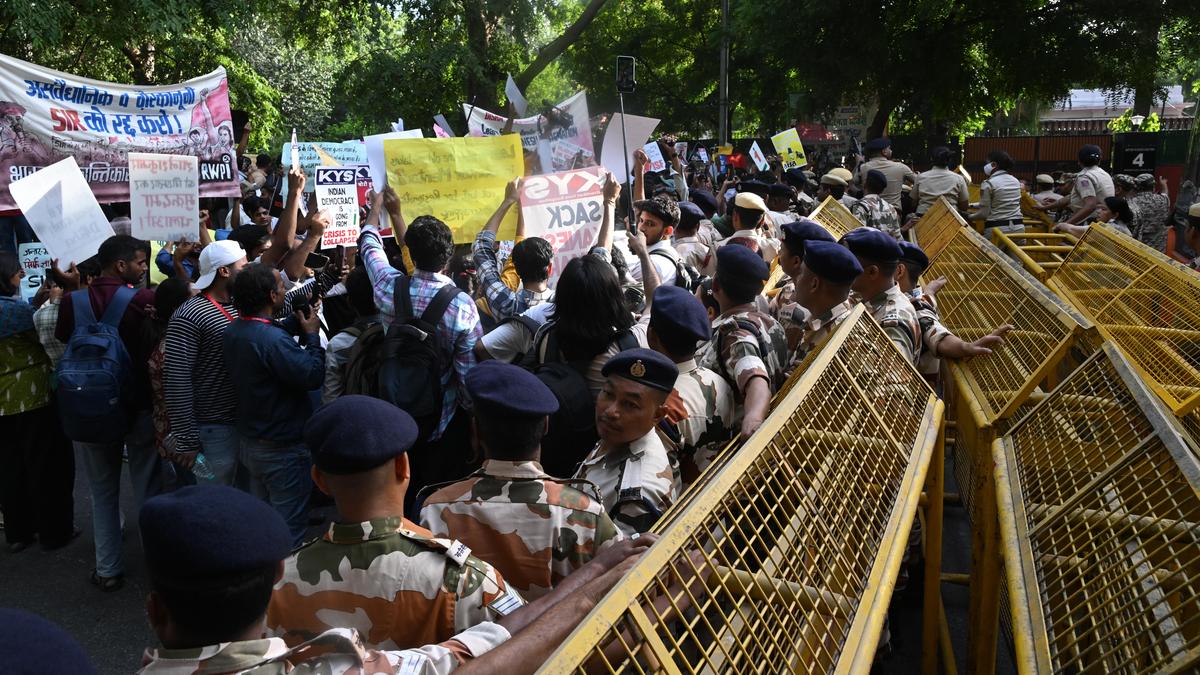

The story so far: A series of protests in Delhi over the Special Intensive Revision (SIR) of electoral rolls and demands for the removal of Chief Election Commissioner (ECI) Gyanesh Kumar have brought the national capital’s rules governing public demonstrations into focus.
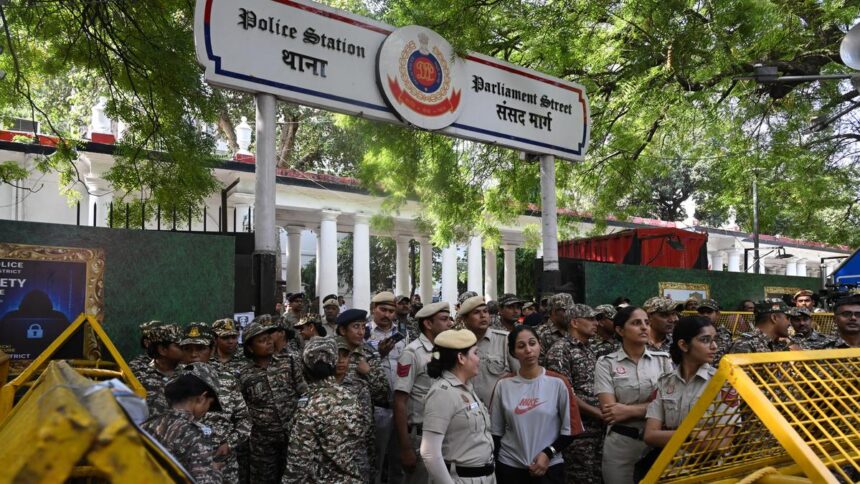
From All India Students’ Association (AISA)-led protests and civil society demonstrations to the INDIA bloc’s mobilisation, several demonstrations in central Delhi have been followed by detentions, cases and police action, with the Delhi Police describing them as “unauthorised” or in violation of restrictions.
The protests have also raised a more basic question. If citizens have a right to assemble and protest, what does an ordinary Delhi resident actually have to do before organising a demonstration? Does informing the police amount to permission? Can a protest be held at Jantar Mantar simply because it is a designated protest site? And what happens when the police refuse permission or impose restrictions? Here is what the rules and the Delhi Police’s current process say.

What does one need to do if they want to hold a protest in Delhi?
Informing the police and seeking permission are not the same thing. Organisers planning a protest at Jantar Mantar are required to approach the Deputy Commissioner of Police of the concerned jurisdiction, the New Delhi district in this case, and apply at least 10 days in advance.
The application is expected to provide details such as the date and time of the proposed demonstration, its purpose, the expected number of participants and other logistical details. The police may also ask organisers to give an undertaking regarding discipline, compliance with conditions and responsibility for the gathering.
The police then assess the request before deciding whether to grant permission, grant it with conditions, refuse it or suggest another venue.

This distinction has become important during the recent protests. Several groups have submitted what they have described as “intimation letters” to the police. Such a letter informs the authorities about a proposed gathering, but does not by itself authorise the protest.
Jantar Mantar is also subject to a capacity limit. Under the restrictions imposed after a Supreme Court judgment in 2018, demonstrations at the designated protest site are limited to up to 1,000 people.
What does Delhi Police look at before saying yes — or no?
The police assessment is not limited to the number of people mentioned in an application. Police and intelligence units assess the likely mobilisation, the organisers and their affiliations, the nature of the issue, the possibility of counter-protests and the potential impact on traffic and public movement.
They also assess whether other demonstrations are taking place in the area at the same time and whether sufficient personnel, barricades, traffic arrangements and other logistical resources are available.
One difficulty, according to the police, is the “open calls” for protests, particularly on social media, without a reliable estimate of the likely turnout or clarity about who will be responsible for managing the gathering.
A last-minute request can create a similar problem. Approaching the authorities a day or two before a protest leaves little time to verify the proposal and arrange deployment, traffic regulation and crowd-management measures. The 10-day requirement, officials say, allows them to assess the scale of the mobilisation and plan accordingly.
An undertaking from organisers is also intended to establish responsibility for maintaining discipline and complying with the conditions imposed for the protest.

The police assessment is not limited to the number of people mentioned in an application. File
| Photo Credit:
Sushil Kumar Verma
Why can a protest be denied even at Jantar Mantar, a designated protest site? And where else can a protester go?
Being a designated protest site does not mean that every proposed demonstration automatically gets permission.
The Supreme Court, in 2018, recognised the right to peaceful protest while also making clear that authorities have to balance that right with public order and the rights of residents and other users of public spaces. Following the judgment, the Delhi Police restricted the number of people who could gather at Jantar Mantar to 1,000.
This means the police have to consider not just the right to protest but also whether a particular gathering can be safely accommodated at the proposed location.
For larger gatherings, organisers are directed towards venues such as Ramlila Maidan and Narela Ground, depending on the scale and circumstances of the proposed demonstration.
The police have also maintained that there is no blanket prohibition on protests in Delhi. Smaller demonstrations have continued to be permitted after assessment, including some gatherings near Jantar Mantar.
Why is Section 163 imposed, and what does it mean for protesters?
Section 163 of the Bharatiya Nagarik Suraksha Sanhita allows an Executive Magistrate to issue preventive orders in situations involving an apprehended danger, disturbance of public tranquillity or similar threats to public safety.
Delhi Police has invoked the provision in parts of central Delhi amid the recent protests and law-and-order concerns. Where an order is in force, it can prohibit specified assemblies, processions or other activities for a particular period and within a specified area.
It is therefore not a permanent ban on protests across Delhi. Its application depends on the area, the period and the activities covered by the particular order.
For protesters, however, the practical consequence is important: even where there is a general right to peaceful assembly, a gathering can still be subject to restrictions imposed under a valid preventive order. Organising or participating in a demonstration without the required permission, or in violation of such restrictions, can lead to police action.
Published – October 08, 2026 09:40 am IST