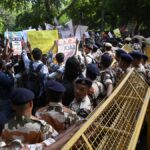



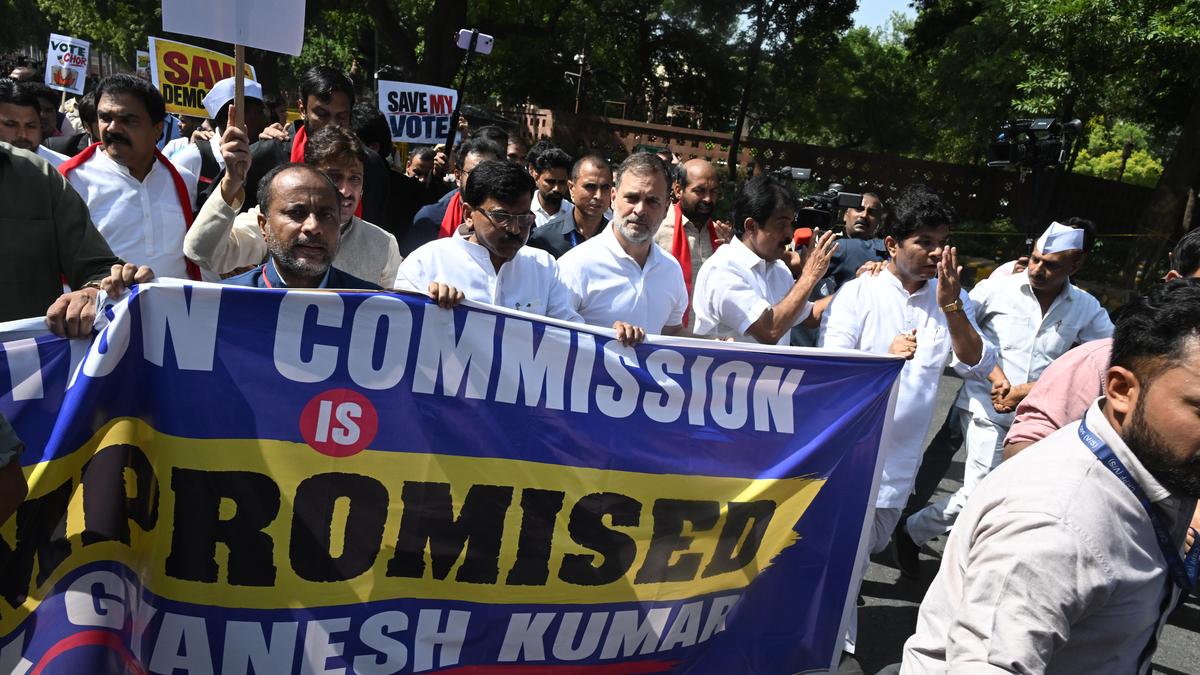


Leader of the Opposition in the Lok Sabha Rahul Gandhi during the INDIA bloc-led protest march from Parliament House to Nirvachan Sadan, demanding Chief Election Commissioner Gyanesh Kumar’s resignation in New Delhi on October 6, 2026
| Photo Credit: Sushil Kumar Verma
The Leader of the Opposition in the Lok Sabha Rahul Gandhi’s politics of resistance has found expression on the streets of central Delhi, as Opposition parties belonging to the see Indian National Developmental Inclusive Alliance (INDIA) have been carrying out back-to-back protests demanding the removal of Chief Election Commissioner Gyanesh Kumar over allegations of vote chori (theft) and electoral manipulation.
The protests have put the spotlight on mainstream Opposition parties, which were somewhat overshadowed by the Cockroach Janata Party (CJP) during the anti-paper leak protests at Jantar Mantar that eventually led to the resignation of Dharmendra Pradhan as Education Minister.

The dramatic visuals of Mr. Gandhi being carried by Delhi Police personnel and forcibly pushed into a bus, Priyanka Gandhi Vadra lying on the road clutching a copy of the Constitution, and Congress general secretary K.C. Venugopal being tossed around by police personnel address one abiding concern among the supporters of the Congress: that the party does not know how to take the fight to the streets.
“We are only just getting started. This petty intimidation will not deter us. We will return in greater numbers tomorrow, the day after, and the day after — until the Vote Chors (thieves) face justice,” Mr. Venugopal said.
But a dilemma stares the Congress in the face: how does the party carry all its partners along without making them appear as marginal actors in what is increasingly becoming a Rahul Gandhi show?

On Wednesday (October 7, 2026), the Samajwadi Party (SP), which has the highest number of Opposition MPs in the Lok Sabha after the Congress, did not attend a lunch hosted by Congress president Mallikarjun Kharge.
Congress general secretary Jairam Ramesh played down the absence, saying the decision to send out the lunch invitation had been taken only late on Tuesday evening and that not every party could attend.

“INDIA and other Opposition parties are united and stand in solidarity against Vote Chori, SIR and Delimitation,” Mr. Ramesh said.
The SP chief, however, was far more cryptic in explaining his party’s absence from the protests.
“In the future, you might hear about a meeting over tea. We could all sit down and eat samosas too — if a ‘samosa’ slogan were to be raised, there’s nothing wrong with that,” SP chief Akhilesh Yadav said.
Mr. Yadav is said to have been upset that the Congress leadership did not keep him and his colleagues in the loop about its plan to stage a dharna at Akashvani Bhawan soon after the march from Parliament on Tuesday.
The episode points to the larger challenge before the Congress. Mr. Gandhi’s emergence as the face of the campaign against the Election Commission has given the protests a sharper edge and generated viral images for television and social media. But it has also created unease among allies with their own political bases and leadership.
The Congress, therefore, needs to strike a balance: occupy the pole position in the campaign while ensuring that the INDIA bloc does not begin to look like a platform for a single party or leader.
Published – October 08, 2026 09:39 am IST