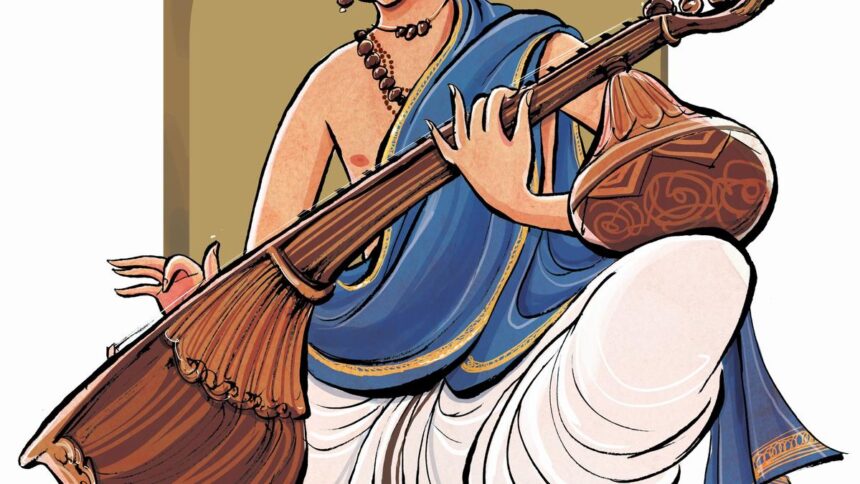







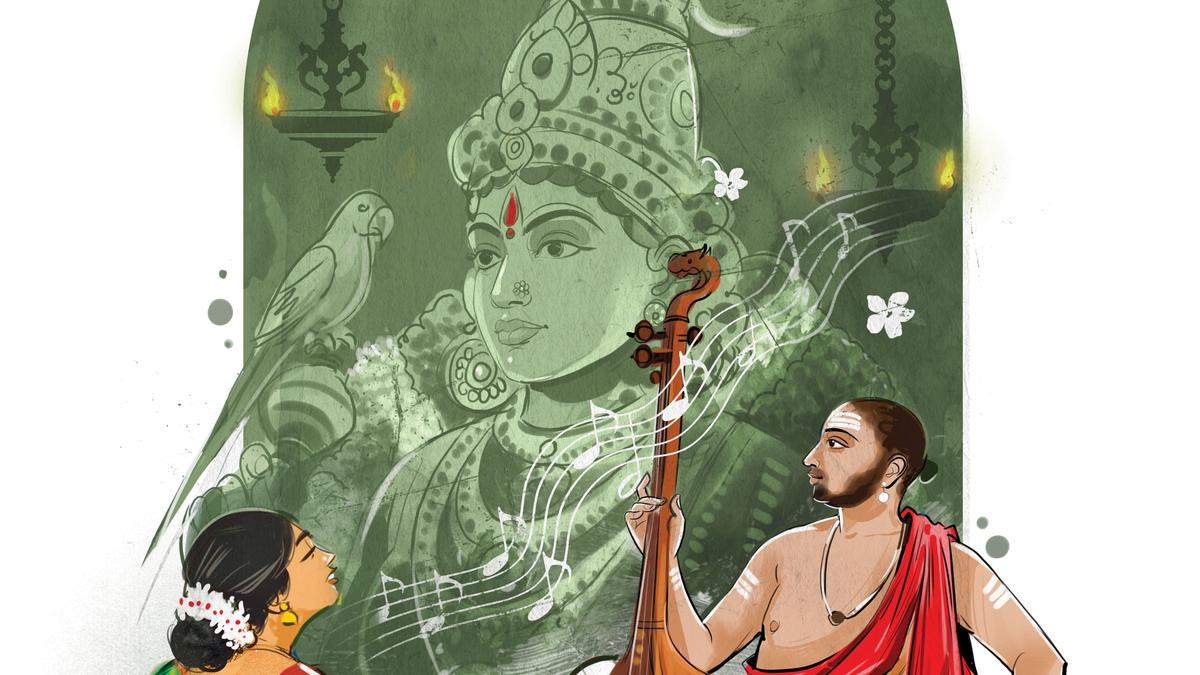

Syama Sastri belonged to a family of hereditary archakas at the Kamakshi Temple in Kanchipuram. During a period of political turmoil, his ancestors left Kanchipuram, carrying with them the golden vigraha of Kamakshi (Bangaru Kamakshi). They travelled through several places before finally settling in Thanjavur. It was during this period of migration that Syama Sastri was born in Tiruvarur. He later made Thanjavur his home, living beside the Kamakshi temple and regularly performing puja to the goddess.
Kanchipuram occupies a cherished place in India’s cultural, spiritual, philosophical, historical and religious heritage. Its sacred temples, particularly the shrine of Kamakshi, have inspired generations of poets, saints and composers. The Trinity have celebrated the goddess through their music, dedicating many compositions to Her. Tyagaraja’s ‘Vinayakuni valenu brovave’, and Dikshitar’s ‘Nirajakshi Kamakshi’, ‘Kanjadalayatakshi’, ‘Kamakshi Varalakshmi’ and several other compositions are among the well-known works dedicated to the goddess.
With the exception of a few kritis, all of Syama Sastri’s compositions are dedicated to Kamakshi. While each is a precious gem, the three swarajatis — ’Kamakshi Anudinamu’ (Bhairavi), ’Rave Himagiri Kumari’ (Thodi) and ’Kamakshi Ni Pada’ (Yadukula Kamboji) — occupy a special place in his oeuvre.
These works are marked by his musical genius and intense devotion to the deity. In the swarajatis, Syama Sastri describes Kamakshi’s beauty, majesty and glory, while addressing her as a child would address his mother. This mother–child sentiment is reflected in the simple, direct and deeply personal Telugu sahitya. The verses draw the listener into the intimate world of a devotee.
While a profound sense of surrender runs through all three compositions, the Bhairavi and Yadukula Kamboji swarajatis express it in the opening lines of the pallavi:
In the Bhairavi swarajati:
‘Kamakshi anudinamu maravakane ni padamule dikkanucu nammitini’
“O Kamakshi, every day, without forgetting, I place my trust in Your feet as my only refuge.”
Similarly, in the Yadukula Kambhoji swarajati:
‘Kamakshi ni pada yugamu sthiramani ne nammi unnanu, na cintalellanu dircamma’
“I have placed my steadfast trust in Your feet; please dispel all my worries, Mother.”
In the Pallavi of ‘Rave Himagiri Kumari’, he makes a supplication to his Mother and asks Her to confer him with boons; sentiment of surrender appears later:
‘kanci Kamakshi ni padame dikku’
“O Mother Kamakshi of Kanci, Your feet alone are my refuge.”
He offers an inkling of this spirit of surrender even in his first composition, Janani Natajana Paripalini, through the repeated words “nammiti, nammiti, nammiti”, “I place my trust entirely in You.”
Swarajati, as the name suggests, combines swara and jati. Syama Sastri’s swarajatis, however, are structured differently. They lack the earlier muktayi-swara section with sahitya and jati; instead, each consists of a pallavi followed by multiple swara-sahitya passages that return to the pallavi.
The Bhairavi and Yadukula Kamboji swarajatis follow arohana krama, with eight and eleven swara-sahitya passages respectively, although some versions of the latter have ten. The swaras proceed in ascending order, and both compositions are set to Misra Chapu tala. The Thodi swarajati, with six passages, does not follow this pattern and is set to Adi tala.
All three begin grandly in the lower register, or mandhara sthayi, establishing a strong edifice for extensive raga and sahitya. Each offers a detailed exploration of its raga through characteristic phrases, oscillations, swara movements and charming rhythmic patterns. The rhythmic introduction of the setting in the pallavi of both the Bhairavi and Yadukula Kamboji are similar.
In the Bhairavi swarajati, the passage beginning on the dhaivata eschews the chatushruti daivata and employs only the shuddha dhaivata right through. This is probably to highlight the supreme importance of the shuddha dhaivata in the raga. In the penultimate swara passage, the concluding phrase moves from tara-sthayi rishabha to madhya-sthayi rishabha, omitting notes in the descent, revealing the quintessence of Bhairavi.
The Thodi swarajati, preserved in two popular versions, showcases poruthams, rhyming melodic phrases, that have become integral to Carnatic music and reflects Syama Sastri’s penchant for melodic and rhythmic symmetry.
The Yadukula Kamboji swarajati offers varied kalpanaswara endings. Each passage demonstrates a different mode of melodic resolution while defining the raga with remarkable clarity.
In many instances, the union of music and sahitya creates a magical experience. In the fourth swara-sahitya passage of the Bhairavi Swarajati, ‘Bhakta jana kalpalatikā’, Syama Sastri refers to Kamakshi as the kalpavriksha of devotees. Its distinct musical structure allows musicians to improvise through manodharma.
The legendary musician Semmangudi Srinivasa Iyer, whose renditions of these swarajatis remain evergreen, was once asked why he chose to sing niraval at this line when the composition seemed complete. He replied that the format offered musicians immense inspiration. The melody of the final line of the last swara passage is similarly enchanting in both versions of the Thodi swarajati.
In the Yadukula Kamboji swarajati, Syama Sastri composes two swara passages in a similar manner but differentiates them through janta swaras, creating distinct aural images. The passage beginning on dhaivata contains a distinctive phrase not found in other compositions in the raga. The second dhaivata passage carries the identical opening phrase leading to different melodic phrasings after.
The repetition of a word three times in succession is also a hallmark of Syama Sastri’s style. In the seventh swara-sahitya passage, he concludes by repeating the word ‘vini’ three times. His son, Subbaraya Sastri, a distinguished composer, inspired by the musical setting of the words ‘Tamasamu seyakane’ in the eighth swara-sahitya passage, echoes the same melodic idea in the chittaswara passage of his kriti ‘Ninnu sevinchina’. The swarajatis are also replete with swaraksharas, in which the swara and sahitya syllables coincide.
Although the swarajatis are in Telugu, Syama Sastri also incorporates beautiful Samskrita expressions to describe the beauty of the goddess. Phrases such as ‘Kuvalaya-dala-nayana, kamala-dala’ and ‘Sarasijakshi, gaja-gamana, mada-matta-gaja-gamana ’, ‘Mada-gaja-gamana, dara-gala’ and ‘Kambu-gala, mani-radana’ and ‘kunda-radana, vidhu-vadana’ and ‘shashadhara-nibha-vadana’ are nuanced usages.
The confluence of sahitya and sangita in these swarajatis is a marvel. The emotional depth, lyrical lucidity and musical brilliance of these masterpieces remain unparalleled to this day. To Syama Sastri, we owe abundant gratitude for gifting us these extraordinary treasures.
(The writer is a well-known Carnatic vocalist)