



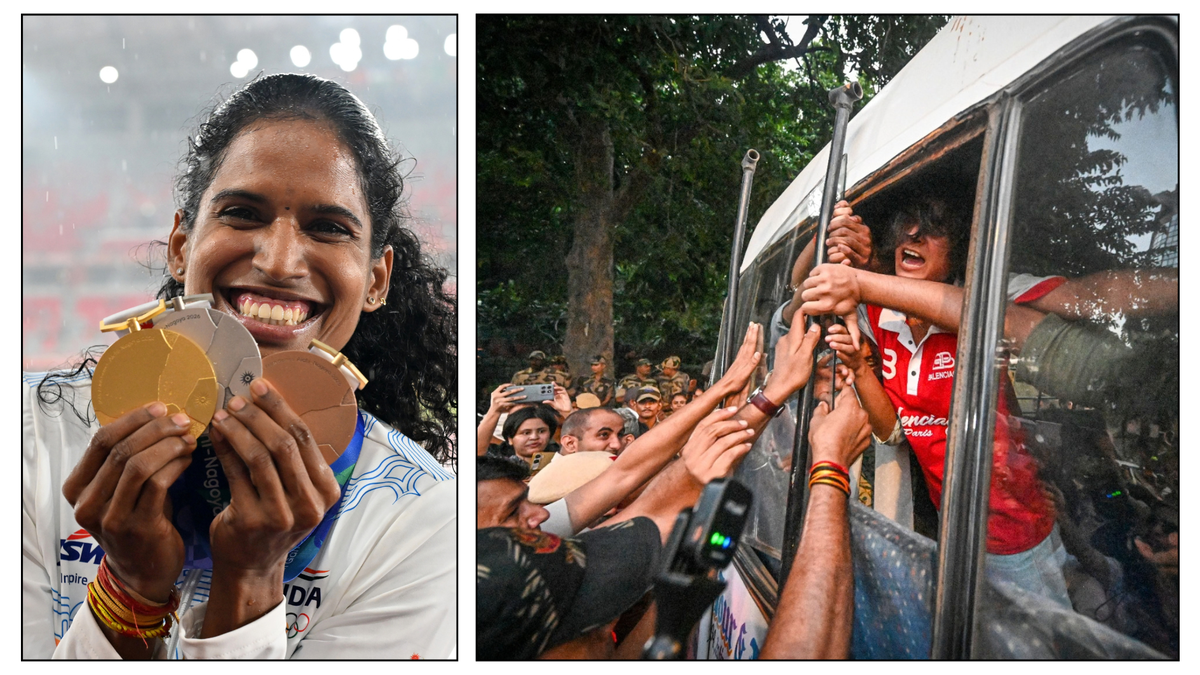

On the evening of October 2, two realities unfolded. As the Indian women’s hockey team was making history in Nagoya, Japan, women across Indian cities were taking to the streets. Hockey player Lalremsiami Hmarzote had put India ahead, and for the next 50-odd minutes, her teammates defended that single goal as though their lives depended on it, refusing to let China through. After 44 years, India’s women won an Asian Games hockey gold.
Back home, women were walking. As part of a countrywide #WhyLoiter campaign, women took to the streets in pink, reclaiming public spaces and asserting something that should require no campaign, no slogan and certainly no courage — the basic human right to walk, linger and exist in public every day of their lives, without fear.

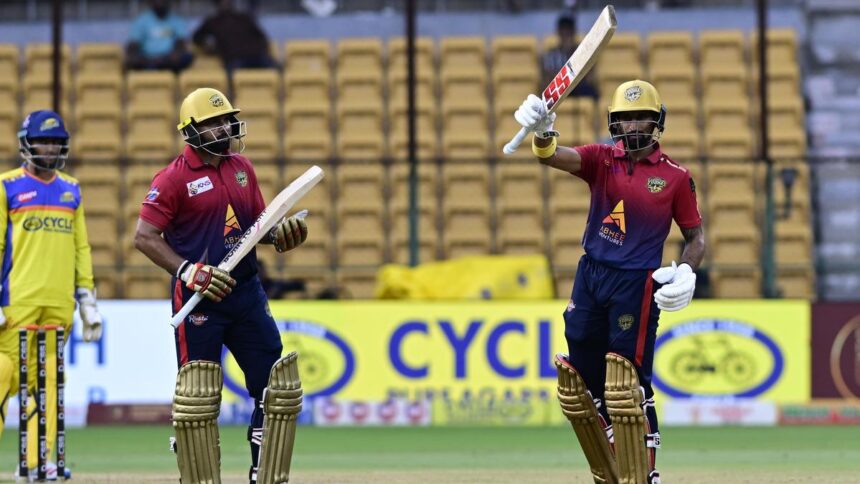
(Clockwise from top left) Indian hockey player Lalremsiami Hmarzote; protesters being detained in New Delhi; wrestlers Vinesh Phogat and Sangeeta Phogat during a 2023 protest; boxer Lovlina Borgohain; hockey player Jyoti Rumavat; archer Kumkum Mohod; weightlifter Mirabai Chanu; and headlines from The Hindu and Sportstar
| Photo Credit:
Sushil Kumar Verma, PTI, Getty Images, AFP, and Reuters
The next morning’s newspapers brought in another Indian sporting triumph. Boxer Lovlina Borgohain had won gold at the Asian Games. And alongside photographs of her celebration was the story of an Indian hockey umpire who had been sent home from Japan following allegations of sexual misconduct, which he has denied.
For the past couple of weeks, this has been the strange, almost obscene rhythm of the news cycle. India’s women athletes winning medal after medal in Japan, while reports of rape and sexual violence against women at home continued to pile up.
In April, Sports Minister Mansukh Mandaviya told Parliament that 33 sexual harassment complaints had been filed against Sports Authority of India personnel over the last decade: 8 against administrative staff, 25 against coaches.
The joy was real, as was the rage. In the national capital, women protesters broke the windshields of the buses they were dragged into for detention, for raising voices for their own safety. A quick-witted young woman even grabbed the ignition key of a bus in which protesters were being loaded and took off with it. “There is no playbook, no script to these protests,” says Prachi, a young student who attended the Jantar Mantar protests last week. “It’s so chaotic, and it’s also funny at times [like when the woman ran away with the ignition key]. Nobody knows how to respond because it’s so unconventional.”
Who is the actual Bharat ki beti?
There is the India where its women athletes are breaking barriers, rewriting records and giving millions of girls reasons to dream. And there is the India that, year after year, cannot guarantee those same girls the basic right to move through the world without fear. It is tempting to call them two Indias. But is it really?
“It’s not a contrast,” says senior sports journalist Sharda Ugra. “It’s not two Indias. The women are negotiating and navigating the same India.” That is the uncomfortable truth. Sport is a reflection of society in every way, and not some magical safe space.
Over the years, we’ve become very good at celebrating Indian women when they win. They are garlanded, felicitated, rewarded. They absolutely deserve every bit of it. At the recently concluded Asian Games, India’s women delivered more gold medals than the men: 11, compared to the men’s tally of 7, with 3 additional golds in the mixed events.
And this matters the most. It matters to the 12-year-old girl watching Kumkum Mohod, only five years older, topple Korea’s archery domination of decades single-handedly. It matters just as much to the woman who, after watching Mirabai Chanu, all of 49 kg, lifting four times her bodyweight, finally walked into the gym. Because when women see other women take up space, take risks and win, possibility becomes visible.

Kumkum Mohod in action in Japan
| Photo Credit:
Reuters

Manipur Chief Minister Khemchand Yumnam with Mirabai Chanu, who won a silver medal in Japan
| Photo Credit:
Special arrangement
Take a moment though to reflect on the ‘Bharat ki beti’ framing used each time a sportswoman excels. It sounds affectionate, empowering even. But the beti is also a deeply patriarchal framework: the good, obedient, respectful daughter who brings glory to the nation. “Outside this daughter framework that has existed forever, does she have no identity?” argues Ugra. “And when that same daughter demands accountability, or challenges the men in power, what happens then?” That is where the affection ends.
When the obedient daughter starts demanding to be heard, when she is angry, loud, abusive or unwilling to fall in line, the discomfort begins. In the wake of the CJP (Cockroach Janta Party) protests of July, Prime Minister Narendra Modi described young women using expletives and abusive language as a “cultural shock”, adding that he chose to “forgive them”. So, alongside the jubilation around the medal wins sits the question we need to ask: what kind of an India are these women really succeeding in?
When women challenge power
It’s a framework we’ve seen before. The 2023 protests by India’s most accomplished wrestlers — demanding the arrest and removal of Brij Bhushan Sharan Singh, then-president of the Wrestling Federation of India, over allegations of sexual harassment and intimidation — showed what happens when women at the top of their game challenged power. The medals, fame and social standing did not insulate them from the machinery of the system. Athletes, including Olympic medallists Sakshi Malik and Bajrang Punia, and world medallist Vinesh Phogat, were forcibly detained. “The wrestlers’ case showed me where exactly women athletes stand in the pecking order in India,” Ugra says. “They have no status.”

Wrestlers Vinesh Phogat and Sangeeta Phogat struggle after being detained by security personnel during their march from Jantar Mantar to Parliament House in 2023
| Photo Credit:
Sushil Kumar Verma
People were reminded of this when, in August, Modi addressed athletes via a video conference during the Khelo India Dialogue, and called for developing ecosystems in off-beat sports such as surfing and winter sports. Responding to him on social media platform X, wrestler Phogat wrote, “Prime Minister ji, how will [they] participate when the federations [in which they are participating] have goons, criminals, and people who exploit women…?”
Can the system be trusted?
In 2023, in the wake of the wrestlers’ protests, the National Human Rights Commission issued a show cause notice to the Sports Ministry over the supposed absence of the law-mandated Internal Complaints Committees (ICC) in multiple sports federations, including wrestling. “There are more guards now. The committee members visit the facilities and hostels annually too,” says 400m hurdler Ashwini Akkunji, former Asian Games gold medallist and now a coach.
But the question is not simply whether a committee exists on paper. It is whether a scared teenager knows whom to go to. It is whether she trusts the system enough to go ahead and complain. It is about whether the person she is complaining about has influence over her selection, career and future. And whether there is anyone in that system who looks at the situation from her point of view. The answer is often no. “We need more female staff around, there’s no doubt about it,” Akkunji adds.
Former India hockey captain Asunta Lakra’s recent experience is an equally deeply disturbing one. In July, Lakra raised concerns with authorities after young women players in Jharkhand approached her with allegations of inappropriate behaviour by a coach. In an interview with ETV, she alleged that Hockey India’s secretary general Bholanath Singh threatened her over the phone, saying, “Aukaat mein raho [know your place].” The allegation is now the subject of an independent inquiry. Lakra’s account is another version of the same story of what happens when a woman attempts to challenge power.

Former India hockey captain Asunta Lakra
| Photo Credit:
Getty Images
This came after Sports Minister Mansukh Mandaviya told Parliament in April that 33 sexual harassment complaints had been filed against Sports Authority of India personnel over the last decade: 8 against administrative staff, 25 against coaches.
The battle for space starts early
But perhaps the most telling measure of how safe women are in sport is not what happens to the champions on the podium. It is what happens to the girl who dreams of getting there one day. The battle for space begins much earlier. Sometimes, it begins in a neighbourhood field or a park, where a girl simply wants to play, and learns, often before she is old enough to understand why, that the space may not quite belong to her.
Shobhita Naithani’s 12-year-old daughter looks up to India’s women cricketers, and attends private coaching classes where things are structured. In their community playing area where they live though, it’s a different story. The boys playing are more aggressive, and often disrupt proceedings when the girls go out to play. “They operate from a space of entitlement. Like, it’s my right to play here,” Naithani says. “What happens is that a girl’s body language and confidence change immediately. They could be in the middle of playing football, and the boys start talking loudly to each other, warming up on the side, jumping around. It disrupts things mentally, and sometimes they just come back home with their tails between their legs.”
Naithani acknowledges their privilege, which allows her to provide private coaching, drop-offs and pick-ups for her daughter. Most of the Asiad medallists, who her daughter has been reading about in the sports section of the papers, are not privileged. “I see girls who finish playing at 5.30 p.m. and then board a bus to get home,” she says. “I would love to let my daughter do it, but I haven’t been able to so far.”

(L-R) Kiran Pahal, Prachi Choudhary, M.R. Poovamma and Vithya Ramraj who won gold in the women’s 400m relay in Japan
| Photo Credit:
R.V. Moorthy
Instead, she’s pointing at every private bus she spots and telling her child that’s the kind of bus she should never board. Unfortunate as it is, the real life tragedies are the examples parents are using as references. The instructions that are muscle memory to women will begin soon enough, she is aware. “Stay on the phone with me,” “ping us when you reach,” “share your live location,” “don’t accept food and drinks from strangers.”
The change has to begin at a micro level. Not with another safety manual for girls, but with lessons for boys on letting girls play. Because the burden of negotiating the world cannot forever be placed on the women navigating it.
India’s sportswomen have time and again shown us what they are capable of. Give them a field, they will play. Give them a track, they will run. Give them a ring, they will fight. Give them an opportunity, they will give you medals. Perhaps, we’ve got the bargain backwards. They shouldn’t have to win gold to earn the right to be heard. They shouldn’t have to represent their country to deserve a safe journey home. They shouldn’t have to become ‘Bharat ki beti’ to be allowed to simply be themselves.
The writer is an independent sports media professional and author of the award-winning book Free Hit: The Story of Women’s Cricket in India.