



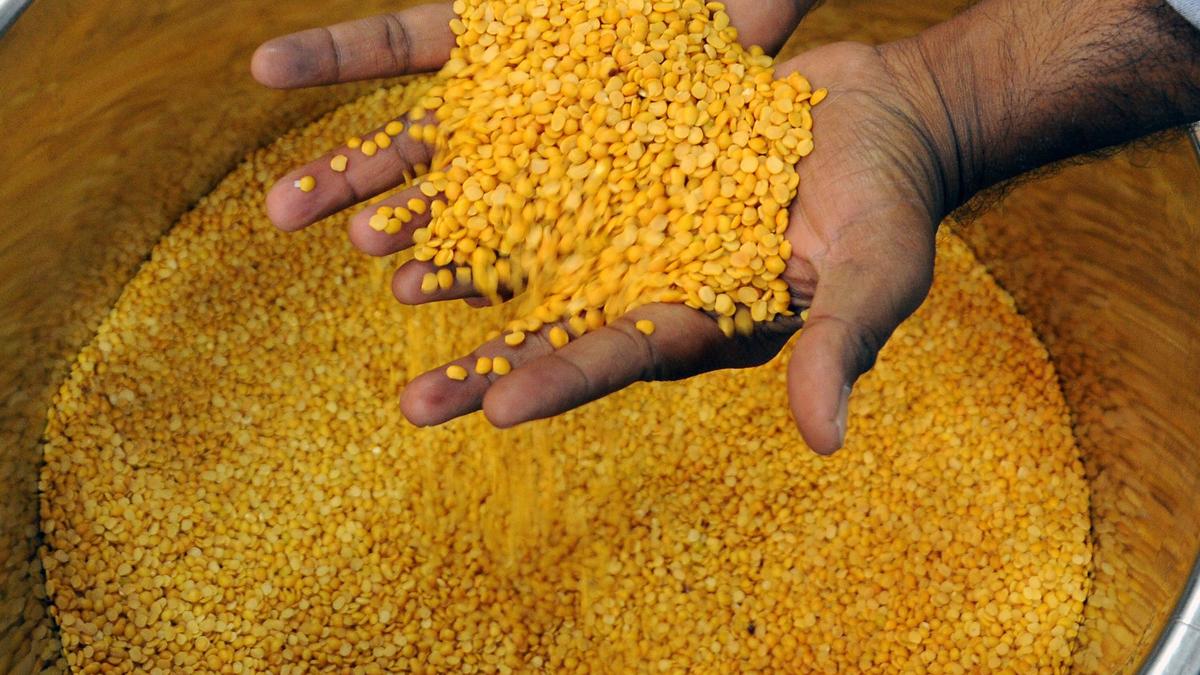


Representational file image.
| Photo Credit: M.A. SRIRAM
Amid a rain deficit of 35% between June and September in Karnataka, the prices of rice and toor dal have increased. The price of rice had already increased twice in two months between August and October.
This has impacted household budgets, while hotels are now weighing their options of increasing their rates.
For instance, the price of the Sona Masuri variety which was ₹75 per kg, has now increased to about ₹80, Basmati has gone up from ₹110 to ₹140 per kg, bullet rice from ₹80 to ₹100, Kolam rice from ₹75 to ₹100, and Rajamudi rice from ₹125 to ₹150, on an average, as per traders The Hindu spoke to.
The price of toor dal varieties have also increased by ₹10 to ₹15 per kg from what it was 10 days ago. The Gulbarga fatkar variety is priced at ₹145 per kg, from ₹125.
According to the Department of Agriculture, the target area for paddy cultivation for the kharif season was 10 lakh hectares while the sown area was only 6.2 lakh hectares. Last kharif season, it was 10.43 lakh hectares. The target area for toor dal this kharif was 16 lakh hectares while the sown area was 13.35 lakh hectares. Last year, the sown area was 14.16 lakh hectares.
Chamarasa Malipatil, president of Karnataka Rajya Raitha Sangha (KRRS), said: “The government did not release water from reservoirs in major paddy cultivation areas of Karnataka, including Ballari, Raichur, Gangavati, Mandya and a few districts of Malnad region, at the right time. It is the same with toor dal cultivating districts mainly in Kalaburagi. Hence, there is crop failure, no stock in market, and demand surge leading to hike in price.”
Mr. Malipatil pointed out that not all farmers benefit from price hike. Those who have stored the harvest from the rabi season will benefit as they can now sell it in the market, he said.
G.R. Denesh, Professor of Agronomy and Scheme Head at All India Coordinated Research Projects (Rice) run by Indian Council of Agricultural Research (ICAR), explained: “According to our estimation, more than 50% crop loss is likely to be recorded in paddy cultivating districts of Karnataka. It is a water-intensive crop and needs sufficient water and rains. Both were not available this year. If we get good rains by the end of October and November, then the price of rice and toor dal might stabilise or it will only increase.”
Shivakumar, general secretary, Karnataka State Rice Mills Association, said: “There are 700 rice mills operating across the State, but the stock of rice is low in the market. Two months ago, mill owners procured paddy at ₹3,500 per quintal which has increased to ₹4,600 to ₹4,700 per quintal. Neither the State nor the Union governments can regulate the price of rice here because they cannot ask farmers to decrease the price of their harvested crops.”
Muniswamy S., scientific officer, Directorate of Research, University of Agriculture in Raichur, said that Maharashtra and Karnataka are the leading producers of toor dal in India. “Even though there is toor dal yield in the State, the quality is not as expected because of less moisture in the atmosphere and infertile soil. Flowering is also delayed because of extreme heat in Kalaburagi.”
Mr. Muniswamy pointed out that floods in Kalaburagi last year was another reason for the price hike. “Floods impacted the production of toor dal in approximately 1.7 lakh hectares,” he said.
Published – October 10, 2026 04:34 am IST