






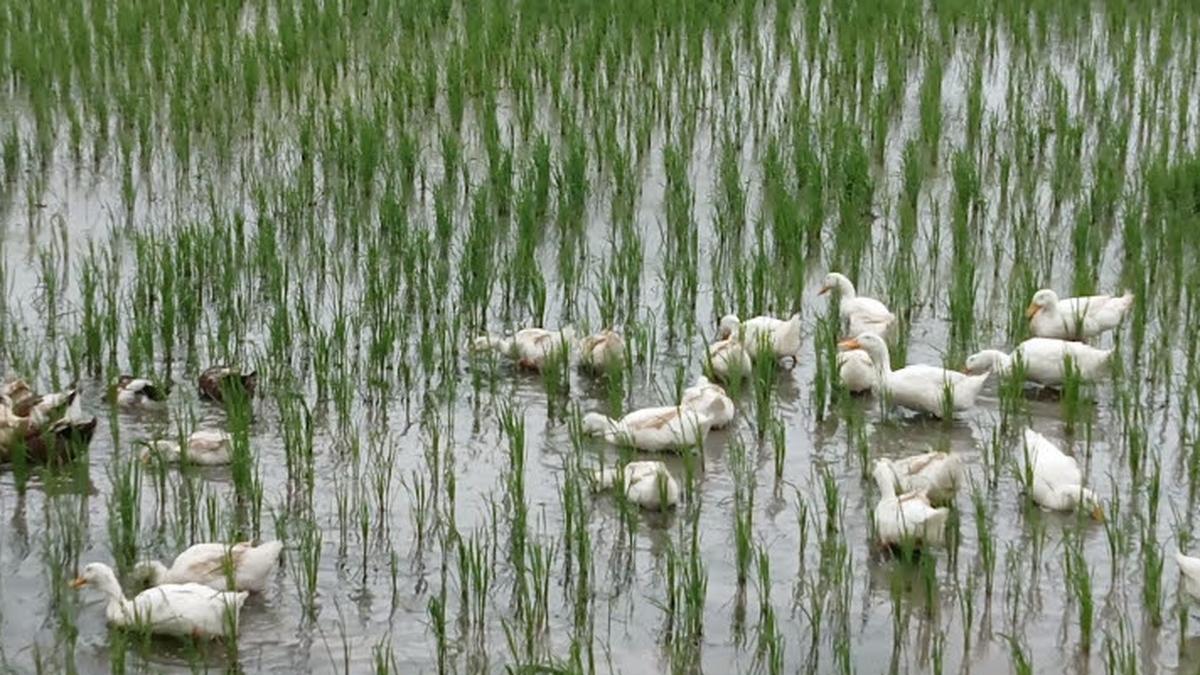

Ducks released into a paddy field as part of an integrated rice-farming model being evaluated by TRRI, Aduthurai, for its potential to cut methane emission and boost productivity.
| Photo Credit: Special Arrangement
A rice field that raises fish, feeds ducks, and carries a green mat of Azolla may look unusual at first glance, but a two-year field study by the Tamil Nadu Rice Research Institute (TRRI), Aduthurai, suggests that it could be one of the most pragmatic climate change solutions for paddy — cutting greenhouse gas emission while delivering a sharp jump in yields.
The study, conducted during the 2022–23 and 2023–24 samba seasons, found that an integrated rice farming system combining green manuring, beneficial microbes, and multiple farm components reduced the overall climate change impact — measured as carbon dioxide equivalent (CO₂e) — by 32.6% compared with conventional rice monoculture reliant on chemical fertilizers. At the same time, grain yield rose by about 45%, the researchers reported.
Paddy cultivation is among the biggest sources of farm-related greenhouse gases, largely because flooded fields create oxygen-starved conditions that favour methane formation, while high fertilizer use drive nitrous oxide emission.
In the integrated plots, paddy followed a green manure crop (daincha) and was supported with phosphorus-, potassium- and zinc-solubilising bacteria, while fish rearing, duck foraging and dual cropping of Azolla were introduced as complementary components. Together, the interventions altered the soil-water environment in ways that improved nutrient recycling and weakened the conditions that favour methane-producing microbes.
Measurements showed a 34.2% reduction in methane emission and a 24.9% reduction in nitrous oxide emission compared with rice fields that thrive with chemical fertilizers. Researchers said that carbon dioxide emissions rose, consistent with higher biological activity, and decomposition under organic inputs, but the overall warming potential still declined, because methane and nitrous oxide trap more heat than CO₂ over comparable timeframe.
K. Subrahmaniyan, Director, TRRI, said the approach redefined “productivity” in paddy cultivation. “Integrated Farming System is not just about yield. It is about food security, nutrition, and soil security — things we often forget in regular farming,” he said. When multiple components are integrated with paddy, he added, the farm generates more value from the same land: “Fish becomes a source of protein and additional income, alongside the crop.”
Importantly, TRRI researchers say the model is designed to be workable even for small farmers. Mr. Subrahmaniyan said even on a one-acre farm, dedicating roughly 10% of the area to a peripheral trench — about one metre wide and one metre deep — could cost about ₹10,000, and under suitable management, produce up to 400 kg of fish, offering an estimated ₹25,000 additional income, apart from the rice crop. In such layouts, about 90 cents of land remains under paddy and 10 cents supports fish, with ducks integrated in some versions.
Published – December 14, 2025 08:00 pm IST