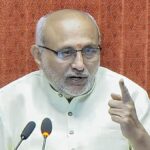





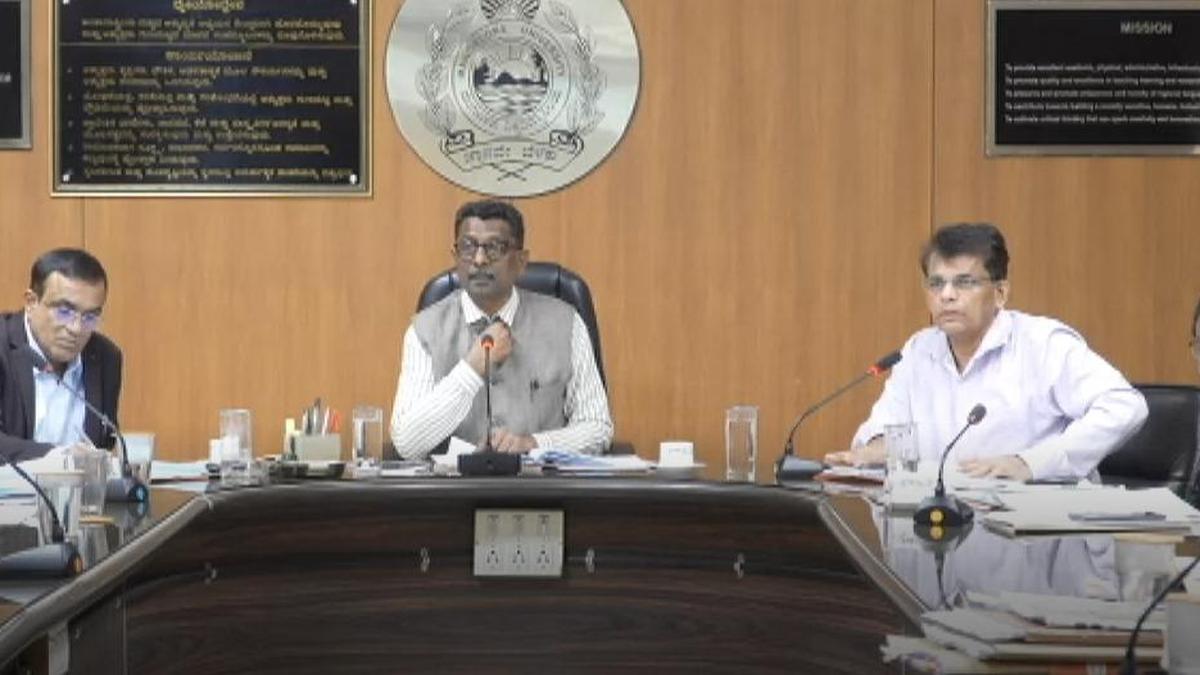
P. L. Dharma, Vice-Chancellor of Mangalore University, speaking at the Academic Council meeting of Mangalore University on December 22, 2025.
| Photo Credit: SPECIAL ARRANGEMENT
As many as 22 private degree colleges affiliated to Mangalore University will cease to exist.
The Academic Council of Mangalore University at its meeting on Monday approved their closure.
An agenda tabled at the meeting of the council said that principals of the colleges in question had communicated to the university that they had closed admissions due to lack of students in required numbers.
The 22 colleges are Aaba Women’s First Grade College, Surathkal; Anjuman First Grade College, Mangaluru; Amrutha College, Padil; Silicon College of Advance Studies, Konchady; Moegling Institute of German Language, Balmatta; Sarsa College of Arts and Science, Mangaluru; Rosario College of Management Studies, Bolar; Karavali College of Education, Mangaluru; Premakanthi College of Education, Mangaluru, and Sapientia Bethany First Grade College, Nelyadi.
The other colleges are Sri Sharada Women’s College, Sullia; Ramakunjeshwara College, Ramakunja; Hazaratha Sayad Madani Banatha Women’s College, Ullal; St. Sebastian College of Commerce, Ullal; St. Thomas College, Belthangady; Mar Ivanios College, Kadaba; Madhava Pai College, Manipal; Mookambika First Grade College, Byndoor; Varasiddhi Vinayaka First Grade College, Kundapur; B.D. Shetty College of Business Management, Udupi; Vidyanikethana First Grade College, Kaup; and Krishnabai Vasudeva Shenoy Memorial College, Katpady.
According to Ganesh Sanjeev, in-charge Registrar (Administration), the university had 167 affiliated colleges, excluding 22 colleges, during the 2025-26 academic year. They include 109 private colleges, 32 government colleges, nine autonomous colleges, 13 B.Ed. Colleges and four constituent colleges owned and managed by the university.
Of the 167 colleges, 108 are in Dakshina Kannada and 42 colleges in Udupi district.
Research Centre on Arebhashe
Vice-Chancellor P. L. Dharma, who presided over the meeting, said that the Governor had approved the Statute Relating to the Institution of Arebhashe Samshodhana Kendra at the university.
NHEQF guidelines
The council decided to adopt the guidelines of National Higher Education Qualifications Framework (NHEQF), introduced by the University Grants Commission (UGC), for all programmes under Arts, Science and Technology, Commerce, and Education disciplines.
The NHEQF represents a comprehensive framework that classifies qualifications based on a set of performance criteria, approved nationally and comparable with international quality standards.
It specifies qualification types and framework levels and the expected learning outcomes corresponding to these qualification types. Qualification types refers to nomenclature such as a certificate, diploma, bachelor’s degree, postgraduate diploma, master’s degree, and doctoral degree.
Each qualification is aligned to an academic credit system based on the attainment of defined learning outcomes and the academic workload of students who complete the chosen programme of study.
Accordingly, the council decided to adopt 120 credits to bachelor’s degree, 80 credits to postgraduate degree, and 40 credits to postgraduate diploma.
Published – December 22, 2025 09:29 pm IST