






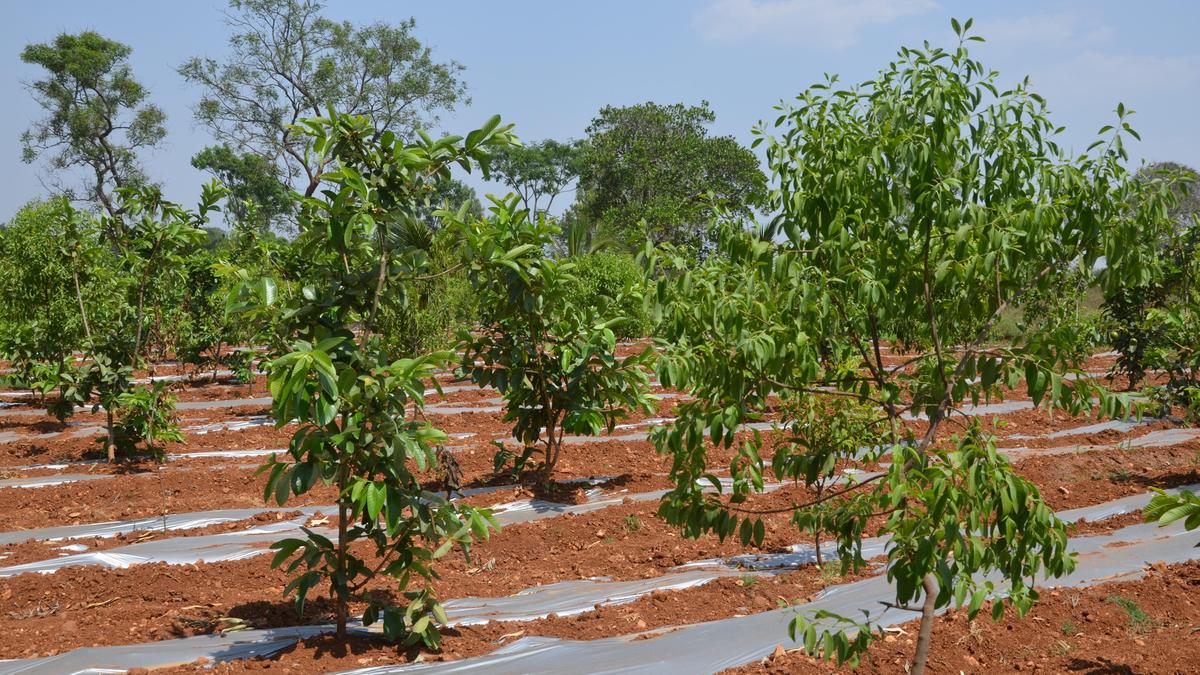

Finance Minister Nirmala Sitharaman on Sunday announced that the Centre will partner with State governments to promote focused cultivation and post-harvest processing to restore the glory of the Indian sandalwood ecosystem.
The announcement comes at a time when Karnataka, a pioneer in deregulating sandalwood cultivation, is struggling to meet demand despite being the largest producer in the country.
According to data accessed by The Hindu, Karnataka Soaps and Detergents Ltd. (KSDL) has an annual demand of 7,000–8,000 tonnes of sandalwood. However, only about 30% of this requirement is met through sandalwood grown within the country. KSDL, a State government entity and the primary buyer of sandalwood from farmers, is meeting the shortfall by importing sandalwood oil from Australia.
Sandalwood market
Ironically, the sandalwood oil Karnataka imports from Australia is extracted from native Indian sandalwood species. “About 25 years ago, Australia procured our sandalwood species and cultivated them on their land. The Indian variety yielded substantial results, giving them significant success in the market,” a KSDL source told The Hindu, adding that Karnataka is now importing from Australia.
A.C. Lakshman, former Forest Secretary of Karnataka, said that even China is rapidly expanding its sandalwood market after recognising the demand, while India has failed to capitalise on its own resource.
“In China, research has progressed to the extent of developing host plant species that aid sandalwood cultivation. In Karnataka, we use Cassia siamea and pigeon pea as host plants, but China’s newly developed species is far more effective,” he explained.
A.N. Yellappa Reddy, former Environment Secretary, Government of Karnataka, welcomed the move, saying it would benefit farmers cultivating sandalwood. However, Mr. Lakshman cautioned that the massive demand has attracted the interest of two industrialists seeking to set up factories across India for manufacturing sandalwood products, which could potentially harm farmers and exploit the market.
“Our government should ensure that any move is made keeping farmers in mind. Sandalwood should not be industry-orientated. The state government must be proactive before agreeing to terms with the Centre,” he cautioned.
Despite favourable conditions, sandalwood cultivation in India has remained below par due to draconian laws, lack of policies, and theft.
State efforts
M.B. Patil, Minister for Large and Medium Scale Industries, told The Hindu that the State government has already introduced policies and onboarded farmers. However, the vulnerability of sandalwood trees to theft is making farmers hesitant.
“We are incentivising farmers, providing saplings, and supporting them with cultivation practices. However, most are still hesitant. We are at the planning stage of addressing the theft issue,” he said. According to KSDL data, 413 farmers across Karnataka are cultivating sandalwood on around 4,000 acres.
Earlier, State governments attempted to relax regulations governing sandalwood cultivation and allowed farmers to sell in external markets.
Farmer leader K.T. Gangadhara said there is a need for a new policy for sandalwood growers. “Farmers first have to safeguard their plantations. Then, to harvest the crop, they require permissions from multiple offices. Post-harvest activities are extremely difficult,” he said, adding that harvesting feels like hell and the government must commit to resolving these issues.
Mr. Lakshman said that in 1996, when he was Forest Secretary, a proposal to relax draconian laws was introduced but did not receive Cabinet approval. Subsequently, then Chief Minister H.D. Deve Gowda showed interest, and procedures were set to begin, but he became Prime Minister and moved to Delhi at that time.
“A few years later, the then bureaucrat Chiranjeev Singh and the then Forest Secretary Shankarlinge Gowda successfully convinced then Chief Minister S.M. Krishna to draft rules for sandalwood cultivation,” he told The Hindu.
Published – February 01, 2026 07:24 pm IST