






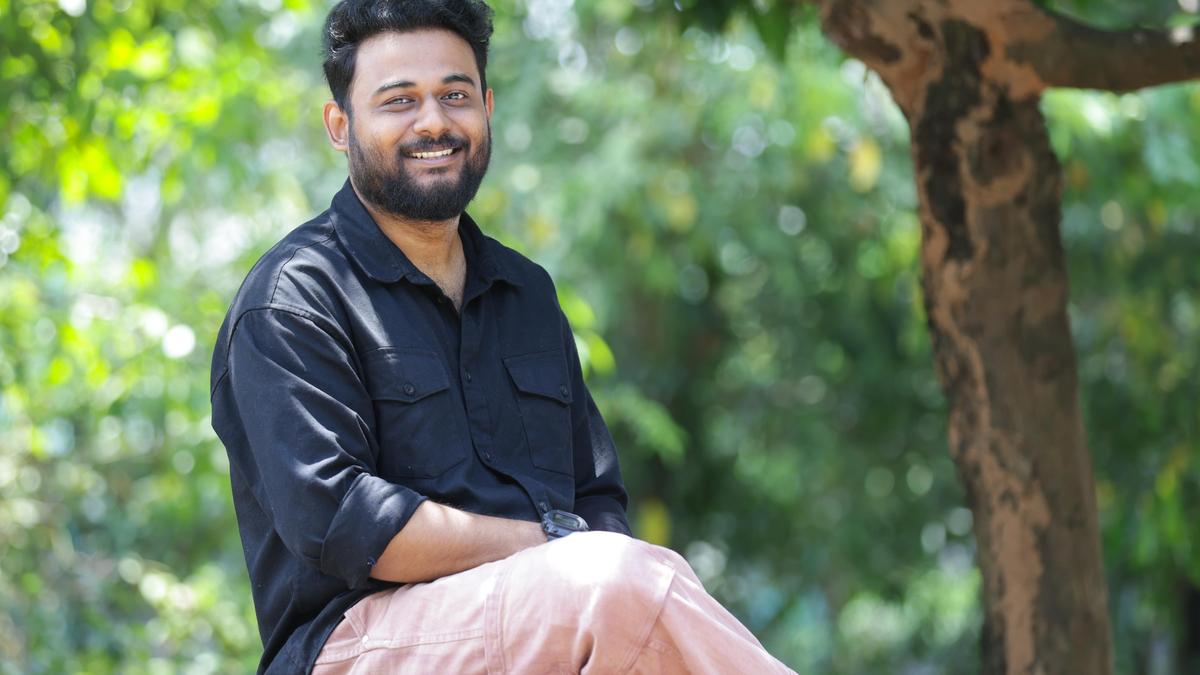

“No,” says debutant director Safar Sanal emphatically to the question whether he would have made Aasha without Urvashi. “No, because by the time I finished the script, I could not place anybody else as the lead character. The role demanded more than an actor, more than a tool… it needed a human being who could understand the character; it had to be a thinking individual.”
The veteran actor’s take as Aasha, possibly one of her career’s best, has drawn an outpouring of praise. Safar is in awe of the performance and considers himself lucky to have been able to see her at work.
He describes a scene in which Aasha confronts her daughter, Anagha (Aiswarya Lekshmi). “By the time she finished, I had goosebumps watching her. She was so overcome with emotion; it was such a charged scene. The entire set was stunned.”
Safar considers himself fortunate to have worked with actors such as Urvashi, Vijayaraghavan, and Joju George in his debut film. Joju co-wrote the screenplay with him and Ramesh Girija, who has also acted in the film. Ramesh has been Safar’s long-time collaborator, from their short film-making days.
Aasha is a suspense thriller that pits a middle-aged woman, Aasha, against a plumber, Jeemon (Joju George). Road rage spirals into murder, unleashing a series of unfortunate events.

Urvashi in Aasha
| Photo Credit:
SPECIAL ARRANGEMENT
Aasha is a complex character, not the filmy mother. She has a quicksilver temper and is possessive of the daughters she raised as a single parent. Her younger daughter, Anagha, she feels, constantly challenges her with her independent thinking. “I have had women of that age call and thank me for making the film. They said they saw their mothers in Aasha,” says Safar.
He explains, “It is a revenge story, but with a mother seeking it…. It is a change of perspective which we thought was worth exploring. We wanted to show what happens when an ordinary woman sets out to exact revenge.”

She is a product of society and is very conscious of living within its boundaries while ensuring her daughter does too. The film subtly, organically peels these layers of her traditional conditioning. For instance, Aasha cannot bring herself to say the word rape or sexual assault; even uttering the words is distasteful. Or her discomfort bordering on shock when she learns that her daughter is sexually active. Her flaws make her human; even when she lies, we forgive her because, in her worldview, she cannot be wrong.
“She is seen as flawed for her belief system due to the new normal, which sees those behaviours as wrong. In a traditional set-up, for a woman of Aasha’s upbringing, it would be okay. That, and society, have given her these peculiar character traits combined with a very strong sense of right and wrong and awareness of social norms.”
A woman would understand Aasha’s motivations and, sometimes, her desperation and what drives her to behave the way she does. Her peculiarities reflect a woman who has lived too long within society’s confines. Alongside challenging our perceptions and prejudices about the kind of people we think are likely to commit a crime.
Safar has had the thread for this story since 2019, when he was making short and indie films.

A scene from ‘Aasha’
| Photo Credit:
SPECIAL ARRANGEMENT
The turning point came when he and Ramesh met Joju while making Peace during the period 2020-22. They co-wrote the screenplay and dialogue for Peace with Sanfeer K. Then came Pani (2024), for which he was an associate. Working closely with Joju and discussing films kindled the desire to make different kinds of films.
Even then, they hadn’t yet decided what to do with the Aasha thread. But Aasha grew into a film that could be his directorial debut.
Collaborating with Ramesh Girija
Apart from Joju, Safar makes a mention of Ramesh Girija, his oldest collaborator since he started making short films back in Aligarh, where he did his high school and graduation. His father was a Malayalam professor at Aligarh Muslim University, and Ramesh had come there to pursue his doctorate in cinema under Safar’s father. A shared interest and passion for films led to the collaboration, which Safar says, will continue. Safar has made several zero-budget short films, which have won awards, which he shot on his phone, and himself edited.
While making Pani, they discussed the idea with Joju, who liked it. He felt the story could be told on a larger scale, probably with a male protagonist. Joju’s involvement was a source of confidence and encouragement. However, as the work on the script progressed, they felt the original idea, with the female protagonist, worked better. As the script evolved, they realised that the role was performance-oriented and demanded an actor who could shoulder it.

“Urvashi chechi was the logical answer.”
By the time the story was ready, Safar knew the film needed an actor of heft who could carry it, and it had to be Urvashi. “Urvashi chechi asked several questions during the narration, sharing inputs and speaking of people like Aasha whom she knew. She was very involved; it was evident that she was waiting for a different character from what she had been doing. She was getting emotional even during the narration of the climax.” He confesses that initially he had apprehensions about whether she would come on board because the role is very unlike what she has done before.
He is also grateful for the support of seniors like Vijayaraghavan and Aishwarya Lekshmi, especially being a newcomer. “I consider myself lucky to have been able to do this. The feedback for the film exceeds my expectations. I had my doubts and questions as someone directing their first film, but the support I got from these seniors was immense. It gave me a lot of courage.”
Aasha is playing in theatres
Published – September 18, 2026 03:58 pm IST