






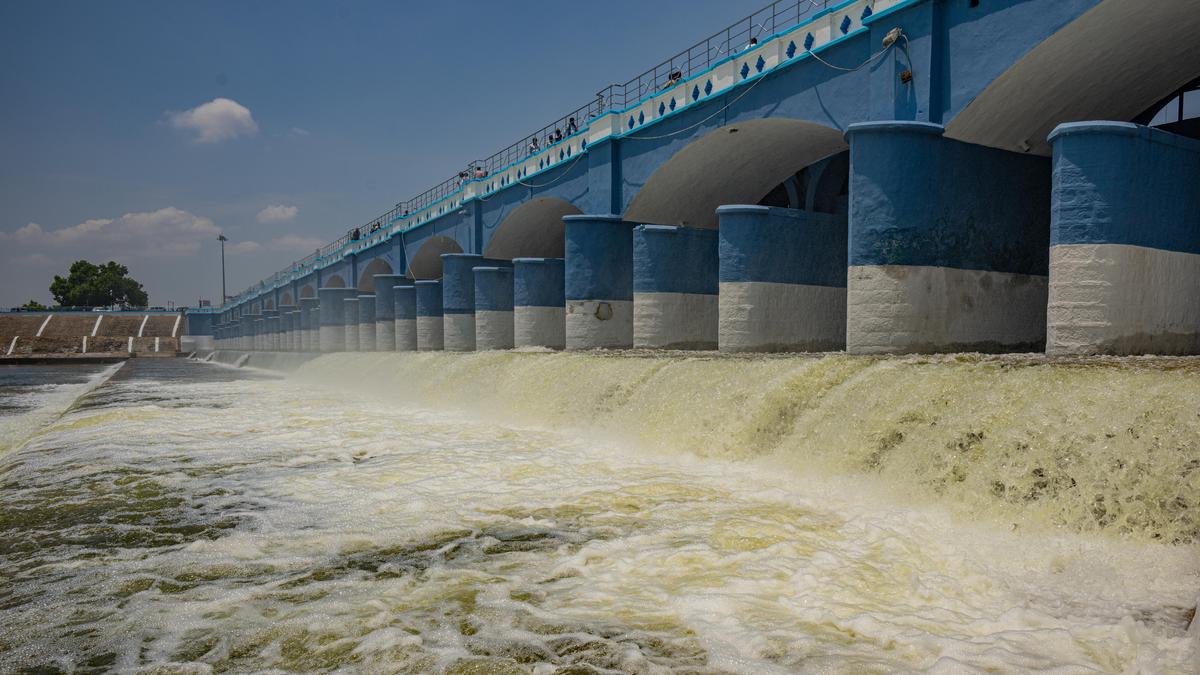


Cauvery water released from the Grand Anicut in Thanjavur in September 2026
| Photo Credit: R. Vengadesh
After a gap of 14 years, Tamil Nadu has realised the lowest realisation of the Cauvery river during southwest monsoon (June-September) in 2026.
In the last four months, the State got 44.208 thousand million cubic feet (tmc ft). Usually, its quota for the period is 123.14 tmc ft. Going by this yardstick, the shortfall in realisation is almost 79 tmc ft. During the monsoon of 2023-24, the State recorded around 45 tmc ft.
However, statistically, the current year’s receipt marked the fourth low realisation since 1974-75, when certain provisions of the 1924 Tamil Nadu-Karnataka agreement on the sharing of the Cauvery river became due for review.
The present storage of the Mettur dam, from which the release of water for irrigation began about a month ago, would last nearly for 18 days, in the event of the current level of discharge (15,003 cubic feet per second or 1.2963 tmc ft. in a day) getting continued. As on date, the storage is 36.639 tmc ft. (capacity: 93.47 tmc ft.). An allowance of 10 tmc ft. has to be provided for drinking water requirement, environmental flows and dead storage.
This has raised concerns among farmers and water experts about the prospects of paddy coverage during the samba-thaladi cultivation season, which is picking up momentum gradually.
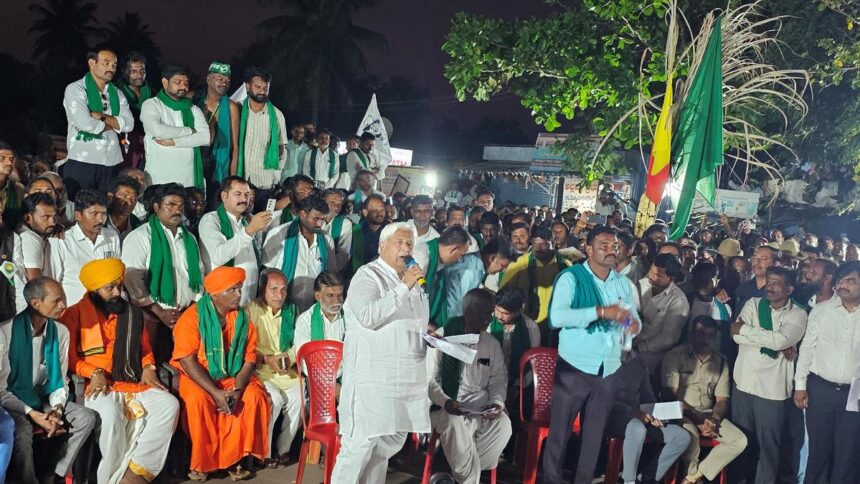
Unless the northeast monsoon comes to the rescue of the farmers, the immediate future appears bleak. Besides, even now, Karnataka has been protesting against the Cauvery Water Management Authority’s (CWMA) prescription on the water release. Between September 24 and October 4, the State received about 3.35 tmc ft. against CWMA’s order to Karnataka to provide 5.18 tmc ft to Tamil Nadu over 15 days (from September 24, 2026).
The paddy coverage in the Cauvery delta region is almost one lakh acres down, compared to the previous year’s figure for the corresponding period. As against 2.64 lakh acres in 2025-26, the existing coverage was 1.68 lakh acres as on October 5. Of the current year’s figure, direct sowing accounts for nearly 1.27 lakh acres, giving an indication that farmers of the region have come to terms with the shortage of water and they have not opted for the conventional way of paddy cultivation that consumes much more water.
Of the nine districts falling under the delta region, two districts alone — Cuddalore and Tiruvarur — account for about 72 per cent of the paddy coverage. Around 52,700 acres in Cuddalore and 68,400 acres in Tiruvarur have been covered. In the same period last year, the delta’s coverage was about 2.64 lakh acres. Eventually, it touched around 13 lakh acres. It remains to be seen how much of the current year’s target of nearly 12.7 lakh acres is going to be met.
Published – October 07, 2026 01:14 pm IST