





AI enforcement camera mistake guitar as pillion river slap helmet less riding challan.
| Photo Credit: Special Arrangement
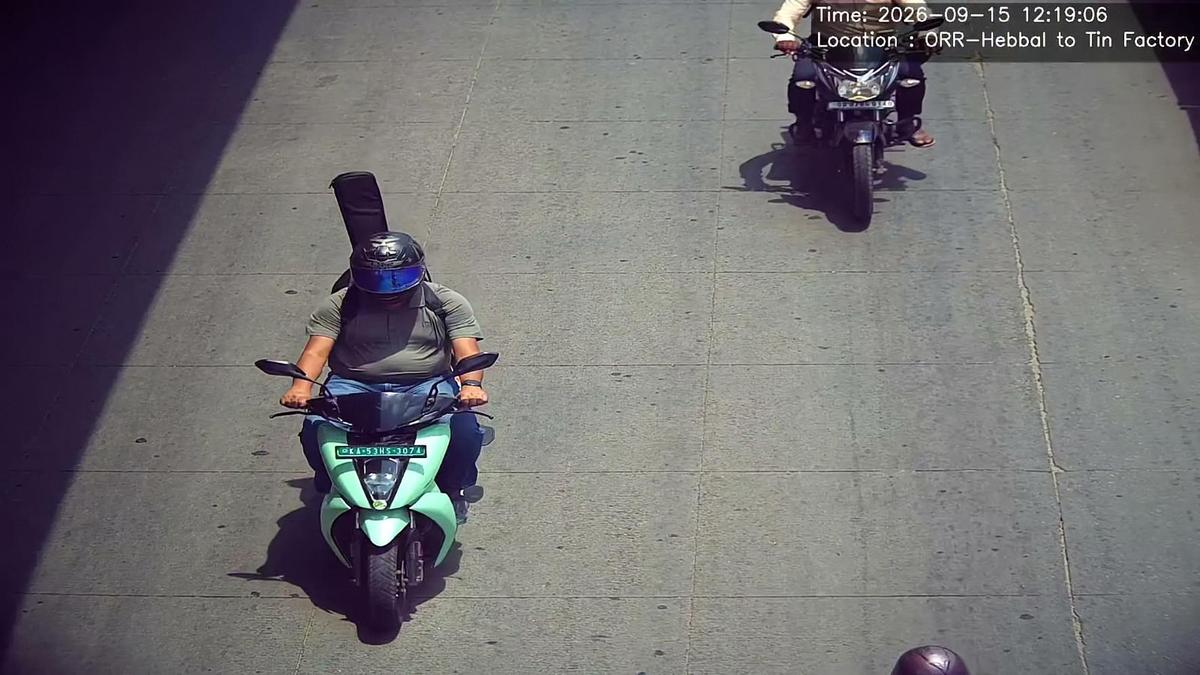
An artificial intelligence (AI)-enabled enforcement traffic camera, installed to detect traffic violations in Bengaluru, recently issued a routine helmet violation challan to a not-so-routine defaulter: a guitar case riding on its owner’s back.
Souvik Dutta was travelling on his scooter from Hebbal towards Tin Factory with a guitar strapped to his back. The AI camera apparently mistook the guitar case for a pillion rider and wrongly identified it as a person travelling without a helmet. A challan, along with a photograph captured by the camera, was subsequently sent to Mr. Dutta’s wife who owns the scooter.
He raised a complaint on the Bengaluru Traffic Police’s (BTP) official handle, stating, “I was riding my wife’s two-wheeler alone with my guitar slung on my back in Bangalore. @blrcitytraffic, my wife received a traffic challan (notice no. 86202541) for ‘pillion riding without helmet’. So much for AI-based traffic violation detection! Pls revoke the challan.”
Responding to his post, BTP officials asked him to contact the traffic automation section for rectification of violations.
Limitations of AI monitoring
The incident has drawn attention to the limitations of automated traffic enforcement systems. Many motorists, taking to social media, raised concerns that the enforcement cameras book them for violations for jumping a signal even if they cross the zebra crossing a little to allow other vehicles that have a green signal to pass through.
A senior traffic police officer admitted that the reported pillion rider violation was a false flag, caused by an error in judgment by the artificial intelligence system, which happens occasionally. Sometimes, it even flags a small child sitting between two people on a scooter for pillion riding without a helmet, he said. Such violations can be questioned, he said, following which they are verified and rectified.
“The AI system sharpens with more and continuous data feeding, and it can go wrong occasionally. We already have a team that usually verifies such wrong flaggings and updates them. This might be one of the oversights, and we will rectify it,” he said, admitting that the system has yet to achieve 100% accuracy.
Published – September 26, 2026 09:40 pm IST