

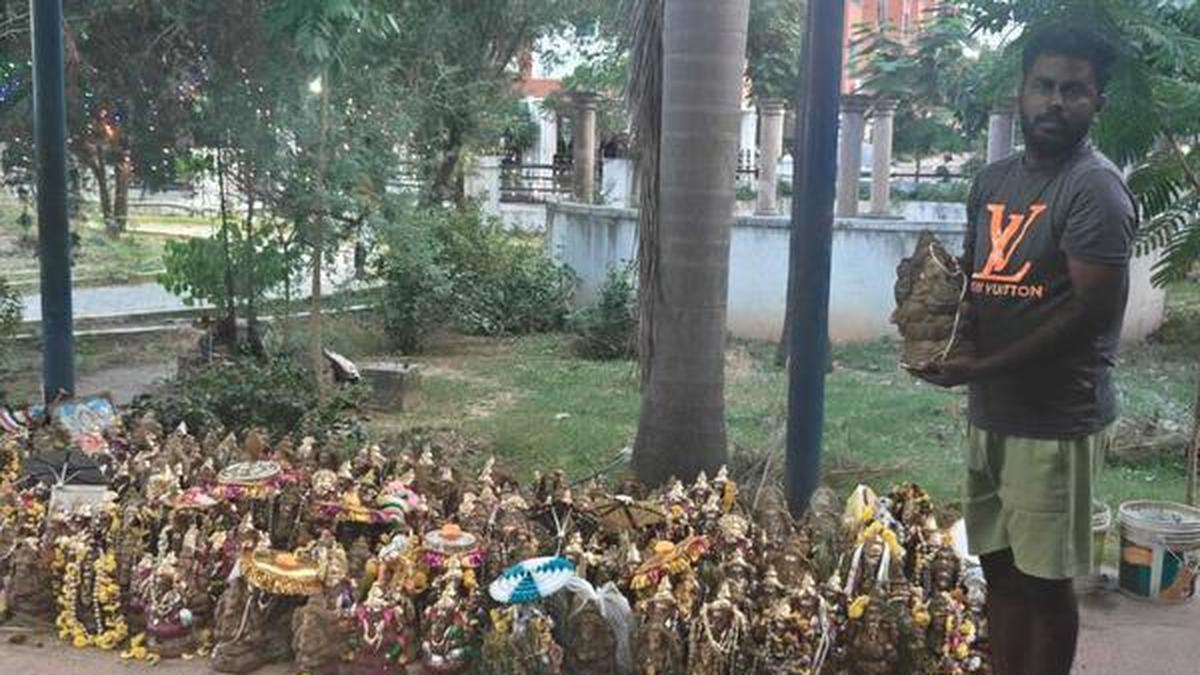

At SSM Nagar in Alapakkam, New Perungalathur, residents have been having an extended Ganesh Chaturthi for the last three years, making the clay Ganeshas central to a recycling initiative. As in the previous two years, under an in-house initiative, ‘KAATRU’ (Keeping Awareness And Action Towards Recycling and Upcycling), helmed by P.S. Jayaraman, has collected clay Ganeshas and kept them ready for potters.
Residents are asked to choose natural, unpainted clay idols and, after the celebrations, leave them at a designated collection point near the Pillayar Kovil. From there, the idols are handed over to potters.
P.S. Jayaraman, a resident of SSM Nagar, initiated this exercise three years ago inspired by a newspaper article about how Malini Kalyanam, pottery artist and environmentalist. “She was in Teynampet. There was a newspaper article saying that Ganesha idols need not be put into water and cause pollution, and that they could instead be given back to potters,” he says. The article prompted Jayaraman to contact Malini, after which the community arranged for its idols to be collected and sent to potters.
The arrangement changed in the second year, when Jayaraman began looking for potters who could directly collect them from the community. “I looked on Google and contacted four or five potters inside Chennai,” he says. Eventually, a potter near Kovalam connected him with another potter in Mahabalipuram, who agreed to collect the idols and reuse the material. “From the second year onwards, we started sending the idols directly to him. Last time, we sent around 900 to 1,000 Ganeshas,” Jayaraman says.
This year, around 200 to 250 idols had already been collected, with residents expected to continue bringing them in until the afternoon of September 19. Jayaraman has also been urging residents to think about their choices before the festival. The campaign asks them to avoid Plaster of Paris idols, non-eco-friendly paints and decorations. “I have been talking only about clay. I have been telling them not to buy painted Ganeshas or plaster Ganeshas,” he says.
For Malini Kalyanam, who is Director of the Artistic Pottery Training Academy in Kattupakkam and one of the founders of The PALM, a public charitable trust, the issue goes beyond what happens to an idol after the festival. As a pottery artist, she has also watched the availability of natural clay decline. This year, her academy received enquiries from corporates as well as members of the public looking to purchase clay for Chaturthi workshops, only to find it difficult to source.
“This year we had enquiries from corporates and the public alike to purchase clay for Chaturthi workshops, and that is when they said it is not available online or even at shops in the locality. This shows that demand is high but supply is on the lower side,” she says. Malini says the recycling project has been around for nearly a decade, but awareness has picked up considerably in recent years. With more people asking what they should do with their idols after the festival, the initiative has gradually expanded into a larger conversation about responsible celebration.
Malini, a Teynampet resident who has shifted her base to Tiruvallur for running The PALM, notes that the clay Ganesha idols recycling initiative, titled “Beautiful Bharath — Save Clay” powered by The PALM, has grown bigger, being pan-Tamil Nadu now as volunteers from across the state, which includes P.S. Jayaraman of SSM Nagar, are chipping in. Malini notes plans are afoot to extend the initiative to cities such as Mumbai and Hyderabad.
An alternative application
Malini Kalyanam notes that if a collection facility or a potter is not available, the clay from the Ganesha idols can be used in tree-planting exercises. She suggests placing the idol in a bucket of water and letting it break down over a few days. Once the clay settles into a powder, it can be reused. However, Malini says, the clay should not simply be poured around a plant or sapling and expected to act as an element of nourishment. For it to support plant growth, it needs to be mixed with other materials. She lists the ingredients that mixed with the clay that has dried up as a powder and found impressive results: garden soil, compost, perlite or sand, mushroom molasses and water. The ratio of the ingredients would depend on the sapling, she notes.
A Golu display of Ganesha idols by Velachery resident
Lakshmi Prabha, 68, a Velachery resident, came to Chennai in 1989 and began collecting Ganesha idols. Her collection started when she bought her first 12 pieces, finding them reasonably priced. She initially kept the idols as part of her Golu display. One of the first idols that caught her attention was a unique Ganesha wearing a coat. However, the piece was later banned due to the material that went into its making, and she could not find another one like it. In 1998, her daughter gifted her nine Ganesha idols, most of which she had bought from Archies. Lakshmi Prabha also began collecting idols whenever she visited Puducherry. Over the years, she has collected around 120 terracotta Ganesha idols
Among her collection is a paper-holder Ganesha with a crown, which she bought for Rs 40. The response from people who visit her house and see the collection excites her. This year, she began arranging the collection on the Friday before Ganesh Chaturthi at 11 am and continued until 9.30 pm.
The idols in her collection are made from a wide variety of materials, including terracotta, clay, gold, silver, wood, white stone, paper mould, porcelain, glass, cement, brass and black stone.
Published – September 20, 2026 10:59 am IST