





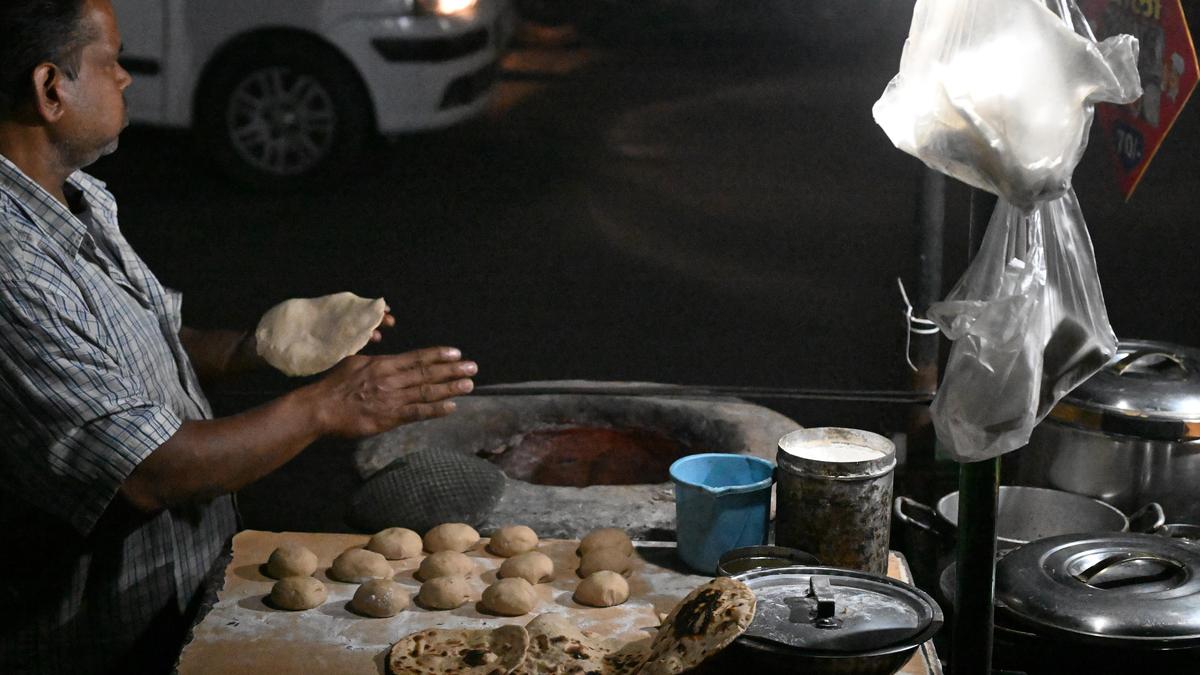
A dhaba in a north Delhi market using a coal-fired tandoor.
| Photo Credit: SUSHIL KUMAR VERMA
Even over two months after the Centre banned coal- and firewood-based tandoors in Delhi-NCR to curb pollution, hotels and eateries across the Capital continue to flout the order, a spot check by The Hindu has found.
At a local dhaba in Malviya Nagar market in south Delhi, workers said the tandoor is essential for their daily cooking. They explained that switching to another cooking method is unaffordable and could hurt their business. “Most of the dishes we make involve a tandoor, especially rotis. It’s fast, affordable, and people come here regularly for dishes prepared on the tandoor,” said Anil Singh, the tandoor operator. “We cannot completely switch to gas, but try to limit tandoor usage to reduce pollution,” he said.
Mr. Singh also said that tandoor emissions are “low”. “Once the coals are ignited and the tandoor is hot, the smoke emitted is very little,” he said.
The ban on traditional tandoor use is part of Stage I of the Graded Response Action Plan (GRAP) measures issued by the Commission for Air Quality Management (CAQM) for National Capital Region and Adjoining Areas. Urban local bodies, such as the Municipal Corporation of Delhi (MCD) and the New Delhi Municipal Corporation (NDMC), have been tasked with ensuring that only electric or gas-fired tandoors are used. Violations of CAQM guidelines on tandoor invite fines ranging from ₹5,000 to ₹2 lakh.
Several outlets said they have received fine notices from authorities but still use tandoors.
A café owner in the ITO area, who was using the traditional tandoor and aware of the GRAP measure, said, “It’s far from here [outlet]. It doesn’t catch the eye of inspectors.”
At Khan Market, a worker at an eatery said they have not yet switched to a gas tandoor. “If the government asks us strictly, we will switch. But gas tandoors affect the quality of kebabs. Last year, when we switched for a month, and the customers started complaining,” the worker said.
Some dhaba owners near Khan Market said that smoke from wood and coal is “less harmful”. “Wood and coal are natural. There are bigger causes of pollution, like vehicular pollution,” said Ashish Landhava, a dhaba owner.
A worker at another dhaba said, “We got a notice to stop using the tandoor, but we are ignoring it as it will hit our business.”
‘No violation’
When contacted, an NDMC spokesperson told The Hindu that there were no rule violations by restaurants and eateries in the NDMC-managed areas, including Khan Market.
“We have 14 inspection teams that conduct checks throughout the year and encourage the switch to clean gas-fueled cooking for any cooking activities,” said the spokesperson.
There was no official response from the MCD. However, an MCD official admitted that enforcing the CAQM guidelines is difficult. “We conduct routine inspections and issue challans, including for using coal and firewood in tandoors, but small eateries are often not deterred by fines,” the official said.
Meanwhile, some food outlets have complied with the CAQM guidelines. A worker at a Chinese food court near Mandi House said they stopped using a tandoor a year ago. “Our menu had limited tandoor items. We switched to gas for rotis. Paying fines made no sense,” he said. Similarly, Jai Mata Corner near Mandi House, known for tandoori naans, now uses a gas-based tandoor. “We switched to gas long ago as coal was polluting,” the owner said.
(With inputs from Ayush)
Published – December 17, 2025 01:21 am IST