






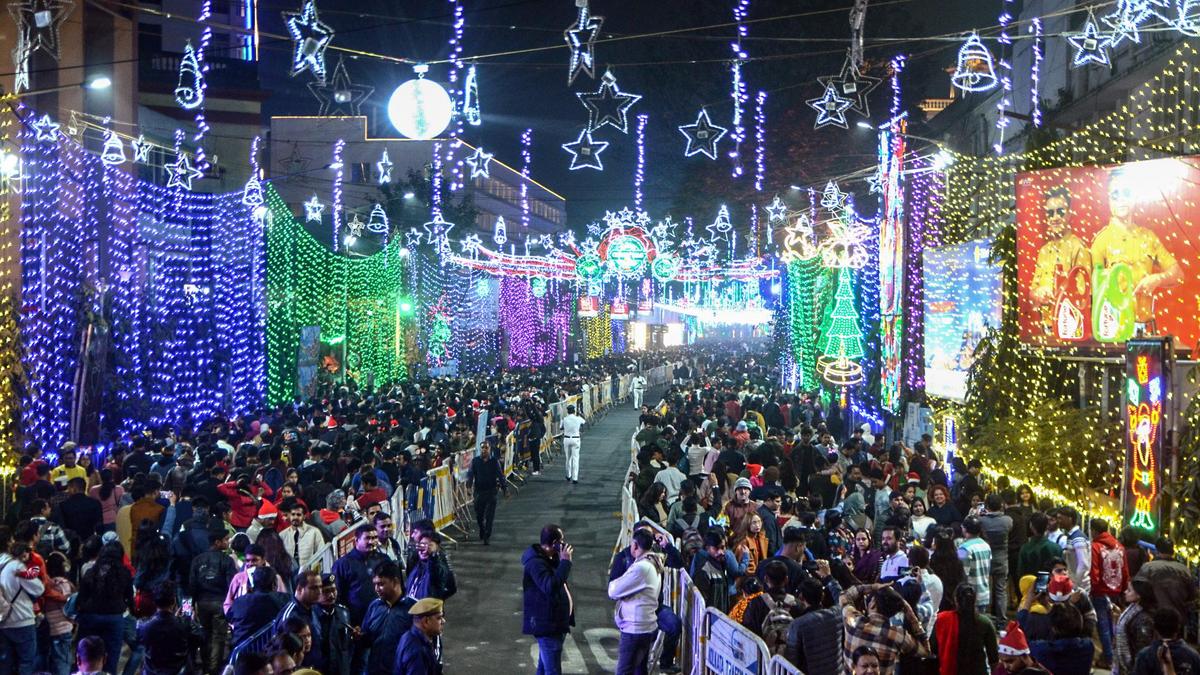


People gather in Park Street during Christmas celebration, in Kolkata.
| Photo Credit: ANI
As the year draws to a close, the general opinion in what is often called the ‘City of Joy’ appears to be that 2025 is not something to be looked back upon fondly for West Bengal, and that 2026 too should be treated with caution because Assembly elections will be held then and there will be attempts to create a communal divide.
“I think people are very much disturbed by the election process. I am personally worried about our long tradition of communal harmony. It is not new for us to aim for votes of the minority community in order to achieve victory. And for the last few years, given the changed political scenario, the Opposition has been trying to get votes of the majority Hindu people by trying to destroy communal harmony,” celebrated Bengali writer Amar Mitra told The Hindu.
“This is a secular country,” the writer, a winner of the O. Henry Award and the Sahitya Akademi Award, said. “Political parties should not talk against the minority people. I must also mention the attack on poor Bengali-speaking people in a few States. This is a threat to our democracy; it’s my right to go and work anywhere in the country,” Mr. Mitra said.
According to a State government officer who did not want to be named, the outgoing year, for West Bengal, was neither transformative nor tranquil and was marked by a recurring pattern where “serious governance challenges coexisted with spectacle-driven narratives”.
“Cases of rape in law and medical colleges shook the public conscience. The SSC (School Service Commission) recruitment scam continued to erode trust among thousands of aspirants. The SIR (Special Intensive Revision) issue further deepened anxieties over transparency and administrative fairness. The visit of Lionel Messi dominated headlines and social media — a major administrative failure, a shame for the entire State. Cultural and religious assertions — seen in renewed debates around the Babri Masjid, and the public chanting of Gita shlokas (verses) — added to political polarisation,” the officer said.
Exactly the same thought is voiced by Shreya Datta, a doctoral research scholar at the University of Calcutta, and much younger than the officer. “In 2025, Bengal appeared to be outwardly stable, but there was a quiet erosion of trust. People were politically aware, yet emotionally detached. Otherwise, we would not have watched and quietly accepted the aftermath of one of the biggest recruitment scams that saw 26,000 people losing their jobs. Looking towards 2026, the election doesn’t feel like a promise of renewal, it feels more like a moment of reckoning. Bengal must answer a difficult question: Are we choosing between futures, or merely negotiating how to live with disappointment? What worries me is not only polarisation but also exhaustion. Intellectual fatigue. Moral fatigue,” Ms. Datta said.
Fellow scholar Ayan Ghosh is also of the opinion that those living in Bengal had nothing in 2025 to look back at. “From losing jobs to being beaten in other States for speaking one’s mother tongue to the establishment of the Jagannath Temple using taxpayers’ money; from the deportation of a pregnant woman to Bangladesh to the recent Messi fiasco — all of these have humiliated us as a Bengali-speaking community. The entire political system failed us. What we need for 2026 is a reset button. We need to delete jingoistic flavours from political discourse rather than engage in discussions on the deletion of voter lists,” Mr. Ghosh said.
Rajiv Kumar Pandey, the Kolkata secretary of the West Bengal Hindi Speakers’ Society, feels the rise of unemployment is the root of the present political scenario in the State. “There was a time when people from other States came to Bengal to look for employment opportunities. But factories here shut down and young people from Bengal began going to other States to look for jobs. It was unemployment that changed the political equations here and allowed communal forces to create a space for themselves. But I feel people are finally seeing through their motives and I expect 2026 to be constructive for us,” Mr. Pandey said.
Published – December 30, 2025 07:30 pm IST