






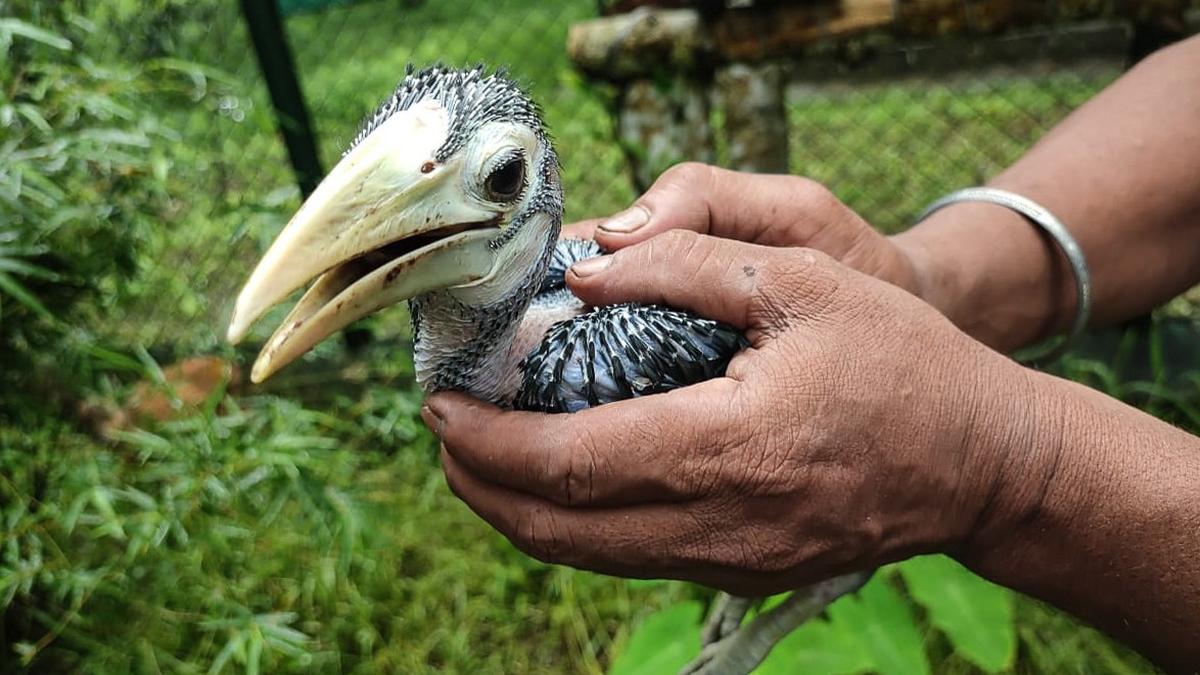


Oriental Pied Hornbill admitted at Assam’s Centre for Wildlife Rehabilitation and Conservation.
| Photo Credit: SPECIAL ARRANGEMENT
Assam’s Centre for Wildlife Rehabilitation and Conservation (CWRC), India’s first dedicated facility to hand-raise, treat and release orphaned and injured animals back into the wild, has stepped into its 25th year.
The Assam Forest Department and Wildlife Trust of India (WTI) jointly run the CWRC in partnership with the International Fund for Animal Welfare.
Located at Panbari near Kaziranga National Park and Tiger Reserve, the CWRC was established on August 28, 2002, for science-based wildlife conservation. Over the years, the centre and its allied mobile veterinary service units have treated and released about 68% of more than 10,000 rescued animals back into the wild.
C. Ramesh, Kaziranga’s Field Director, said the CWRC’s contribution to the rescue, rehabilitation and conservation of Assam’s wildlife, especially animals in distress, has been invaluable.
“The centre has not only saved countless wild animals but has also deepened our understanding and strengthened our capacity to manage human-wildlife interactions across the state,” he said.

Otter pup at Assam’s Centre for Wildlife Rehabilitation and Conservation.
| Photo Credit:
SPECIAL ARRANGEMENT
Rathin Barman, WTI’s Joint Director, said the CWRC represents a journey of compassion, science and partnership. “From responding to wildlife emergencies to giving thousands of wild animals a second chance to return to the wild, CWRC has shown what is possible when conservation organisations and governments work together,” he said.
According to Bhaskar Choudhury, the CWRC’s Centre Manager and lead veterinarian, local communities played a major part in the centre’s conservation success story. Apart from the Forest Department, he appreciated the support of the Ministry of Environment, Forest and Climate Change, the Central Zoo Authority and Guwahati’s College of Veterinary Science.
Beyond emergency response, CWRC works closely with communities, conducting outreach to reduce human-animal conflict and strengthen community-led conservation efforts.

The female rhino calf which was rescued on 17th July 2019, was under care at CWRC.
| Photo Credit:
SPECIAL ARRANGEMENT
“Flood rescue has been a key part of our work. Our teams work alongside the Forest Department to rescue animals stranded, injured, or displaced during floods, provide veterinary care, and reunite young animals with their mothers wherever possible,” Dr Choudhury said.
The CWRC has also played a pivotal role in reintroducing the one-horned rhinos to western Assam’s Manas National Park by rehabilitating rescued individuals. Other notable efforts include rehabilitating Asiatic black bear cubs in Manas and Dihing Patkai National Park; rescued wild buffalo in Dibru-Saikhowa National Park and Laokhowa and Burachapori Wildlife Sanctuary; and rescued hoolock gibbons.
Published – August 28, 2026 07:08 pm IST