


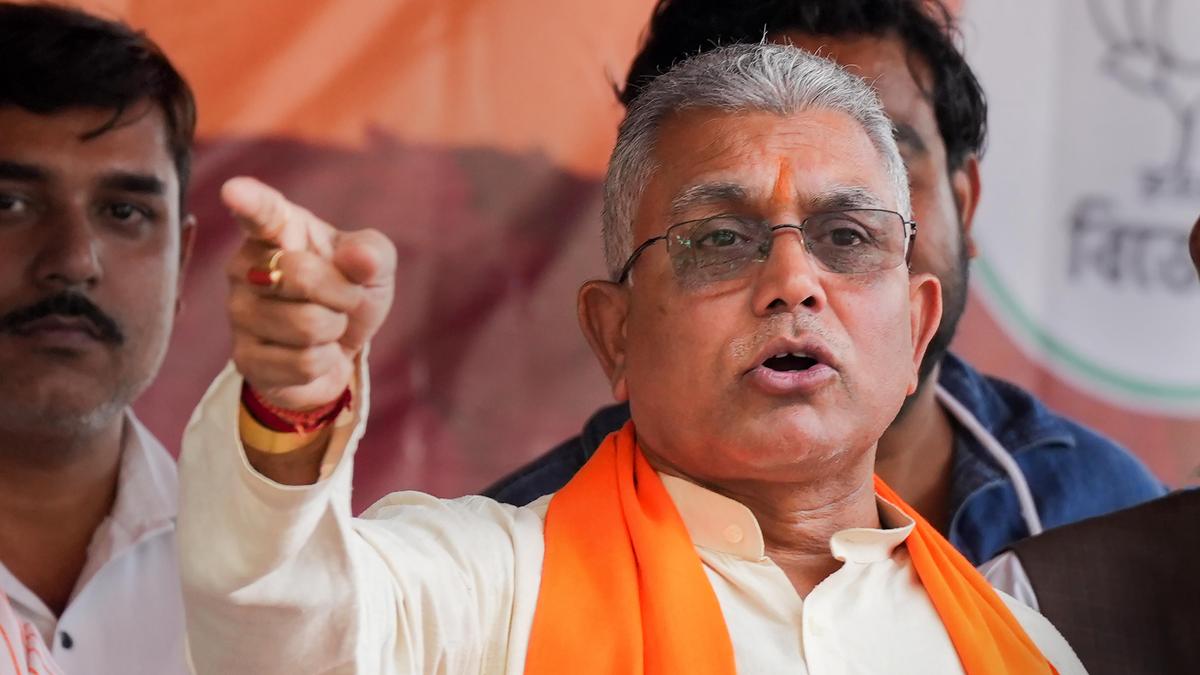

BJP leader Dilip Ghosh. File
| Photo Credit: PTI
Former West Bengal BJP president Dilip Ghosh met incumbent Samik Bhattacharya on Thursday (January 1, 2025), a day after Union Minister Amit Shah included him in key meetings with the State leadership ahead of the 2026 Assembly election in the State.

Mr. Ghosh is likely to return to active politics after keeping a low profile in the BJP for several months, with a political rally with Mr. Bhattacharya in Durgapur scheduled on January 13.
“There have been some changes in the party recently… Many karyakartas have changed. Many new people have been given responsibilities, some have been tested already. Central leaders are visiting, the local team is also making plans. I will remain in the team and will do as I am told,” the former State BJP president said at a press conference on Thursday.
Also Read | West Bengal govt. is allowing infiltration as a policy to strengthen its vote bank: Amit Shah
When asked if he will contest the upcoming Assembly election, he said it would be decided by the party. “I will be there when the party needs me,” Mr. Ghosh said.
The developments assume significance as Mr. Ghosh had stayed away from core party activities and events in 2025, since his controversial meeting with Chief Minister Mamata Banerjee after the inauguration of the Jagannath Temple in West Bengal’s Digha. He was also absent from rallies addressed by Prime Minister Narendra Modi and Mr. Shah last year in West Bengal, leading to speculations of a rift between him and the State BJP leadership.
However, Mr. Ghosh’s presence in key meetings with the Home Minister in Kolkata on Wednesday signalled the possibility of the former State president playing a key role in the upcoming election. It is worth noting that during his tenure as the State BJP chief, the party won 77 of 294 seats in the 2021 Assembly election, compared with three in 2016, and 18 of 42 seats in the 2019 Lok Sabha election, compared with two in 2014.
Published – January 01, 2026 08:05 pm IST