







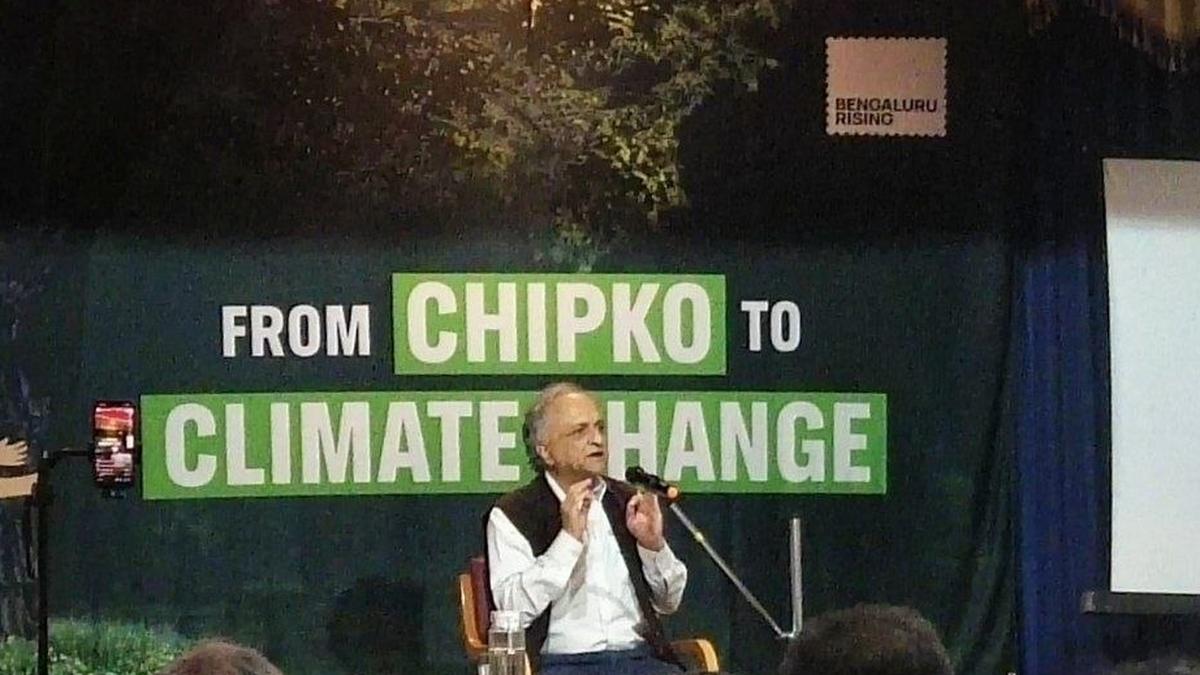


Historian Ramachandra Guha at the event
| Photo Credit: Special Arrangement
As part of the Bengaluru Rising campaign, a climate talk titled, From Chipko to Climate Change was organised by Greenpeace India at Malleswaram, recently. The event was inaugurated with a talk by historian Ramachandra Guha who drew on his years of work on environmentalism, nature and India’s changing climatic conditions, and his book Speaking with Nature (2024).
In his talk, Guha referred to English poet William Wordsworth as one of the first environmentalists and then mentioned Tagore and Gandhi, and their stance on environmentalism in India. He recalled his research on the Chipko Movement, which he described as a “forceful, but non-violent form of resistance.”
Calling environmentalism, “a philosophy of how to live compatibly with nature,” Guha said, “The Chipko Movement disproved the belief that countries such as India were too poor to be green”. Hailing from Uttarakhand, he talks of the influence this movement had in the State and acknowledged the, “critical role journalists played in the Indian environmental movement”.
The historian also lauded the participation of young campaigners present at the event as well as members of the Bengaluru Rising and Greenpeace India initiative teams.
The talk concluded with an interactive session with the audience, and was followed by presentations and discussions with conservationist Rachna Ravikiran, environmental activist Preethi Sunderajan, climate studies researcher Kaustubh Rau and Ravindra, a retired forest officer, under the Voices of Bengaluru banner.

Ravindra, Kaustubh Rau, Rachna Ravikiran and Preeti Sunderajan at the event
| Photo Credit:
Special Arrangement
Naomi Pasangha, a campaigner from Bengaluru Rising, said, “Parks, lakes, forests and rivers are under growing threat in Bengaluru and across the country. Drawing from grassroots movements of the past and present, we must reclaim our voices and reassert ourselves in the public narrative to protect the spaces we care about.”
Stressing on the importance of why such discussions are important, Preeti Sunderajan said, “We often connect environmentalism as being outside the city, in the forests and Western ghats. But conservation in cities is important too, to preserve limited green spaces and water bodies.”
In her talk on ‘Citizens and the fight for Bengaluru’s Commons,’ Rachna Ravikiran said, “Bengaluru’s blue and green spaces should not be treated as merely decorative,” and drew attention to dying lakes and felled trees across the city, mentioning Hosakerehalli Lake, in particular.
Kaustubh Rau spoke of the Mysore Lamps factory in the city and campaigns raised around it. He spoke on the importance of species such as the slender loris,and the role canopies play in helping them traverse their habitats within the city. Ravindra spoke about the leopard population around Banashankari, and brought forward his idea of “a deemed forest status” to protect the city’s green spaces.
Posters, cartoons and models based on the topic were also exhibited at the venue.
Published – September 25, 2026 11:50 am IST