






According to Bescom’s Annual Performance Review report, it incurred capital expenditure of ₹3,164.79 crore for the 2024-25 fiscal. Of this, ₹2,41.04 crore was for replacement of distribution transformers.
| Photo Credit: File photo
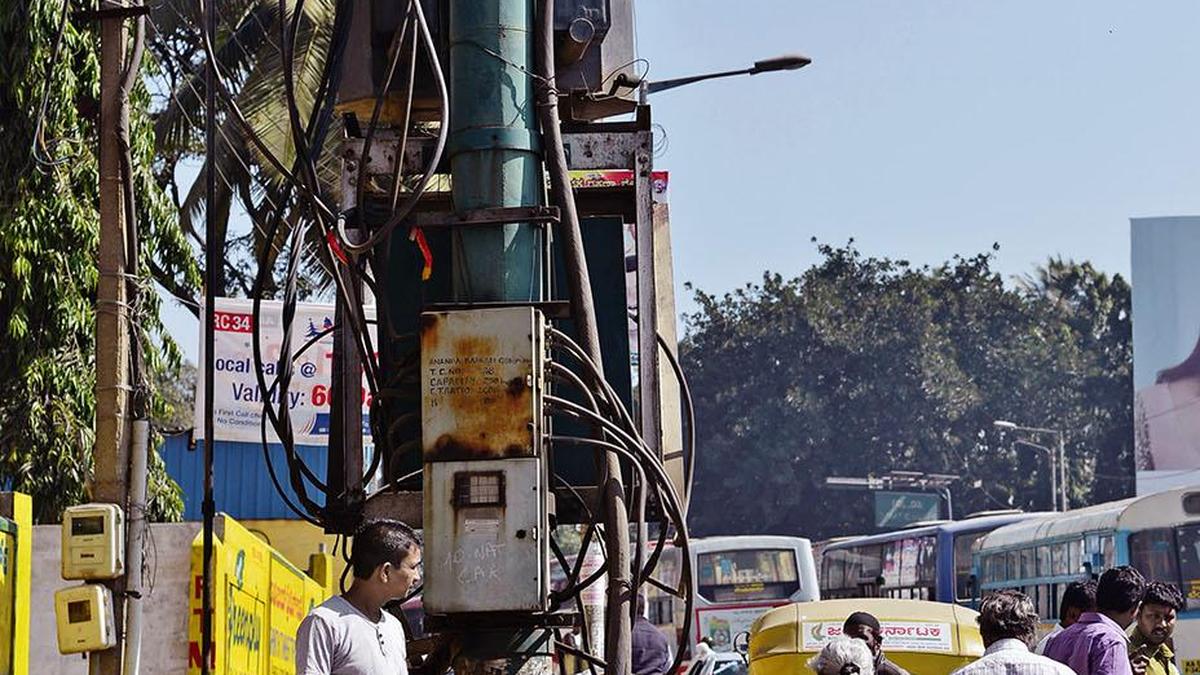
Every year, around 38,000 to 40,000 transformers are burnt or damaged due to overload, lightning, aging, short circuits, manufacturing defects and other reasons within the jurisdiction of the Bangalore Electricity Supply Company Ltd. (Bescom). This year, in just seven months, around 16,749 transformers were burnt in Bescom jurisdiction until July 2026 out of a total of 5,71,178
According to Bescom’s Annual Performance Review report (APR), it incurred capital expenditure of ₹3,164.79 crore for the financial year 2024-25. Of this, ₹2,41.04 crore was for replacement of distribution transformers.
Officials state that on an average, around 28,000 transformers are added every year to the existing number. The average percentage of failure of transformers has remained consistent between 7 and 8% since 2019.
Total transformers burnt in last three years
| Year | Burnt transformers |
| 2023-24 | 38,288 |
| 2024-25 | 40,791 |
| 2025-26 | 38,062 |
| 2026-27 (till july 2026) | 16,749 |
A Bescom official acknowledged that despite regular service and maintenance, transformers get damaged due to overloading and lightning. The official said: “We have identified a few places where overload happens and necessary steps are being taken. We have installed additional transformers and upgraded existing transformers to avoid overloading issues.”
He added: “Phase balancing process is followed. Regular maintenance of transformers, cable management, tightening of connections, and strengthening of damaged earthings are carried out regularly. Cutting trees along high tension and low tension routes to avoid tree branches touching electric wires or even transformers is also done. We have also tightened loose paths, straightened crooked poles, and removed unauthorised loads.”
As per the APR report, the failed transformers are being replaced with repaired transformers from the buffer stock. The report further stated that the replacement of failed distribution transformers is essential to maintain continuous power supply for drinking water installations and maintain quality power supply to consumers.
Percentage of failure, existing and failed transformers
| Financial year | Existing transformers | Failed transformers | % of failure |
| 2019-20 | 3,81,103 | 30,751 | 8.07 |
| 2020-21 | 4,25,897 | 32,034 | 7.52 |
| 2021-22 | 4,55,604 | 35,987 | 7.9 |
| 2022-23 | 4,78,361 | 38,047 | 7.95 |
| 2023-24 | 4,97,991 | 38,288 | 7.96 |
| 2024-25 | 5,29,848 | 40,791 | 7.7 |
| 2025-26 | 5,62,189 | 38,062 | 6.77 |
| 2026-27 (July ’26) | 5,71,178 | 16,749 | 2.93 |
Bescom said there is a sufficient buffer stock of 10,202 new and repaired transformers at transformer banks and divisional stores for replacement of failed ones. The replacement or installation cost of a standard distribution transformer averages around ₹5.05 lakh per unit. It varies according to the procurement, contract prices and is based on the capacity including 25kVA, 500kVA, and 1000kVA.
M.G. Prabhakar, energy expert, said: “Technologies have vastly improved in manufacturing of transformers and the State government must purchase top class ones. Whenever they are purchased in huge numbers, the stock should be double-checked so that there are no faulty ones. If there is an overload issue, naturally they fail. But Escoms must ensure they are not overloaded. Whenever a particular power capacity requires augmentation, they must install more than one transformer in such places.”
Published – September 15, 2026 08:46 pm IST