



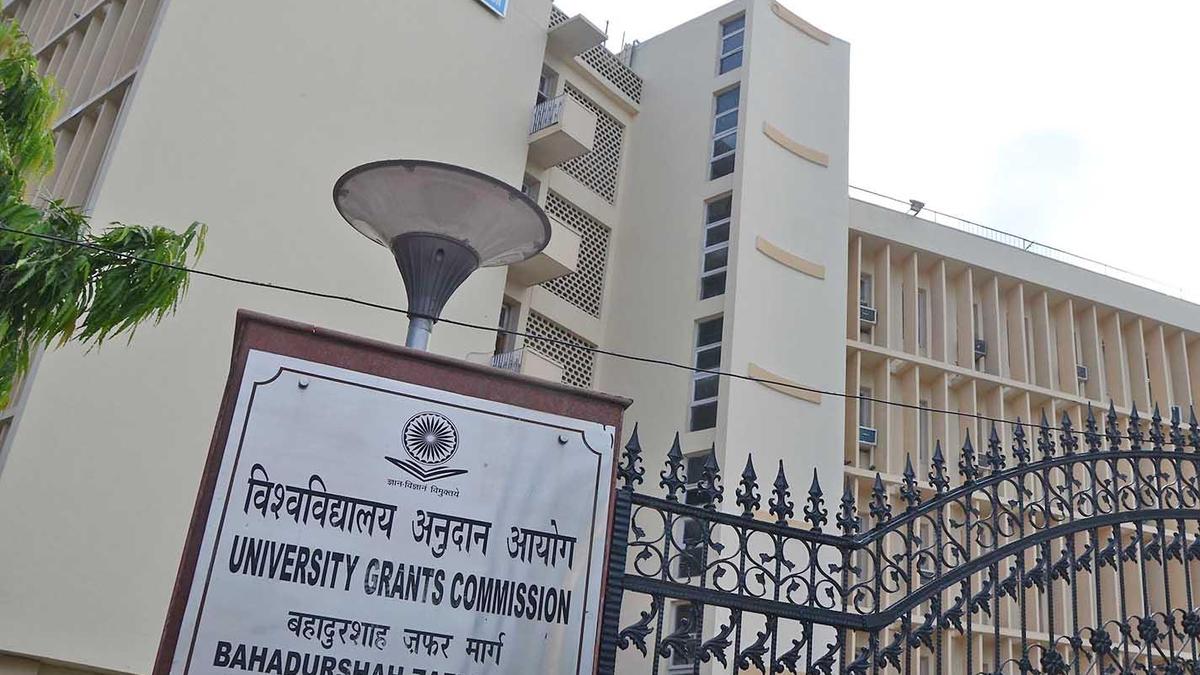

University Grants Commission (UGC).
| Photo Credit: Sushil Kumar Verma
A Parliamentary Standing Committee on Education tabled a report on Monday (December 8, 2025) reviewing autonomous bodies and institutions under the Education Ministry. In the report, it urged the University Grants Commission to include discrimination against Other Backward Classes in the definition of caste-based discrimination in the latest version of the Promotion of Equity rules being framed by the government. It also asked the government to “re-evaluate” the EWS reservation in Associate Professor and Professor-level appointments.

The panel recommended that a Chairperson be appointed to the UGC as soon as possible, noting that the position had been vacant since April this year. It also reiterated the recommendation to ensure that the Draft UGC (Minimum Qualifications for Appointment and Promotion of Teachers and Academic Staff in Universities and Colleges and Measures for the Maintenance of Standards in Higher Education) Regulations, 2025, be discussed with the Central Advisory Board of Education (CABE), noting that at least 10 States have written to the government pointing out concerns and providing suggestions.
The committee, headed by Congress MP Digvijaya Singh, also mentioned its study visit to Varanasi, where it found that “filling of EWS positions in faculty is nearly impossible for Associate Professor and Professor levels”.
The panel explained that a candidate for the post of Professor must have served as an Associate Professor, and that a candidate for Associate Professor must have served as an Assistant Professor. Since both Associate and Assistant Professors earn over ₹8 lakh according to the UGC pay scale, there will never be a candidate who qualifies under the income criteria for the EWS position.
“Universities spend a lot of time and resources seeking applicants for such positions despite knowing that candidates will be impossible to find. In such a situation, the Committee recommends that the Ministry re-evaluate the implementation of EWS at the level of Associate Professor and Professor,” it said.
In the section dealing with the Promotion of Equity rules for higher education institutions, the panel pointed out concerns in the draft version put out earlier this year. It noted that these rules had not been finalised yet and recommended that disability be included as an “axis of discrimination”.

“The draft Regulations must require an annual public disclosure of caste-based discrimination cases, mandatory sensitization programs for faculty and administrative staff, and adequate mental health support and legal aid in all HEIs,” it said. It also called on the government to ensure that the Equity Committee under these rules were representative of the faculty and students, meaning that over half of its composition should be from the SC, ST, and OBC communities.
On higher education in general, the committee said the goals of the National Education Policy, 2020 were “ambitious” in terms of achieving a 50% Gross Enrolment Ratio by 2030 and switching from a three-year to a four-year undergraduate programme. This would require considerable infrastructure enhancement and faculty recruitment.
However, the panel said, “UGC and the Department’s recent measures to restrict funding for capital projects in HEIs poses a challenge to achieving the goals of the NEP. The Committee is also concerned about the ability of the degree colleges to meet the requirements of the NEP and it feels that there exists mismatch between the current status of these colleges and the vision of the NEP which needs a comprehensive evaluation and a concrete response.”

The committee noted that universities needed “greater support” in implementing Multiple Entry Multiple Exit frameworks and to design the curriculum for these courses in a way that one-year certificates or two-year diplomas can provide students with “marketable skills”.
The House panel also highlighted that apart from the Indian Institutes of Technology and the National Institutes of Technology, newly recruited faculty at Central universities and other UGC-funded institutions “do not receive seed grants at the beginning of their tenure for establishment and research expenditures”.
Published – December 08, 2025 09:30 pm IST