






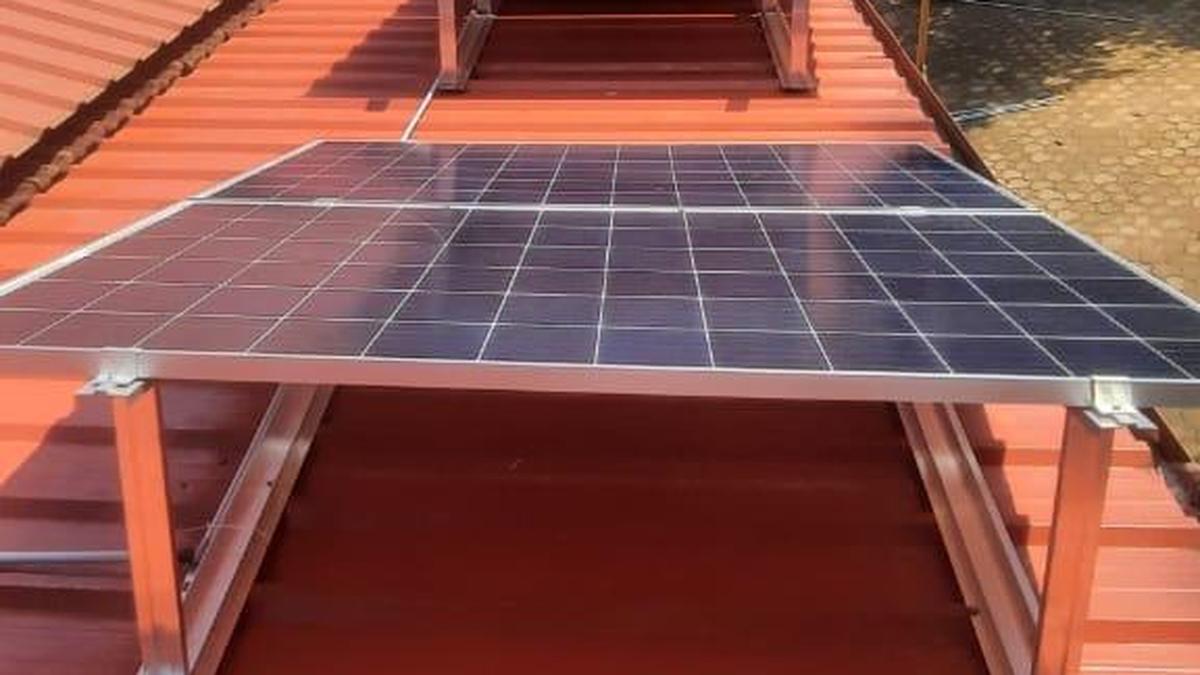


A 5 kW solar power generation unit installed at the Primary Health Centre at Basrur in Kundapura taluk of Udupi district in Karnataka.
| Photo Credit: FILE PHOTO
In a move to curb electricity expenditure in government health facilities, the Health Department has prioritised the adoption of solar power across Karnataka. Karnataka has become the first State in India to install solar power units in as many as 3,600 health centres within a year, achieving 80% to 85% savings in electricity bills, officials said.

The installation of solar power units is being supported under Corporate Social Responsibility (CSR) funds. The project is being implemented under the ‘Saura Swasthya’ scheme in partnership with SELCO Foundation. It is expected to benefit more than three crore rural residents by enabling uninterrupted power supply to government hospitals.
Since its launch in November 2024, solar power units have been installed in around 3,000 health centres, with over 1,150 facilities fully solarised. With ongoing installation work in nearly 1,300 sub-centres, the department expects to reach 3,700 centres by the end of the year.
Through the partnership, Karnataka aims to solarise 5,000 health facilities by 2026. These include 2,877 sub-centres, 1,971 Primary Health Centres (PHCs), 28 Urban PHCs, 12 Community Health Centres (CHCs), and 112 taluk hospitals.
While sub-centres have rooftop solar units ranging from 0.25 kW to 1 kW capacity, PHCs are equipped with 4 to 5 kW units. Taluk hospitals are being fitted with systems of up to 10 kW capacity.
The project, implemented at an estimated cost of ₹120 crore, has already yielded power savings of over three megawatts and reduced electricity bills by up to 70% in the facilities covered so far. The department foresees savings of about ₹50 lakh every month — over ₹100 crore in 10 years — by reducing dependency on grid power and diesel generators.
Carbon reduction
Health Minister Dinesh Gundu Rao told The Hindu on December 5 that the initiative will ensure 24×7 power availability at health facilities, enabling critical equipment and services to function without disruption.
“The project will help strengthen healthcare delivery in rural pockets. Saura Swasthya will not only ensure uninterrupted healthcare services, but also lead to immense savings in electricity bills,” he said.
Long-term functionality
Beyond installation, SELCO Foundation is focusing on ensuring the long-term functionality and extended lifespan of the systems through innovative operation and maintenance (O and M) strategies. Remote Monitoring Systems (RMS) have been deployed to enable real-time tracking and preventive maintenance.
Additionally, a ‘Saura e-Mitra’ mobile application is being used for maintenance support. Medical staff can raise service requests through the app, which are routed through a centralised system for timely action. So far, 626 such complaints have been logged, 314 of which have been resolved. More than 2,000 personnel have been trained in the maintenance of solar units and the monitoring system.
SELCO Foundation director Huda Jaffer said Karnataka has become the first State in the country to establish a dedicated Solar O&M Learning Centre for health institutions. Located in Raichur, the centre aims to build local technical capacity for continuous and decentralised maintenance.
“This initiative is reducing electricity costs, lowering CO₂ emissions, and strengthening uninterrupted healthcare services for last-mile communities,” he said.
Published – December 06, 2025 10:20 am IST