


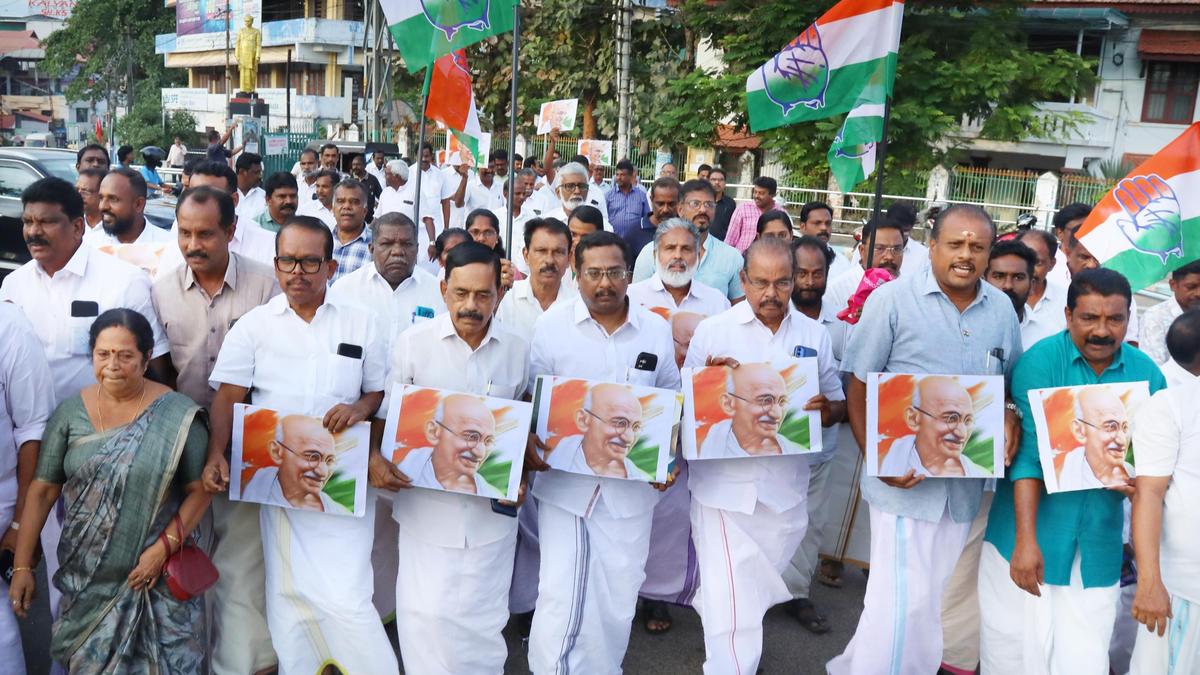

A demonstration led by the Kollam District Congress Committee against the omission of the name of the Father of the Nation from the Bill replacing the Mahatma Gandhi Rural Employment Guarantee Scheme.
| Photo Credit: C. Sureshkumar
Recent changes introduced by the Centre to the Mahatma Gandhi National Rural Employment Guarantee Scheme (MGNREGS) will impose an additional financial burden of ₹1,600-₹2,000 crore annually on Kerala, according to Finance Minister K.N. Balagopal.
The Minister was presiding over the 9th I.S. Gulati Memorial Lecture organised by the Gulati Institute of Finance and Taxation (GIFT).
At present, the Centre bears 90% of the expenditure on the scheme. With the contribution reduced to 60%, the State will be forced to shoulder a significantly higher share, Mr. Balagopal said. Last year, the Centre provided ₹4,838 crore for the scheme.
Kerala, he said, has been performing exceptionally well in implementing the MGNREGS. However, frequent policy changes by the Centre in the financial domain make it difficult for States such as Kerala to move forward. The Minister added that Kerala has managed to sustain itself largely due to its ability to raise tax revenues.
Delivering the memorial lecture, D.K. Srivastava, Chief Policy Advisor at Ernst & Young, and a former member of the Finance Commission, called for prioritising equity in financial transfers between the Centre and States. Disparities in revenue and expenditure across States remain a major challenge, Prof. Srivastava said, urging the Finance Commissions to address the issue. While interstate disparities are still significant, he noted that they are gradually narrowing, which is encouraging.
Former Finance Minister T.M. Thomas Isaac, who moderated the session, said equity should be the guiding principle in resource allocation to States. Disparities in per capita income and private investment across States are widening, he said, adding that backward States could adopt Kerala’s model in several areas to improve their performance.
GIFT director K.J. Joseph and Prof. Gulati’s wife Leela Gulati were among those present.
Published – December 17, 2025 08:43 pm IST