




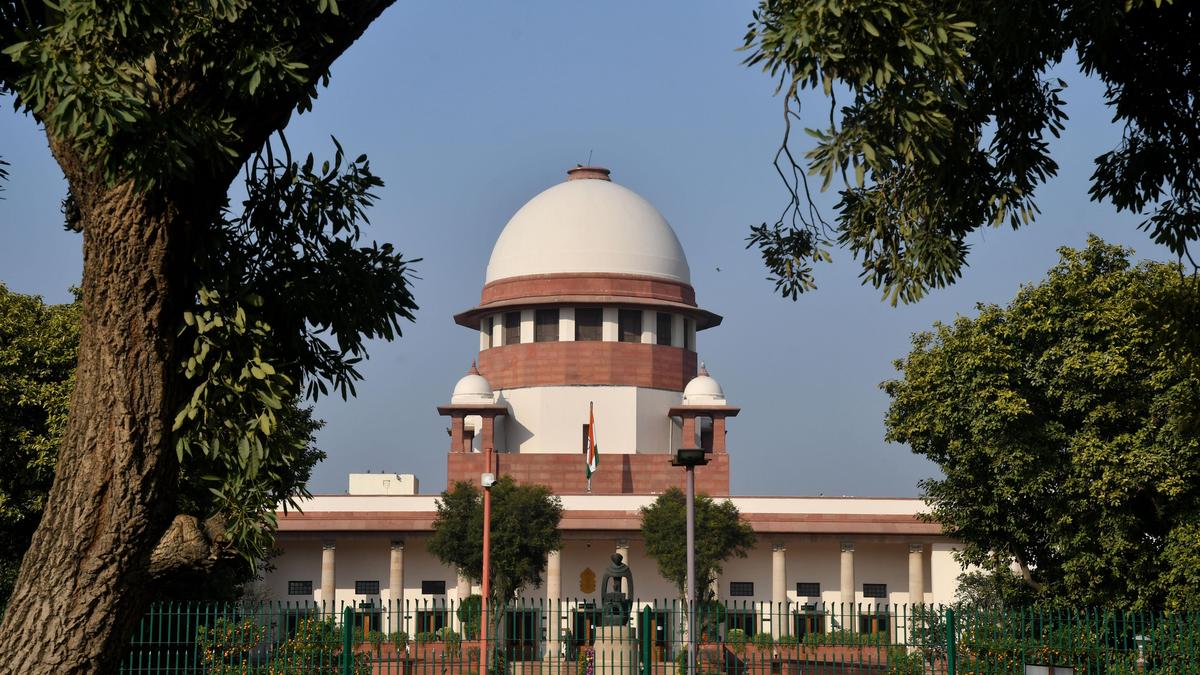


Justice Datta turned the spotlight on the Union government’s “piecemeal approvals” of recommendations made by the Supreme Court Collegium for judicial appointments. File.
| Photo Credit: Sushil Kumar Verma
Supreme Court Justice Dipankar Datta on Wednesday (September 23, 2026) lashed out at critics in the Union government who claim that the Collegium system of judicial appointment is an insular mechanism of “judges appointing judges”, saying the judiciary cannot always be at the receiving end of the Executive.
“The oft-repeated phrase that ‘Judges appoint Judges’ is a myth which people have been fed by vested interests through motivated narratives, often drawing sustenance from certain controversial decisions taken in this century in relation to appointment of judges,” Justice Datta observed.
The observations were part of his separate opinion in a split verdict on the legality of a 2023 law on appointments of the Chief Election Commissioner and Election Commissioners.
Justice Datta said sweeping generalisations that the Collegium acted as a law unto itself overlooked the detailed consultative process and the intrinsic role of the Executive, both at the Central and State levels, as well as intelligence and other agencies in the judicial appointment process.
The judge said every judicial appointment bore the imprimatur of the President.
Justice Datta turned the spotlight on the Union government’s “piecemeal approvals” of recommendations made by the Supreme Court Collegium for judicial appointments.
The judge said the government has calibrated the judicial appointment system to override recommendations of the Supreme Court Collegium. Names proposed by the Collegium gather dust for years. Even recommendations for transfer of judges are not acted upon by the government in many cases.
“This court is left to wonder why, even after the judiciary has been relegated to playing second fiddle to the Executive in the matter of appointment of Judges, is there still a clamour to induct an outsider at the stage of selection? Coming as it does from the side of the Executive, the argument ill-behoves its stature and is a feeble attempt to deflect attention from its own dereliction and failure,” Justice Datta said.
The judge said the Supreme Court Collegium, despite the government’s conduct, continue to do its work to “avoid a head-on conflict with the Executive, left with Hobson’s choice to keep the institution running”.
Justice Datta was responding to oral submissions made by Solicitor General Tushar Mehta during the hearing, drawing a parallel between judicial and Election Commission appointments.
Mr. Mehta had questioned the Supreme Court’s consistency, asking why it had rejected “outsiders” in judicial appointments during the NJAC ruling while insisting that the Chief Justice of India sit on the selection committee for Election Commissioners.
Justice Datta said the criticism was “unworthy”, but it was necessary to reply to Mr. Mehta “lest the silence be misunderstood as a tacit acceptance”.
“Vociferous criticism, by itself, does not offer an alternative. While the absence of an outsider in the process may invite scrutiny, Executive supremacy cannot be the cure. The constitutional quest is not to transfer primacy from one organ to another, but to secure a system that preserves institutional independence,” Justice Datta noted.
Justice Satish Chandra Sharma, however, differed with Justice Datta’s observations, saying the submissions by the Solicitor General were not meant as a criticism of the Collegium system.
“In my opinion, it was a submission to the effect that if the Constitution Bench has held that the presence of outsiders in the Collegium as violative of the Doctrine of Separation of Powers, a similar independence should be read in the Executive also… In my perspective, it was neither a criticism of the Collegium system nor initiating any debate regarding the manner in which the system of selection has worked,” Justice Sharma wrote in his opinion.
Published – September 23, 2026 11:01 pm IST