



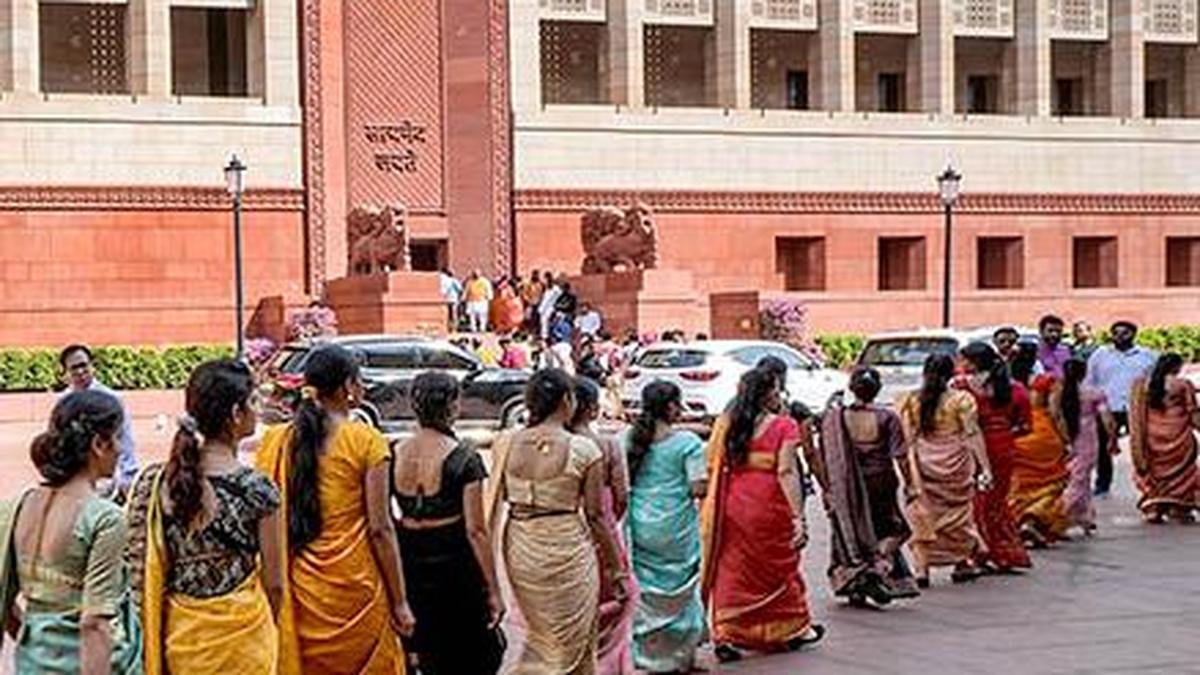

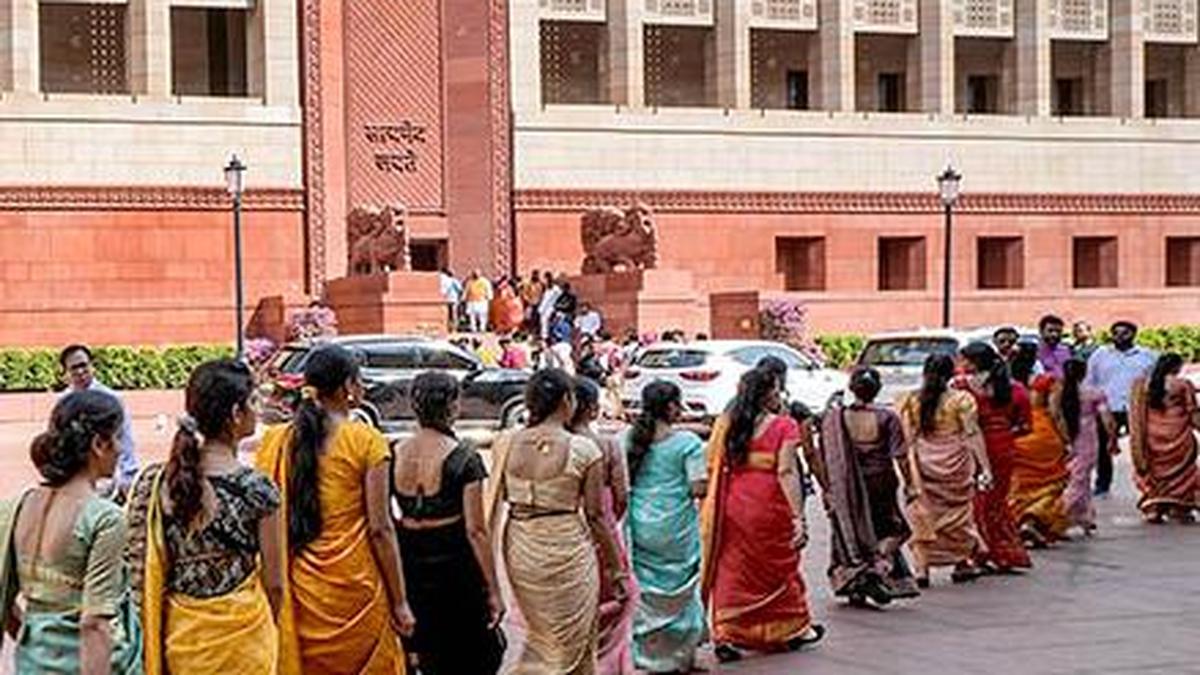
If the Bill is passed, seats in the Lok Sabha will increase to 816, out of which 273 will be reserved for women.
| Photo Credit: PTI
Even as the Congress has refused to meet government interlocutors on the implementation of the Women’s Reservation Act—now proposed to be based on the 2011 Census instead of waiting for the ongoing enumeration—two of the largest opposition parties, the Samajwadi Party (SP) and the Dravida Munnetra Kazhagam (DMK), met Home Minister Amit Shah last week.
The government’s move also accelerates delimitation of Lok Sabha and Assembly seats, increasing the Lower House’ strength from 543 to 816.

On Thursday, the SP delegation was scheduled to meet Mr. Shah at 10:30 a.m. An hour before the meeting, Union Law Minister Arjun Meghwal arrived at the residence of senior SP leader Ram Gopal Yadav to accompany him and the rest of the delegation. Mr. Meghwal’s unusual courtesy was to ensure that the party did not skip the invitation after earlier reschedules. A DMK delegation led by its Lok Sabha leader K. Kanimozhi met the Home Minister on Friday.
Both parties responded positively to the government’s proposal. Tamil Nadu Chief Minister and DMK president M.K. Stalin said in a post on X on Tuesday (March 24, 2026) that the party “fully supports this initiative of bringing women’s reservation with any preconditions,” while insisting on the southern States’ “right to fair delimitation.” He reiterated that the current proportional representation of States “should not be disturbed” and called for a constitutional guarantee preserving this balance for the next 30 years.
Mr. Stalin, however, questioned the timing, calling it an attempt to “secure electoral gains” ahead of upcoming Assembly elections in four major States. With the Model Code of Conduct in force, he said, “pushing such an important step is unprecedented,” urging the government to convene a special session in June after the polls to enact the constitutional amendment.
Two days before the SP meeting, on March 16, Congress president Mallikarjun Kharge, responding to a written invitation from the government, after it spurned many oral invites, insisted on an all-party meeting where the “roadmap can be discussed with all opposition parties present.” The Congress had already conveyed this stance verbally to the government.

Congress, which sees itself as the natural leader of the INDIA bloc owing to its parliamentary strength and national footprint, failed to communicate this position to allies, several of whom met the government individually.
On Tuesday, Mr. Kharge again wrote to Union Minister Kiren Rijiju, this time on behalf of “all Opposition parties,” reiterating the demand for an all-party meeting and asking the government to circulate a written note detailing its proposal. The meeting, he said, should be held only after the current round of Assembly elections. Several Opposition parties, including the Left, signed the letter.
The Left parties, incidentally, were the only ones to follow the Congress’s lead. They refused to meet the government either individually or collectively, declining invitations for Monday’s round of talks during which Mr. Shah met the NCP (SP), Shiv Sena (UBT), YSR Congress, and AIMIM. Several rounds of invitations hurriedly scrawled on chits passed around on the floor of the House, ahead of Monday’s meeting, by the government interlocutors to invite the Left leaders also failed.
Signatories to Mr. Kharge’s latest letter include several parties that have already met the government, such as the DMK and the NCP (SP).
The Trinamool Congress, meanwhile, refusing to take its eye off the assembly elections in West Bengal, has not engaged on the issue, either with the government or with the rest of the Opposition. It has spurned all invitations from the government. Trinamool Rajya Sabha leader O’ Brien called it an “election stunt”. Another senior leader said that such invitations could not be extended informally in Parliamentary corridors.
The government has not shared any written document with the parties it briefed. Instead, Mr. Shah communicated key elements verbally: delimitation will be based on the 2011 Census; population will not be the determinant in deciding strength of a State’s representation in the Lok Sabha; Lok Sabha and Assembly seats will increase by 50% across the board; each State’s percentage share of Lok Sabha seats will remain unchanged; and a quota for women will apply to SC and ST reserved seats. A Delimitation Commission is likely to be constituted by June. The government has not explained the basis for the 50% figure.
Published – March 24, 2026 10:05 pm IST