




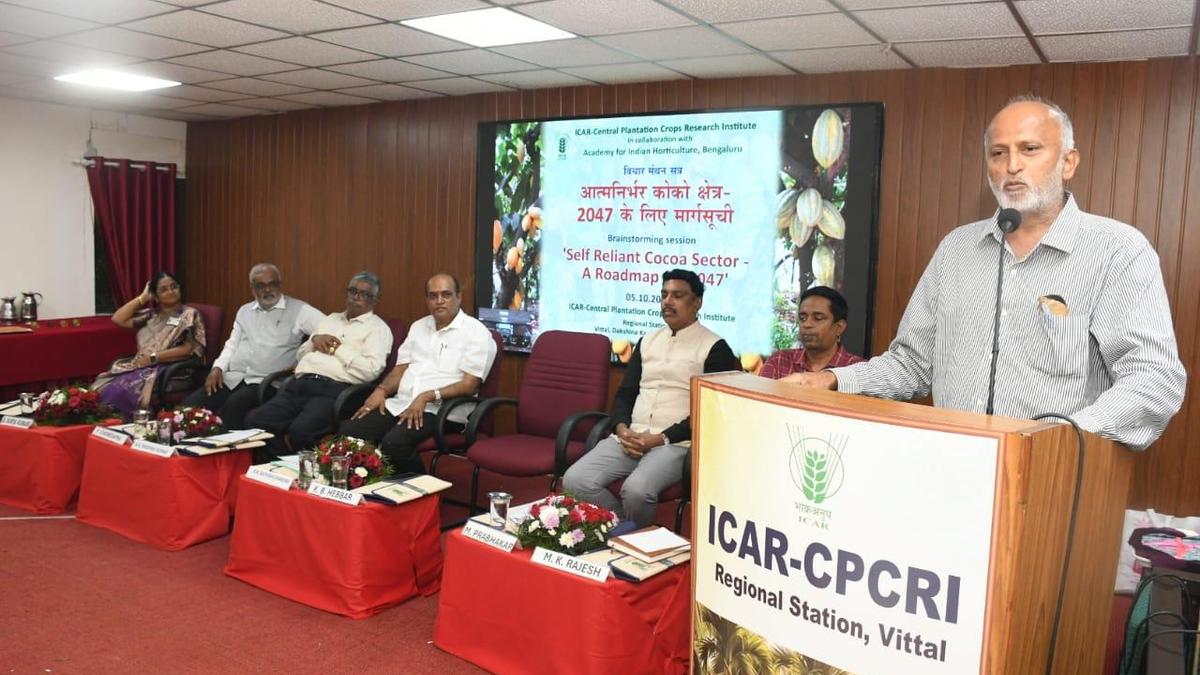


K. B. Hebbar, director, ICAR-CPCRI, speaking at a programme at CPCRI’s Regional Station, Vitla, on Monday.
| Photo Credit: SPECIAL ARRANGEMENT
K. Balachandra Hebbar, director, Central Plantation Crops Research Institute (ICAR-CPCRI), Kasaragod, Keralam, said on Monday that a “definite answer” on whether arecanut consumption results in cancer will be available within the next two years.
The multi-institutional research project titled ‘Evidence-Based Research on Arecanut and Human Health’, which began in 2025, will be completed within the next two years, he said.
ICAR-CPCRI is the coordinator of the Union government-sponsored project.
Speaking at the inauguration of a workshop on ‘Self-Reliant Cocoa Sector: A Roadmap for 2047’ organised by ICAR-CPCRI at its Regional Station in Vitla, Mr. Hebbar said it is a comprehensive and first-of-its-kind research project on arecanut undertaken anywhere in the world.
“In one or two years’ time, we will come out with a definite answer on whether arecanut is really responsible for causing cancer in human beings,” he said.
The research team includes representatives from the All India Institute of Medical Sciences (AIIMS), the National Botanical Research Institute (NBRI), the Centre for Cellular and Molecular Biology (CCMB), the Indian Institute of Science (IISc), the Jawaharlal Institute of Postgraduate Medical Education and Research (JIPMER), the Central Food Technological Research Institute (CFTRI), Kasturba Medical College, K.S. Hegde Medical Academy, and SDM College of Medical Sciences and Hospital, among others.
According to the Union government, 16 national and State-level agencies are involved in the research.
Referring to cocoa cultivation, Mr. Hebbar said ICAR-CPCRI is studying cocoa production under a project both as a monocrop and as an intercrop in arecanut and coconut-based systems across different agro-ecological regions.
Mr. Hebbar said experts in the cocoa sector estimate the country’s demand for cocoa beans at 1.10 lakh tonnes, as against a domestic production of 30,000 tonnes. Cocoa can also be cultivated as an intercrop in oil palm plantations, apart from arecanut and coconut plantations. A vast area is available for cocoa cultivation in the country, he said.
Meanwhile, 24 tissue-cultured and hardened dwarf arecanut plants were planted on the Regional Station premises for field trials. The plants were developed by ICAR-CPCRI for the first time and are part of 100 such plants developed by the institute for field trials.
Published – October 05, 2026 07:17 pm IST