


The Delhi High Court on Friday (September 18, 2026) banned victory processions after the declaration of Delhi University Students’ Union (DUSU) election results, directing the Delhi Police to ensure that no such procession is held on roads, inside colleges or hostels.

The court warned that any violation would invite criminal and administrative action against the erring students and also amount to contempt of court.
A Division Bench of Chief Justice Devendra Kumar Upadhyaya and Justice Tejas Karia passed the direction while expressing strong concern over repeated violations of the Lyngdoh Committee recommendations and alleged incidents of hooliganism in and around the university campus during the DUSU elections.

The Bench observed that the actions taken by Delhi University and the police had “not been working as deterrent” and said there could be no doubt that violations of the Lyngdoh norms were recurring.
“The situation has to be checked by all means,” the Bench said.
The court also proposed imposing “collective electoral damages” on individual students found violating the norms as well as student organisations, and directed that notices be issued to all student organisations along with their candidates. Around 140 candidates are contesting the DUSU elections, the court was informed.
The Bench also directed the petitioner to compile, within two weeks, a report of students who may have violated the election norms.
The observations came as the court questioned the authorities over alleged unruly conduct by students, including cavalcades of vehicles and an incident in which a student was allegedly involved in assaulting a teacher after winning an election.

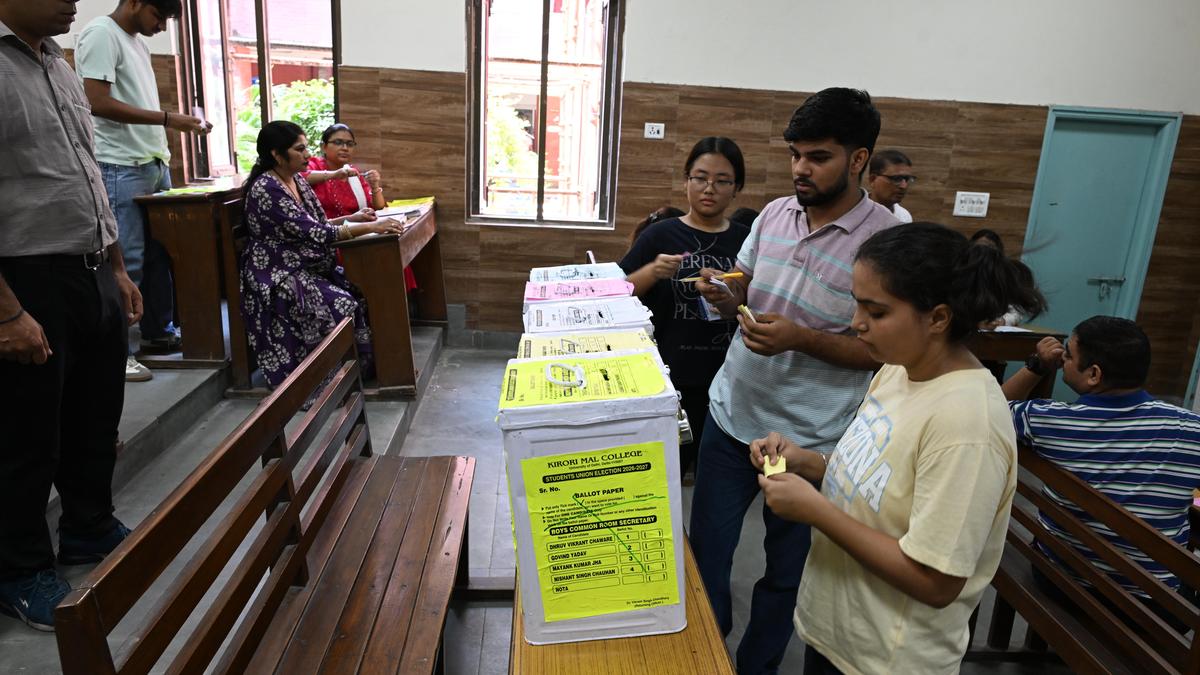
Student voters gather outside Kirori Mal College to cast their votes during the Delhi University Students’ Union (DUSU) elections at North Campus, in New Delhi on September 18, 2026.
| Photo Credit:
ANI
The court particularly questioned how vehicles without registration plates were allowed to ply on Delhi roads and asked the police about a reported cavalcade of around 20 cars.
The court said such cavalcades and processions “create a sense of terror, fear” and a sense of “hegemony” being established by candidates. “Standing on the roof and bonnet of the cars, what else is hooliganism?” the Bench remarked.
Additional Solicitor General Chetan Sharma, appearing for the Delhi Police, told the court that 998 challans had been issued, 30 cars impounded, six FIRs registered and four students were arrested. One student had also been rusticated, he said.
The court then sought details of an alleged assault on a teacher. Mr. Sharma said the accused had been arrested.
When asked whether the accused was a student or an outsider, Mr. Sharma said the person was a student and that three other students had also been arrested in connection with the incident.
The Bench questioned Delhi University on the action taken against the students. The university said show-cause notices had been issued to them. The court said the criminal action initiated by the police should be taken to its logical conclusion.

It also said that administrative action by Delhi University and the Delhi Police did not appear to be acting as a sufficient deterrent to students allegedly indulging in hooliganism and other activities amounting to offences.
The Bench further said police officials should not feel “shy or constrained” from taking action merely because those involved were students. “Can somebody brandishing weapons be termed as a student?” the court asked.
The court also questioned the source of money being spent on luxury vehicles used in cavalcades, asking, “Roaming around in a cavalcade of luxury cars, where do they get these money from?”
With polling for the DUSU election underway on Friday (September 18, 2026) and counting scheduled to conclude by Saturday (September 19, 2026), the Bench directed that no victory procession be taken out after the results are declared.
The direction applies to candidates, their supporters, students and any other persons, and covers roads as well as university campuses and hostels.
The court was considering a plea by advocate Prashant Manchanda, seeking effective implementation of the Lyngdoh Committee recommendations, anti-defacement norms and the code of conduct governing the DUSU elections.
His plea flagged alleged instances of violence, vandalism and clashes during the ongoing election campaign, involving candidates, their supporters and outsiders.
Published – September 18, 2026 05:03 pm IST