




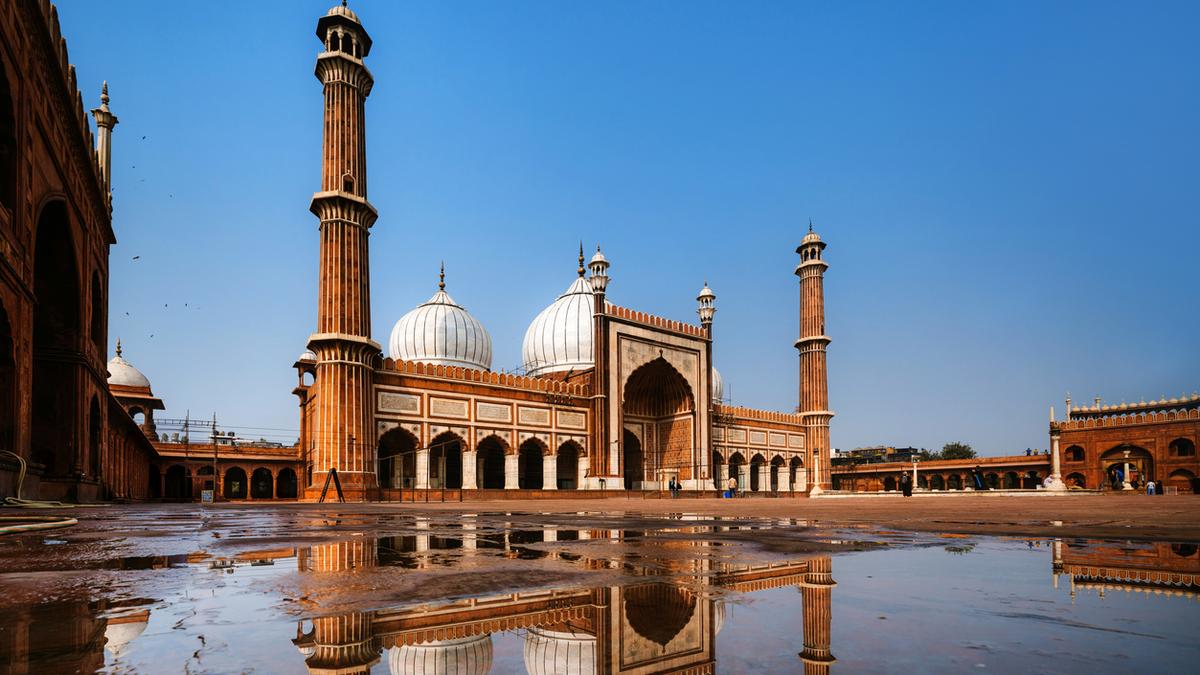


Jama Masjid in Old Delhi, built by Mughal emperor Shah Jahan, between 1644 and 1656.
| Photo Credit: Getty Images
In Delhi, a city where you can choose the route for your early-morning run based on which century’s ruins you want to run alongside, and where a 500-year-old Mughal-era mausoleum can nonchalantly serve as a traffic island on your daily commute to work, timelines can be confusing.
Recently, a post on X by Kaustubh Misra, a history buff who has built a website that visualises the many dynasties that have left their mark on Delhi, created quite a stir among history enthusiasts online. His project attempts to use technology to do what historians, guides, books and brochures about the city have long tried to do: peel back its layers and help navigate the fascinating labyrinth of Delhi’s many cities.
The website is rudimentary. It uses pinned locations on a map of Delhi that you can filter through based on the ruling dynasty and their period of reign. For instance, select the Gupta Empire (375-415 CE) and a single red pin pops up marking the Iron Pillar located in Mehrauli. For the Maurya Empire (250 BCE), there are three blue pins: the Rock Edict of Ashoka in Srinivaspuri and the Ashoka pillars (at Feroz Shah Kotla and Northern Ridge). In all, there are 18 such “layers”, ending with the British colonial rule. Select all and it shows how, in some parts of the city, like Mehrauli, for example, a short walk will have exploring built structures that are hundreds of years apart.

A screenshot of the website developed by Kaustubh Misra.

Kaustubh Misra
A new way to learn history?
Misra, originally from Lucknow and now working in Bengaluru, says the idea came to him when he was working in Delhi and living in Malviya Nagar. A short distance from his home, he could visit Tughlaq-era monuments as well as structures built during the Khilji dynasty.
“I have always been fascinated by the monuments and history of Delhi. I find it very similar to Jerusalem as it too has been demolished and rebuilt several times. When I wandered around, I realised that while each monument has an ASI (Archaeological Survey of India) board outside explaining its history, there was nothing that connected them,” says Misra.
Crediting historian and author William Darlymple’s writings, especially City of Djinns (1993), with piquing his interest in the subject, Misra says that the feedback he has received online has made him realise that he may have inadvertently built a tool that can teach history differently. “Perhaps in the process of building something for history nerds, I have created something that can be used in the classroom to make the study of history more interesting. I wish I had something like this when I was sitting in a classroom in class IX or X,” he adds.
Misra says his experience working in the social sector, with a focus on research using technology-enabled tools, laid the foundation for developing the website. He adds that he sourced the information about the various empires from Wikipedia, while the latitude and longitude coordinates used to pinpoint the locations were taken from the ASI website.
Published – September 18, 2026 05:13 pm IST