

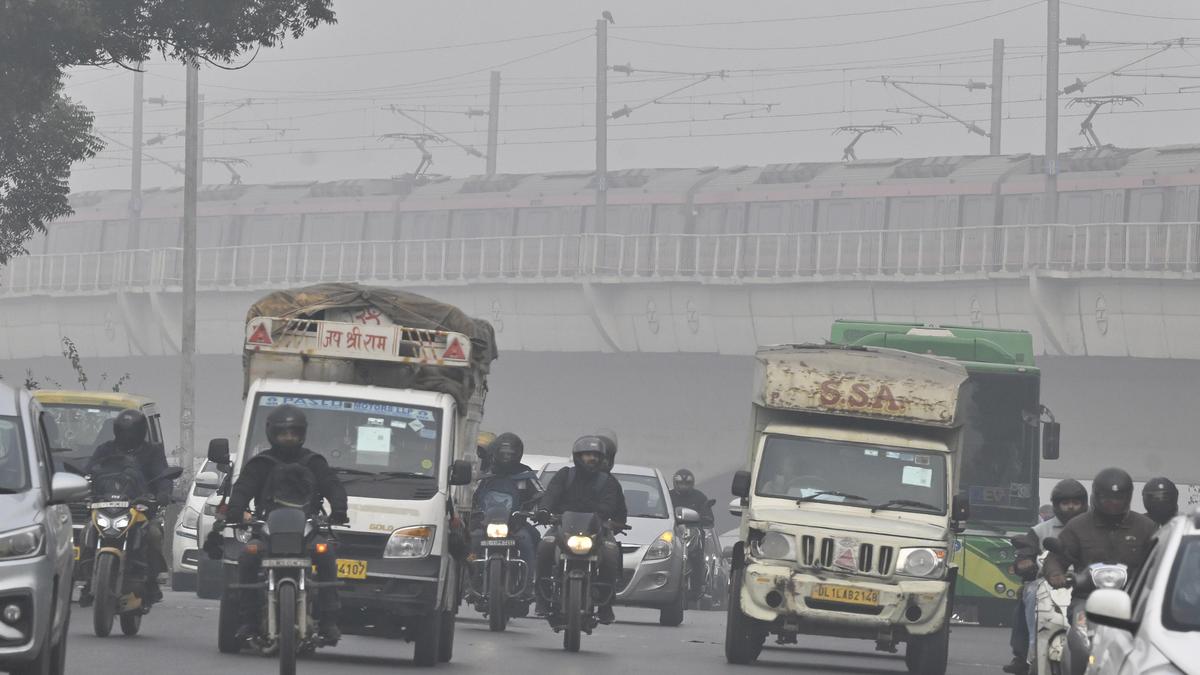

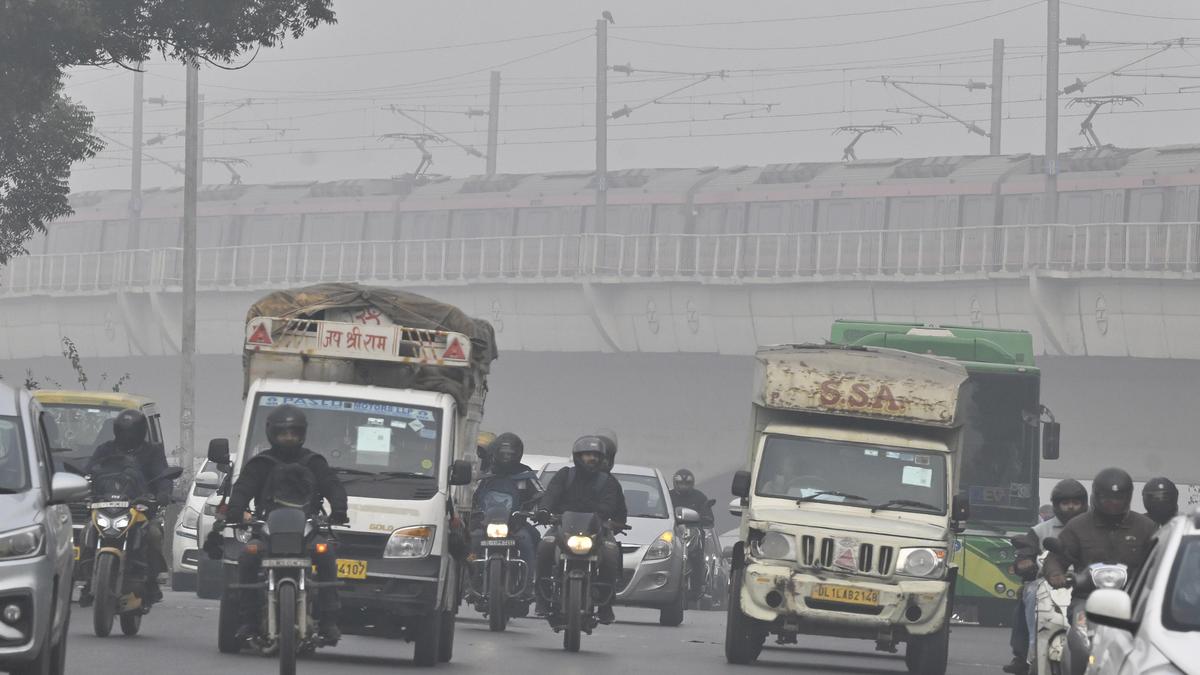
A layer of thick smog shrouded the city of Delhi and other cities around, like NCR, in the Capital on December 30, 2025. Air quality remains in the ‘very poor’ category.
| Photo Credit: Shiv Kumar Pushpakar
As the air quality of the national capital continued to be toxic, Chief Minister Rekha Gupta on Tuesday (December 30, 2025) said that as soon as the Graded Response Action Plan (GRAP), a set of short-term emergency measures to control air pollution, is lifted, the government will start construction of nearly 400 km of roads across Delhi.
The CM said that the construction of these roads will not only improve traffic flow but will also significantly reduce dust emissions from damaged and worn-out roads, which have been a major contributor to pollution in Delhi, as per an official statement.

Meanwhile, the air quality of the city is expected to be in the ‘severe’ category on Wednesday (December 31, 2025) and Thursday (January 1, 2026), as per official data. Air pollution of ‘severe’ level “affects healthy people and seriously impacts those with existing diseases”, as per the CPCB.
Ms. Gupta said that these roads will be constructed wall-to-wall, ensuring that dust generated from road edges is eliminated at the source. “Along with road construction, the Delhi Government is continuously installing mist spray systems on the central verges of roads to neutralise dust particles and strengthen pollution control efforts,” the CMO said in a statement.
As per the Delhi Government, budgetary allocations for 300 kilometres of the proposed 400 km of roads have already been released by the Central Government, and the remaining 100 km of roads will be constructed using the Delhi Government’s own resources.
Ms. Gupta informed that all tenders and related procedural formalities for road construction have already been completed. She said that once the GRAP is lifted, the Public Works Department (PWD) will begin work at a war footing, with construction activities starting simultaneously in multiple parts of the city.
The CM said that roads constructed five years ago or those that have deteriorated significantly will be taken up on priority and the government aims to complete the construction work, with a strong possibility of its completion within the current financial year.
Ms. Gupta said that currently, around 340 mist spray systems are operational at hundreds of locations across the capital, and their coverage is being expanded in a phased manner.
‘Severe’ air pollution
The overall air quality of the national capital on Tuesday (December 30) improved slightly to the ‘very poor’ category, but continue to stay close to the ‘severe’ mark.
Delhi’s 24-hour overall average Air Quality Index (AQI) was 388 ‘very poor’ at 4 p.m. on Tuesday (December 30), down from 401 ‘severe’ a day earlier, as per the Central Pollution Control Board’s (CPCB) daily official bulletin, which is considered as a day’s official AQI. A higher AQI means an increase in air pollution.
But many stations were in the ‘severe’ levels, including Anand Vihar, Chandni Chowk, Rohini, and Punjabi Bagh at 8 p.m. on Tuesday (December 30).

“The air quality is likely to be in the ‘Severe’ category from December 31, 2025, to January 1, 2026. The air quality is likely to be in the ‘Very Poor’ category on January 2, 2026,” said the Central Government’s ‘Air Quality Early Warning System for Delhi’.
An AQI between 51 and 100 is ‘satisfactory’, 101 and 200 is termed as ‘moderate’, 201 and 300 ‘“poor’, 301 and 400 ‘very poor’, and 401 and 450 ‘severe’, and 451 – 500 ‘severe plus’, as per the Commission for Air Quality Management in NCR and Adjoining Areas (CAQM).
Every winter, air pollution spikes in Delhi-NCR and many parts of the larger Indo-Gangetic Plains (IGP), mainly due to meteorological factors such as lower wind speed and a drop in temperature. And pollution from stubble burning during October-November and bursting of firecrackers worsens it.
Published – December 30, 2025 09:45 pm IST