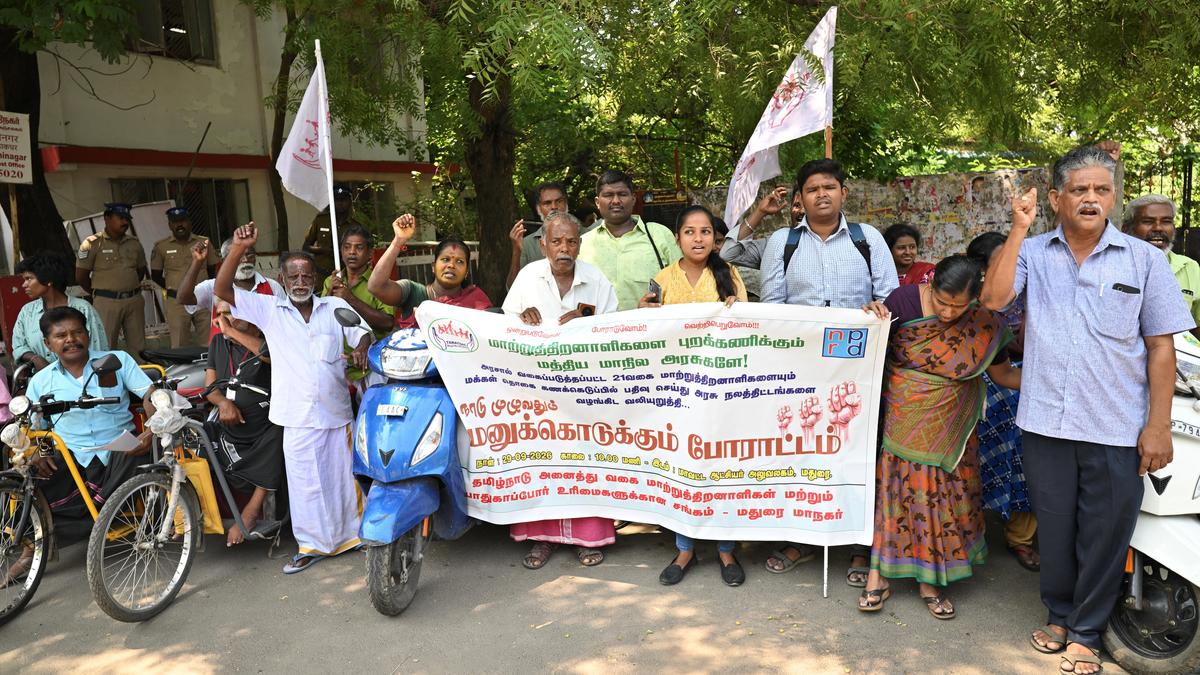


TARATDAC members staging a protest in Madurai on Tuesday.
| Photo Credit: R. ASHOK
Members of the Tamil Nadu Association for the Rights of All Types of Differently Abled and Caregivers (TARATDAC) staged a demonstration condemning both the Union and State governments for allegedly marginalising persons with disabilities in the upcoming census.
As the protest focused on the 2027 Census questionnaire, district secretary A. Balamurugan said it undermined the legal protections and recognition mandated by the disability laws.
“While the Rights of Persons with Disabilities Act, 2016 (RPwD Act) legally recognises 21 distinct categories of “specified disabilities,” the proposed framework for the 2027 Census reduces these to a compressed list of just nine classifications,” he alleged.
These included visual, hearing, and speech impairments, locomotor and intellectual disabilities, mental illness, acid attack survivorship, chronic neurological conditions, and a broad blood disorder category.
Apart from renaming mental retardation to intellectual disability and adding three new groups—acid attacks, chronic neurological conditions, and blood disorders—the proposed census layout mirrored the heavily outdated structure last used in 2011, he stated.
Protesters expressed deep dismay, noting that this narrow framework persists despite firm assurances previously given by Union Minister Ramdas Athawale that all 21 legally recognised conditions would be comprehensively tracked.
They stressed that condensing complex medical and social realities into inadequate brackets caused severe administrative and humanitarian fallout.
“Specific conditions such as Autism Spectrum Disorder, specific learning disabilities, dwarfism, leprosy cured persons, deaf blindness, and multiple disabilities have been entirely omitted as independent categories. Similarly, progressive and debilitating conditions like Cerebral Palsy, Muscular Dystrophy, Multiple Sclerosis, and Parkinson’s disease are lumped into broad general sections, while distinct genetic hurdles like Thalassemia, Hemophilia, and Sickle Cell Disease are added into a single blood disorder heading,” Mr. Balamurugan observed.
He warned that such flawed classification will inevitably confuse census enumerators, spawn inaccurate statistical data, and result in vulnerable populations completely disappearing from government records.
Such an erasure, he argued, would have catastrophic ripple effects, directly undermining policy formulation, welfare scheme design, targeted fund allocation, and administrative accountability.
He demanded that the 2027 Census truly reflects the progressive spirit of contemporary disability rights legislation rather than clinging to obsolete norms.
Published – September 29, 2026 08:32 pm IST