





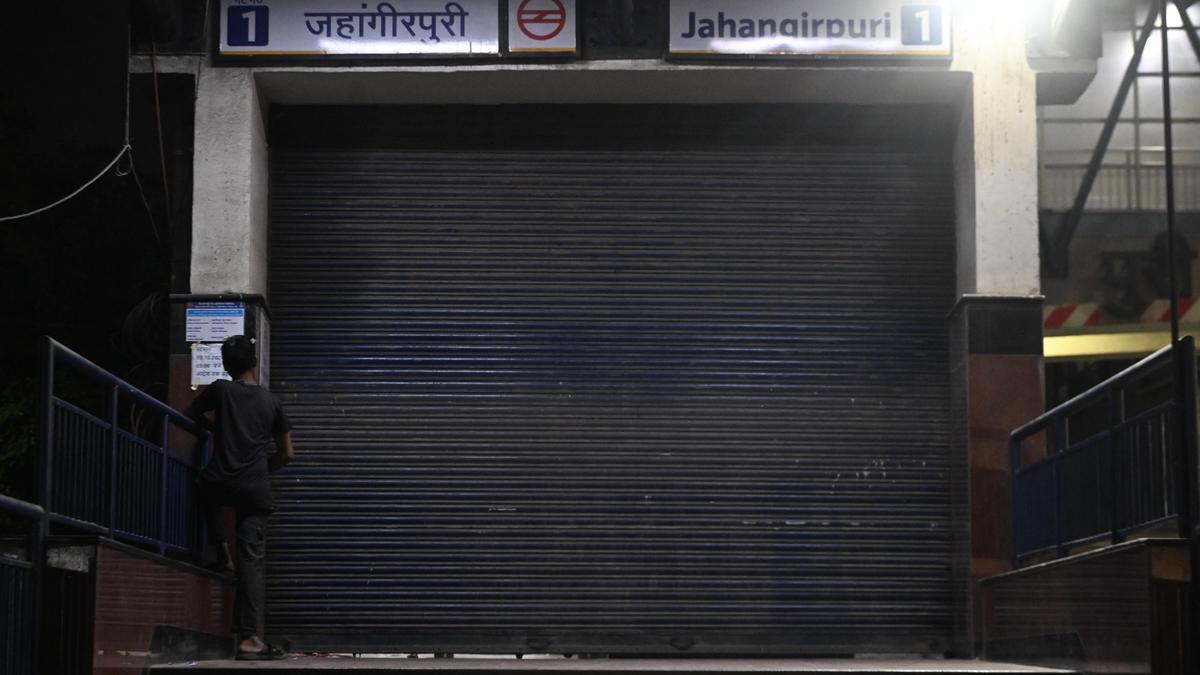


A view of the closed Jahangirpuri Metro Station, as the Delhi Metro Rail Corporation (DMRC) announced that entry and exit gates at 57 stations would remain closed from 9 p.m. on 9 October and throughout 10 October, citing security reasons.
The Delhi Metro Rail Corporation (DMRC) and its chairperson filed separate affidavits in the Supreme Court on Wednesday (October 15, 2026), stating that the Metro network remained “fully functional” on October 10, recording 32 lakh passengers.
“There was zero reduction in the total volume of metro operation or the number of train trips,” the DMRC said.

Though the DMRC admitted that commuter traffic was “slightly lower” than the typical 58 lakh passengers on a “normal” second Saturday, it attributed the drop to public caution amid protests rather than administrative paralysis. It said ordinary citizens were “compelled to forgo their usual day-to-day activities” on October 10.
The day saw heavy security crackdowns in the capital against demonstrations demanding the resignation of Chief Election Commissioner Gyanesh Kumar. Petitioners like CPI(M) general secretary M.A. Baby and advocate Shailendra Mani Tripathi had argued that widespread barricading and station closures violated an October 9 Supreme Court order mandating proportionate movement restrictions.
Defending its actions, the DMRC said entry and exit regulations were limited to 45 of the network’s 303 stations on October 10. Though the initial count of the number of stations to be closed on October 10 was 57, it was scaled down to 45, accounting for about 15% of the network.
“Over 85% of the network (258 stations) remained fully operational, accessible, and functional for commuters,” the DMRC stated.
Crucially, of the 45 stations where entry and exit gates were regulated, 14 key interchange stations (including major transit hubs such as Rajiv Chowk, Kashmere Gate, Central Secretariat, Mandi House, Hauz Khas, Dilli Haat-INA, and Netaji Subhash Place) continued to provide full and uninterrupted line-interchange facilities for commuters. Commuters entering the city as well as inside the city were able to change transit corridors seamlessly without disruption, the affidavit said.
“For the limited stations where passenger gates were regulated, other Metro stations had remained open to minimise inconvenience to the travelling public,” the affidavit noted.

The corporation asserted that the full service schedule was maintained, with 271 trains making 4,157 trips, and noted that restrictions on the 45 affected stations were lifted entirely by 10 p.m. on October 10.
DMRC chairperson D. Thara, in her affidavit, sought discharge from contempt proceedings initiated by the Supreme Court in an order passed at the end of a special hearing on Sunday, October 11.
Ms. Thara said the DMRC would act strictly in accordance with the assessments made and directions issued by the law enforcement agencies and ensure the smooth functioning of the Metro network.
On October 12, the affidavit said that Metro services at six stations were closed from 6 a.m. to 4 p.m. The time was later extended by an hour, until 5 p.m. This may have been in view of the Opposition bloc’s “March for Democracy” to the Supreme Court.
Published – October 14, 2026 05:05 pm IST