



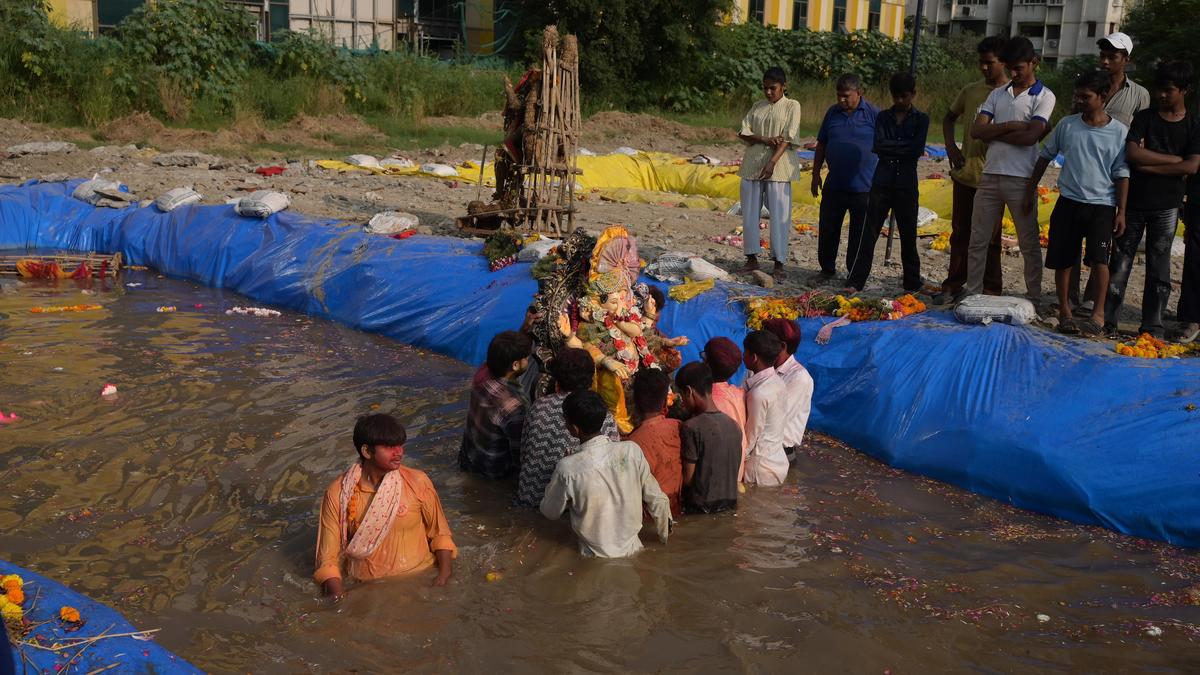


Idols of Lord Ganesha is taken out in procession for immersion, in New Delhi on Friday, September 25, 2026.
| Photo Credit: Sushil Kumar Verma
As drums rolled, DJs blared and dancing groups wound through south-east Delhi on Friday (September 25, 2026) for Ganesh immersion processions, the noise reached beyond the streets. At the National Zoological Park, along Mathura Road, animals were also exposed to the festival noise, with zoo officials acknowledging that loud noise can unsettle them.
The challenge is compounded by the absence of prescribed routes for immersion processions. While seven artificial ponds have been designated across south-east Delhi and devotees also head towards Kalindi Kunj, traffic officials say they have little control over the routes individual groups choose.
At least six traffic officials told The Hindu that no separate route permission is sought for immersion processions. “People from all possible colonies and areas can choose to go to any artificial pond in the area. It is very difficult to determine who will take which path and so there are no designated routes specified for such processions,” a South district traffic official said.
This brings the zoo into focus as Mathura Road, about 100 metres from the animal enclosures at its closest point, is among the arterial roads used by processions. Green belts along the zoo boundary provide some screening from dust and noise, officials said.
A senior zoo official said solitary animals, particularly tigers, were more sensitive to such disturbances. “Carnivores, particularly tigers, and others who stay outdoors, are very sensitive to these noises and can get triggered,” the official said. While some external noise sources cannot be eliminated, “self-discipline by citizens and the government taking steps to ensure that the noise is low in the area near the zoo will help”, the official said.
Animals that live in groups can be comparatively more accepting of noise, the official said. During Diwali, loud sounds and firecrackers force animals into their cells at night as they can become more frightened in open enclosures. For animals such as deer, moving them indoors is not always practical, so staff remain near the enclosures at night to monitor them in case they become agitated.
Speaking to The Hindu, Gauri Maulekhi, trustee of NGO People For Animals said loud noise triggers a primal panic response in animals. “Their hearing is far more sensitive than ours, and what we see as celebration can be perceived by them as an immediate threat to life,” she said.
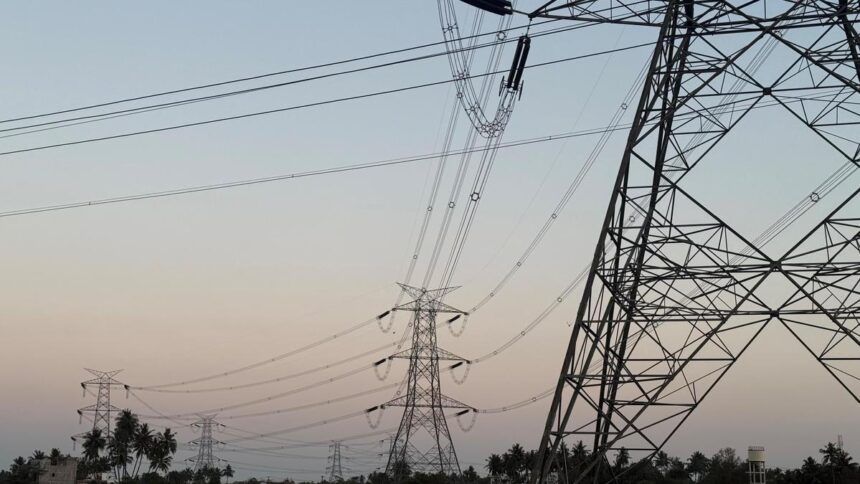
Ms. Maulekhi said the disruption could extend to the wider urban ecosystem, with disoriented animals fleeing into walls, roads, power lines, and birds abandoning nests. “Dogs and deer run into roads. Some die of cardiac arrest. These are the non-target victims of our celebrations. We need to move towards more civilised ways of celebrating festivals, without loud DJs and firecrackers,” she said.
On Friday, the zoo was closed to visitors and the animals were already inside their cells, helping curtail the impact of the immersion-related disturbance to an extent.
For residents too, the sound was difficult to escape. “The sound was so loud that I had to close my windows and sit in a farther corner of my house to be able to work and avoid exposure to the noise. I cannot even imagine how the animals would feel,” said Priyanshi, a Sundar Nagar resident.
The use of DJs and loudspeakers is also governed by the Noise Pollution (Regulation and Control) Rules, 2000. Loudspeakers and public address systems require written permission and at the boundary of a public place, noise from such systems cannot exceed 10 dB(A) above the prescribed ambient standard or 75 dB(A), whichever is lower. In residential areas, the ambient standard is 55 dB(A) during the day and 45 dB(A) at night.
A South-East Delhi district administration official said coordination meetings were held with the traffic and police departments to manage traffic and sound levels. However, the administration maintains no data on the number of idols immersed at each pond, the routes taken by devotees or the noise levels during processions.
Published – September 26, 2026 08:04 am IST