



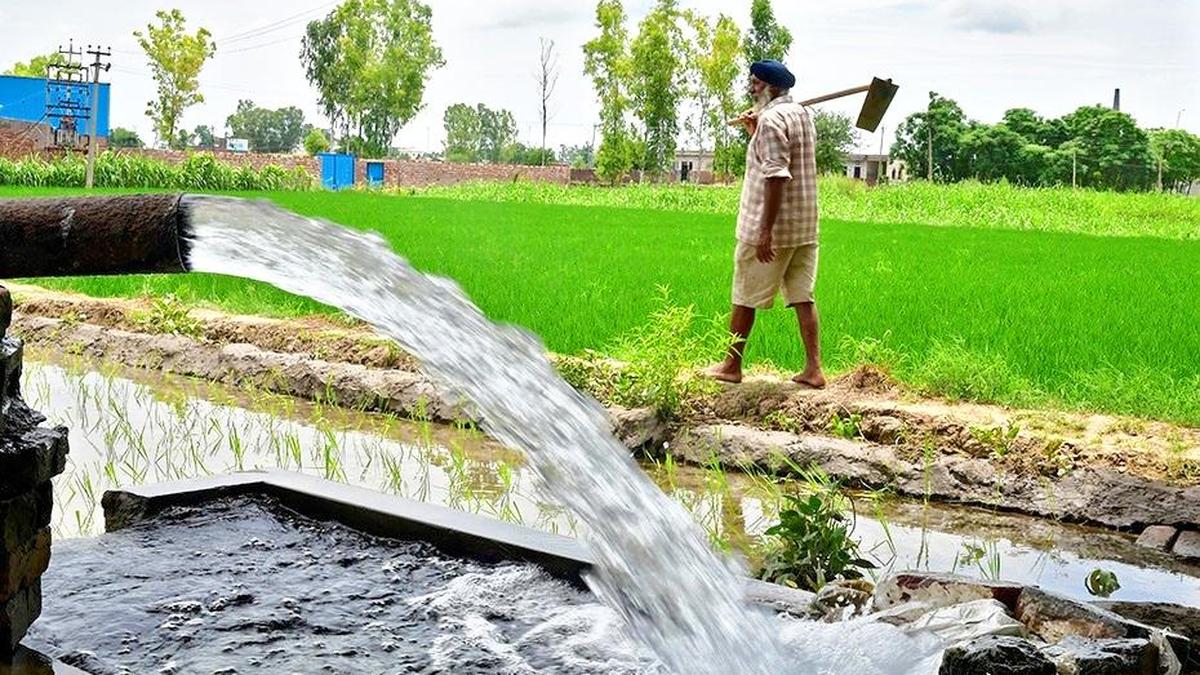

Low utilisation of surface canal water alongside extensive cultivation of water-intensive crops has triggered a severe groundwater crisis in Punjab, which in turn is exacerbating social and economic inequality across the State, according to a recent study.
The study, titled ‘Unequal Burden of Groundwater Depletion in Punjab’, shows the State is experiencing one of the most critical groundwater crises in the country, with a staggering 76.47% of its groundwater blocks classified as over-exploited — the highest percentage among all States in the country — and only 13.07% of blocks listed in the ‘safe’ category.
This statistic signifies that in most areas across Punjab, groundwater is being extracted at rates far exceeding the natural replenishment capacity of aquifers. The root cause lies in the State’s heavy reliance on groundwater for agriculture, particularly for cultivating water-intensive crops, including wheat and rice. Unabated over-exploitation has rapidly depleted groundwater levels, forcing farmers to dig deeper wells at a considerable cost. Compounding the problem are the associated environmental impacts, including land subsidence, deteriorating water quality due to contaminant ingress, and the drying up of surface water bodies dependent on groundwater discharge, the study found.

Only a small proportion of farmers use surface water (canal water) for irrigation in Punjab, implying a high dependence on groundwater resources, the author of the paper, Sandeep Kaur, Professor, Department of Economics, Central University of Punjab, Bathinda, who has worked extensively on agrarian issues, said.
Highlighting the critical role of financial capital in enabling farmers to adopt efficient technologies and invest in agricultural inputs, she noted in her paper, published recently in The Economic and Political Weekly, that larger farmers with greater financial resources often expand their groundwater extraction systems by installing more borewells with high-capacity motor pumps. This allows large farmers to access deeper groundwater levels, reduce cultivation costs, and achieve higher returns per unit cost when compared with smaller farmers. In contrast, small farmers have fewer pumping motors per unit area because most of their operational holdings consist of leased-in land.
Paddy, tube wells and depleting groundwater: Why Punjab’s water resources are under strain
“It is apparent that large farmers obtain higher returns over cost despite their low groundwater productivity, while the reverse is true in the case of small marginal farmers. The implication of this is that large farmers, who contribute the most to environmental degradation and threaten water sustainability, benefit the most in terms of income accrued, while small and marginal farmers, who bear the cost of environmental degradation and lack of water availability, contribute the least to environmental degradation. This makes it clear that the groundwater crisis in Punjab has deepened social and economic inequality in the State,” Prof. Kaur said.

Experts voice similar concerns. “Punjab’s blanket, free agricultural electricity is economically crippling the vulnerable smallholders it was meant to protect. Capital-rich large farmers heavily dominate groundwater extraction. Facing no financial constraints, they have been in the past proactively securing electricity connections for their new and even additional tube-wells, and they have been continuously, fearlessly deepening their borewells to chase receding water tables. Running high-powered submersibles, they siphon most of Punjab’s groundwater, fuelling an unregulated shadow economy,” S.K. Saluja, former Chief Engineer with the Ranjit Sagar and Shahpurkandi dam projects in Punjab, and having decades of experience in the State’s water resource challenges, including groundwater depletion and surface water management, told The Hindu.
“Conversely, resource-poor small and marginal farmers lack the capital to deepen their tubewells, and watch helplessly as shallow wells run dry. As a result, they are forced to informally buy water from large farmers in their neighbourhoods. So by maintaining this universal subsidy, the state actively funds a system that enriches wealthy landlords, drains the public exchequer, and accelerates the economic ruin of small farmers,” Mr. Saluja said.
“The government needs to reconsider the provision of free electricity to farmers in the State. Policy interventions should incentivise and encourage farmers, especially large farmers, to adopt water-saving practices, including drip irrigation, sprinklers, etc.,” Prof. Kaur said, adding that the government had initiated various schemes to tackle the over-exploitation of groundwater in the State but they fell short of addressing the full scope of the problem.
“Large farmers must also be encouraged to diversify their cropping patterns and reduce their reliance on water-guzzling crops like rice. In addition, there is a need on the part of the government to put into practice a much more equitable system of access to groundwater, so that marginal and small farmers are not disproportionately affected by the ongoing groundwater crisis,” Prof. Kaur said.
Published – September 21, 2026 05:05 pm IST