






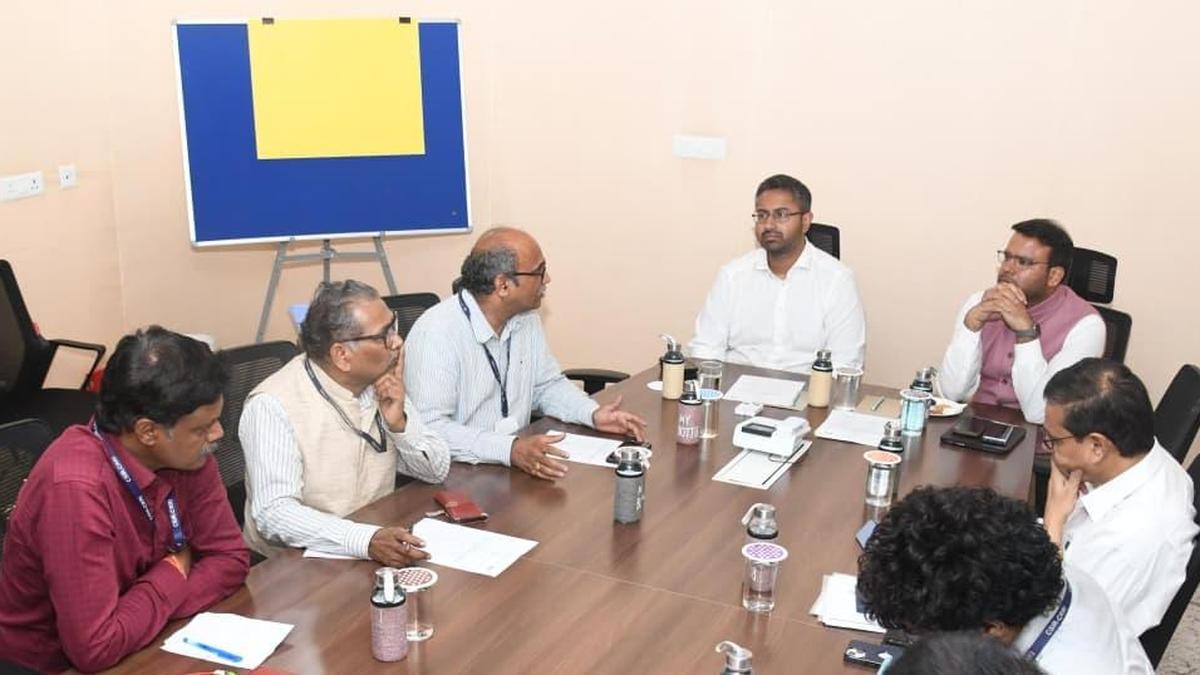


Visakhapatnam MP Sribharat reviewing the 228-KM Vizag road plan with officials in Visakhapatnam on Monday.
| Photo Credit: BY ARRANGEMENT
VISAKHAPATNAM
The Greater Visakhapatnam Municipal Corporation (GVMC), with the support from the Visakhapatnam Metropolitan Region Development Authority (VMRDA), is planning to upgrade 228 kilometres of roads across eight Assembly constituencies. This was discussed during a high-level review meeting at the GVMC–Smart City Office on Monday.
The proposed works includes converting existing gravel and Water Bound Macadam (WBM) roads into durable Black Top (BT) and Cement Concrete (CC) roads, developing 34 km of central medians, installing more than 1,550 streetlights, and improving key traffic junctions.

To ensure long-term durability and world-class execution, the local bodies will be partnering with the CSIR–Central Road Research Institute (CSIR–CRRI) for technical oversight and quality assurance.
Field inspections
Recently, a delegation led by CSIR–CRRI Director Chalumuri Ravi Sekhar conducted preliminary field inspections of selected stretches across Visakhapatnam city. Mr. Ravi Sekhar, presented technical frameworks covering road safety, junction design, and pedestrian amenities.
He said: “The institute is prepared to sign formal technical cooperation agreements (MoU/MoA) with the GVMC and VMRDA.”
The proposed collaboration would focus on joint field studies, road safety audits, speed breaker rationalization, and the establishment of a modern Road Asset Management System.
Nodal officers will be nominated shortly to finalise priority road stretches, said officials.
Focus on quality
While addressing the meeting, Visakhapatnam Member of Parliament Mathukumilli Sribharat stressed the need to incorporate expert recommendations from national technical institutions into tender specifications and construction guidelines before taking up major road works. He emphasised that public-funded projects require strict quality control, transparent execution, and technological monitoring of pavement thickness and material quality.

Mr. Sribharat also called for mandatory, restoration of roads to prescribed standard whenever they were dug for utility repairs like electricity and drinking water lines.
Looking toward long-term urban transit, the MP called for integrating road infrastructure with the Bus Rapid Transit System (BRTS), proposed Metro routes, and electric public transit systems.
Integrated urban development
GVMC Commissioner Ketan Garg instructed the engineering departments to coordinate closely with the CSRI-CRRI team to identify priority corridors based on traffic density and terrain conditions.
Officials said that road relaying (removing old road surface and replacing it with fresh new asphalt or concrete) should be accompanied by integrating proper drainage, wider footpaths, and optimised street lighting to reduce frequent deterioration during monsoons.
Published – September 21, 2026 09:22 pm IST