




At a time when AI bosses are making headlines, warning that their machines may become too powerful to control, Venice is a city of hope. With its quiet argument for handmade and human intelligence, be it at the Venice Biennale, Homo Faber or the zillion art and design shows across the city, it provides a winning case for where human agency should remain.
On the island of San Giorgio Maggiore, Homo Faber 2026 unfolds under British artist and scenographer Es Devlin’s keen direction, across workshops, cloisters, a labryinth, a mirrored hall and a swimming pool. It is a celebration of things made slowly and deliberately and by people who have spent years learning the craft.

British artist and scenographer Es Devlin
| Photo Credit:
Victor Picon
But in his opening speech, Alberto Cavalli does not dismiss technology; he calls it a tool. As executive director of the Michelangelo Foundation, Cavalli oversees this biennial exhibition of contemporary craftsmanship (running September 1–30, 2026). “If you go to an artisan’s workshop, they have many tools, but they will not use a hammer if they have to use, you know, scissors. Every tool has its own function,” he says, drawing a line at the moment the tool begins to replace human ideas and talent. Meanwhile, Devlin wants visitors to the exhibition to understand that “artisan thought” happens through the fingertips. During an interview with a handful of journalists, she says it is vital not only to think with the cerebral cortex but to “think through the body”.

Alberto Cavalli
| Photo Credit:
Nicoló Zanatta

“The collaboration with the JSW Foundation and the Jindal family has helped me approach contemporary Indian craftsmanship with a good eye. You can discover exquisite Indian craftsmanship that reveals its heritage without becoming folk. I have nothing against folk, but it’s not the Homo Faber way. I think tradition or heritage is not the worship of ashes, but the preservation of fire, to borrow from composer Gustav Mahler. And this is very important when you look at a country like India with a population that is very young, a country that is not a country but a continent with so many faces, cultures, identities, and that still expresses its identity through craft. This requires all of our respect”Alberto CavalliExecutive Director, Michelangelo Foundation
In this fourth edition of Homo Faber Biennial, Devlin’s An Island of Light features about 700 exceptional objects, 500 artisans and more than 70 countries, across 15 unforgettable installations. More than 40 of the artists and ateliers are from India, including Ankon Mitra and Shalini Mithal, Gunjan Gupta, architect Rooshad Shroff, and the designers Vikram Goyal and Tarun Tahiliani. Supported by the JSW Foundation, Indian crafts are represented across the show, and it is a pleasure to find them holding their own, sometimes outshining their neighbours. You can spend hours ruminating over the objects in any one room or go back over several days to soak up Devlin’s immersive theatre. A few to get started:
A Full Moon Rising: Clearly the standout. Nico Daswani from the Michelangelo Foundation rightly says that this is the installation he would get right to if he were “coming in from outer space”. Installed in the Fondazione Giorgio Cini’s former swimming pool, it turns the Korean moon jar into a global craft vocabulary: ceramics, paper, glass, metal and other handmade vessels are arranged on a semicircular structure that slowly emerges from the water, creating the illusion of a moon rising over the lagoon.

A Full Moon Rising
| Photo Credit:
Nicoló Zanatta
An Alphabet of Objects: More than 200 handmade objects sit on a kinetic structure and backlighting throws their silhouettes onto the walls, turning vessels and sculptures into something resembling an ancient visual language. It also makes the human hand unusually visible indirectly, through the complexity of the silhouette.

An Alphabet of Objects
| Photo Credit:
Nicoló Zanatta
“Our karigars are, in every sense, India’s living heritage. It was this belief that led us to create the JSW Prize for Contemporary Craftsmanship: to celebrate their artistry and place Indian craftsmanship firmly on the global map. We meet at Homo Faber at a moment when the world speaks of little else besides AI, of machines that can write, design, even imagine. But no algorithm will replace the hand of a karigar, the patience behind a single perfected motif, the instinct passed down through generations”Sangita JindalChairperson, JSW Foundation

Sangita Jindal
| Photo Credit:
Special arrangement
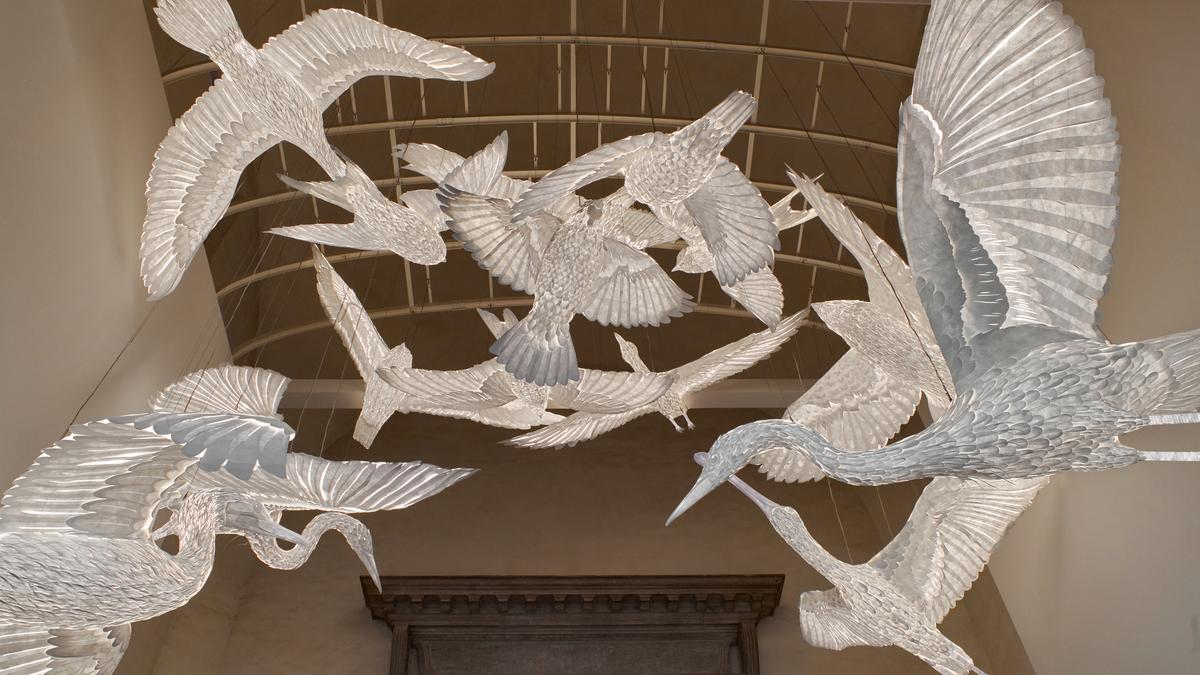
An Infinite Birdsong: An enclosed, mirror-filled environment in which handmade birds and insects, including jewel-like interpretations, multiply seemingly without end.

An Infinite Birdsong
A Great Turning: This instantly recognisable image, of Devlin’s enormous two-axis kinetic mirror mosaic rotating over shallow water in the Palladian Cloister, is what you get back to often. It reflects the architecture, sky and sunlight back into itself. It references the Venetian history of broken mirror fragments, and marries modern machinery with the ancient monastery.

A Great Turning — Devlin’s enormous two-axis kinetic mirror mosaic rotating over shallow water — in the Palladian Cloister
| Photo Credit:
Nicoló Zanatta
A Feast of Light: A strong craft-and-curation showcase, where the Palladian refectory is transformed into an almost monochrome banquet table of porcelain, glass, paper, textile, marble, mother-of-pearl and even Lego, all brought together by a single vertical shaft of light.

A Feast of Light
Getting the most attention
Most iconic image and instagrammable: A Full Moon Rising
Conceptually most intelligent: An Alphabet of Objects
Most immersive: An Infinite Birdsong
Quintessentially Es Devlin: A Great Turning
Strongest craft display: A Feast of Light
The writer attended Homo Faber as a guest of JSW Foundation and the Michelangelo Foundation.
Published – September 19, 2026 07:07 am IST