






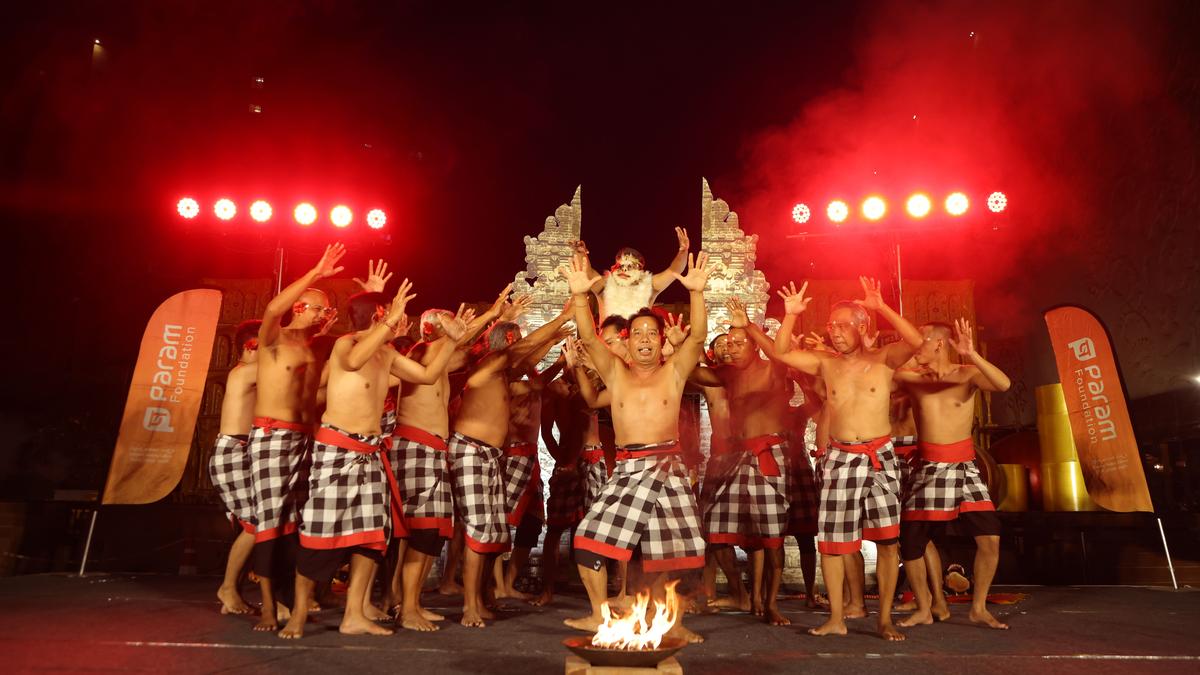

As theatre productions look beyond conventional auditoriums to connect with new audiences, malls, public spaces and community venues are increasingly being transformed into stages. At Orion Mall in Bengaluru, the story of Sita and Hanuman unfolded in a way that was both familiar and novel. There were no fancy costumes, elaborate orchestra or recorded soundtracks. Instead, a circle of performers in black-and-white checked sarongs created their own soundscape, their voices rising and falling in a relentless chorus of “cak, cak, cak”. The rhythmic chants gathered momentum, transforming human voices into a pulsating musical ensemble.
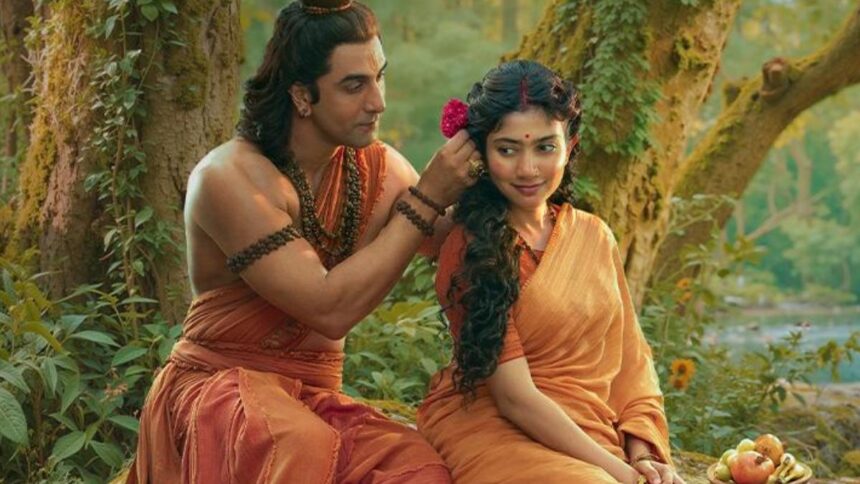
The Kecak performance by Balinese artistes, led by veteran scholar and choreographer I Wayan Dibia, who was awarded the Padma Shri in 2021, presented an episode from the Sundarakanda from the Ramayana. Hanuman reaches Lanka in search of Sita and finds her in Ashok Vatika. She gives him her choodamani, the hair accessory, as a proof of their meeting when he returns to Rama.
While the episode is drawn from an epic familiar to Indian audiences, it is the distintive vocal form through which it is narrated that sets Kecak apart.
“That’s exactly the essence of Kecak, a vocal chanting form that belongs to Bali. The voice becomes central, with each performer creating multiple layers of rhythmic patterns. The chorus also trains in breath and energy control, knowing when to inhale and exhale while maintaining the flow,” explains Dibia. The performers must listen closely to one another, regulate their breathing, and sustain the collective energy that drives the chorus.

An episode from Sundarakanda was presented to show how Hanuman is revered in both Indian and Balinese cultures.
| Photo Credit:
Special Arrangement
The sound “cak” is significant in its own right. The syllable carries cultural associations and, according to Dibia, is onomatopoeic, imitating the call of a house lizard. In Balinese culture, the sound of a house lizard heard during prayer is considered an auspicious sign, indicating that the prayer has been received.
To understand Kecak, one must look beyond its popularity as a tourist attraction in Bali. The form traces its origins to Sanghyang Dedari, a trance-possession ritual traditionally performed when a village faced disruption or distress. The chorus chants formed an integral part of the ceremony, invoking spiritual forces to help restore harmony and well-being within the community.
However, Dibia rejects the popular description of Kecak as a “monkey dance”. The association stems from the frequent use of the Ramayana narratives. But, he points out, Kecak is fundamentally a vocal form. “The essence of Kecak is not about dancing like a monkey but the vocal chanting with different rhythmic patterns,” he says.

Dancer and choreographer Wayan Limbak worked with Walter Spies to popularise kecak.
| Photo Credit:
Wikipedia
‘Kecak’ evolved into an independent theatrical form in the early 20th century through a collaboration between German painter and curator Walter Spies and veteran Balinese dancer Wayan Limbak. Walter arrived in Java in 1923 and subsequently collaborated with Limbak in the 1930s to develop a performance that drew on the chanting associated with the sanghyang ritual and combined it with episodes from the Ramayana. Wayan Dibia, who has also written a book Kecak: The Vocal Chant of Bali states that Walter Spies encouraged Limbak to take the Kecak chorus out of the sanghyang ritual and build an independent performance around the epic. Limbak chose an episode from the Yuddhakanda, featuring the battle between Kumbhakarna, Ravana’s brother, and Rama’s monkey army.
The form has continued to evolve while retaining traces of its ritual origins. From around the 1970s, fire sequences became a feature of many Kecak performances in Bali, echoing its connection to the Sanghyang tradition. For Indian audiences, however, much of Kecak’s appeal lies in the interplay between the familiar and the unfamiliar: a well-known Ramayana narrative retold through a distinctive performance vocabulary built around vocal chanting, rhythm and collective movement.
The Ramayana has been part of Balinese Hindu culture for centuries. According to Wayan Dibia, all seven kandas find expression in Bali’s dramatic traditions. A conventional Kecak performance, familiar to many tourists in Bali, typically begins with Sita’s abduction, follows Hanuman’s search for her in the Sundarakanda and culminates in the battle scenes of the Yuddhakanda. For the Bengaluru performances, however, Dibia adapted the repertoire to suit the festival format and its audience. He presented a brief episode from the Kishkindhakanda before moving to the Sundarakanda, placing the focus on Hanuman’s quest and his encounter with Sita.

The performance often begins with Sita’s abduction and ends with the battle in Yuddhakanda.
| Photo Credit:
Special Arrangement
Dibia’s engagement with Hanuman goes back decades. He has performed the character since 1969, including during his debut performance in India at Delhi’s Kamani Auditorium. What interests him is the way Hanuman is perceived in both India and Bali. In each cultural tradition, Hanuman transcends his identity as a monkey and is revered as a divine figure endowed with extraordinary powers.
Wayan Dibia’s ‘Kecak’ is not frozen in time. It’s presentation, style and stories continue to evolve. Working with the form since 1971, he has experimented with new stories, formations and movement, including adaptations drawn from the Mahabharata and Western theatre.
Traditionally performed by men, Kecak has also opened up to mixed-gender groups through his efforts. He experimented with such groups in the U.S. during the 1980s and 1990s before introducing women’s Kecak in the early 2000s. “It’s not about gender. It’s about how good they can do the rhythm,” he says.
The presence of women among the perfomers at the Orion Mall reflected this widening participation. Their inclusion was a reminder that traditions can retain their defining characteristics while adapting to new contexts and performers.
For the Bengaluru performance, he swayed away from the traditional circular formation, adopting a semi-circle to suit the available space. For Dibia, such adjustments are part of keeping the form alive rather than merely reproducing a familiar spectacle. that is witnessed in Bali. A thoughtful artiste, he believes, must be able to rework the performance according to different spaces and situations.

In the early 2000s, Wayan Dibia introduced performances featuring women in Kecak which were once performed only by men.
| Photo Credit:
Special Arrangement
“Bringing Kecak to India is an opportunity to demonstrate the many dramatic forms through which the Ramayana has lived in Bali and the importance the epic continues to hold in Balinese performing arts,” says Dibia.
Presented and curated by the Param Foundation with support from the Ministry of Culture, Bali in Bengaluru, which runs until October 14, highlighted the enduring ability of culture to cross geographical boundaries and forge human connections. Through a story familiar to Indian audiences but told in a distinctly Balinese idiom, the performance became a reminder that art often succeeds where borders do not.

A section of the audience at the Kecak performance presented in Bengaluru rencently.
| Photo Credit:
Special Arrangement
Published – October 12, 2026 03:12 pm IST