


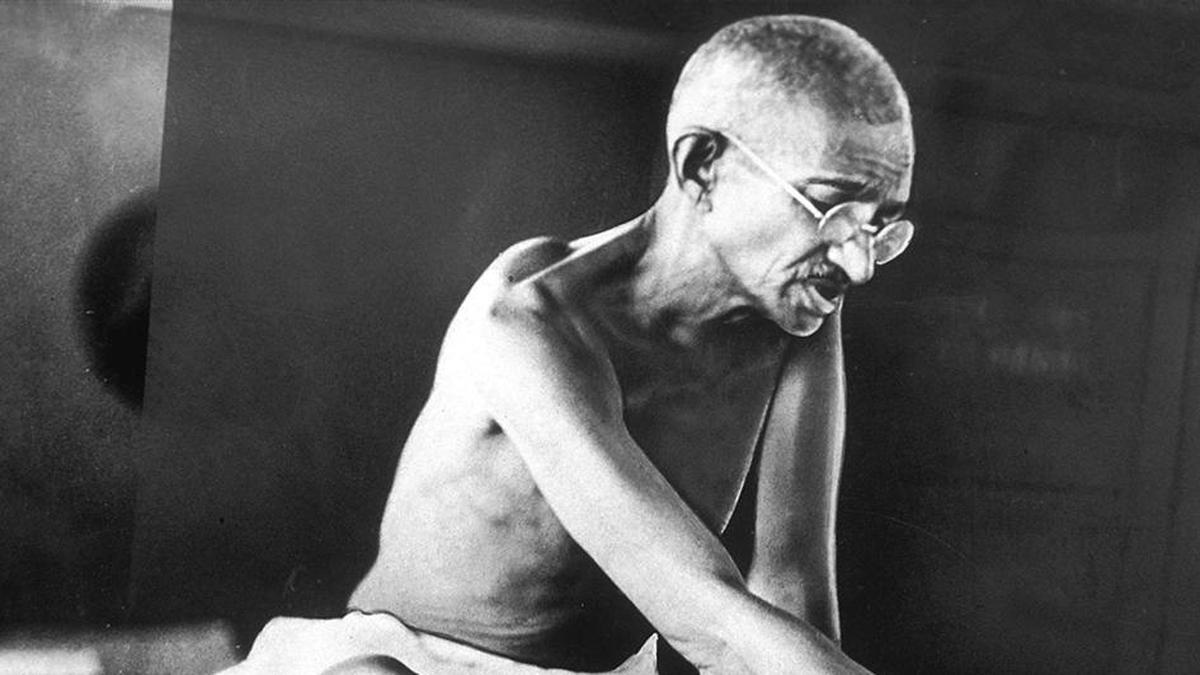


File photo of Mahatma Gandhi.
| Photo Credit: Getty Images/The Hindu Archives
The protesters courting detention while peacefully demanding the resignation of Chief Election Commissioner Gyanesh Kumar on October 10 brings back to life Mahatma Gandhi’s statement during a 1922 sedition trial in a colonial court on how dissent must confront power.
The youth protesters had called for passive resistance amidst the massive build-up of security forces in the national capital.
March 18, 1922, which happened to be a Saturday like October 10, saw Mahatma Gandhi accept an offer from the Ahmedabad District and Sessions judge, C.N. Broomfield, to make a statement in open court.
The former lawyer and the future Father of the Nation stated that “affection cannot be manufactured or regulated by law”.
“If one has no affection for a person or system, one should be free to give the fullest expression of his disaffection, so long as he does not contemplate, promote or incite to violence,” Mahatma Gandhi stated.

He urged against what he called “violent non-co-operation”, which he said “only multiplied evil”.
He said that non-violence implied a “voluntary submission to the penalty for non-co-operation”.
Mahatma Gandhi was on trial for publishing three articles in his journal ‘Young India’. He and his editor, Shankarlal Ghelabhai Banker, pleaded guilty and was sentenced to six months’ simple imprisonment.
The Supreme Court, in post-Independence India, has enshrined the spirit of dissent voiced by Mahatma Gandhi in Article 19 of the Constitution, making the right to free speech and expression and the right to association and peaceful assembly fundamental rights.

The court had held that public streets were the natural choice and venue for expressing opinions. The right to assembly was subject to reasonable restrictions for the sake of public order, but the police cannot arm themselves with arbitrary powers and impose blanket bans on meetings.
“The state can only make regulations in aid of the right of assembly of each citizen and can only impose reasonable restrictions in the interest of public order… While prior to the coming into force of the Constitution, the right to assemble could have been abridged or taken away by law, after the coming into force of the Constitution, the right cannot be abridged except by imposing reasonable restrictions,” a Constitution Bench of the Supreme Court held in a 1972 judgment in Himat Lal K. Shah v. Commissioner of Police, Ahmedabad.
Nearly half a century later in 2016, the Supreme Court ensured that the right to peaceful and public dissent did not wane by declaring that holding a peaceful demonstration to air grievances was a fundamental right.
“Organised, non-violent protest marches were a key weapon in the struggle for Independence, and the right to peaceful protest is now recognised as a fundamental right in the Constitution,” the apex court had observed in Anita Thakur vs Government of Jammu and Kashmir.
The court had held that a violation of fundamental rights due to police misconduct could give rise to a liability under public law, apart from criminal and tort law. Pecuniary compensation could also be awarded for violation of fundamental rights.
The doctrine of sovereign immunity did not apply to cases of fundamental rights violation, and was not a defence in public law, 2016 judgment had held.
Published – October 11, 2026 02:05 pm IST