






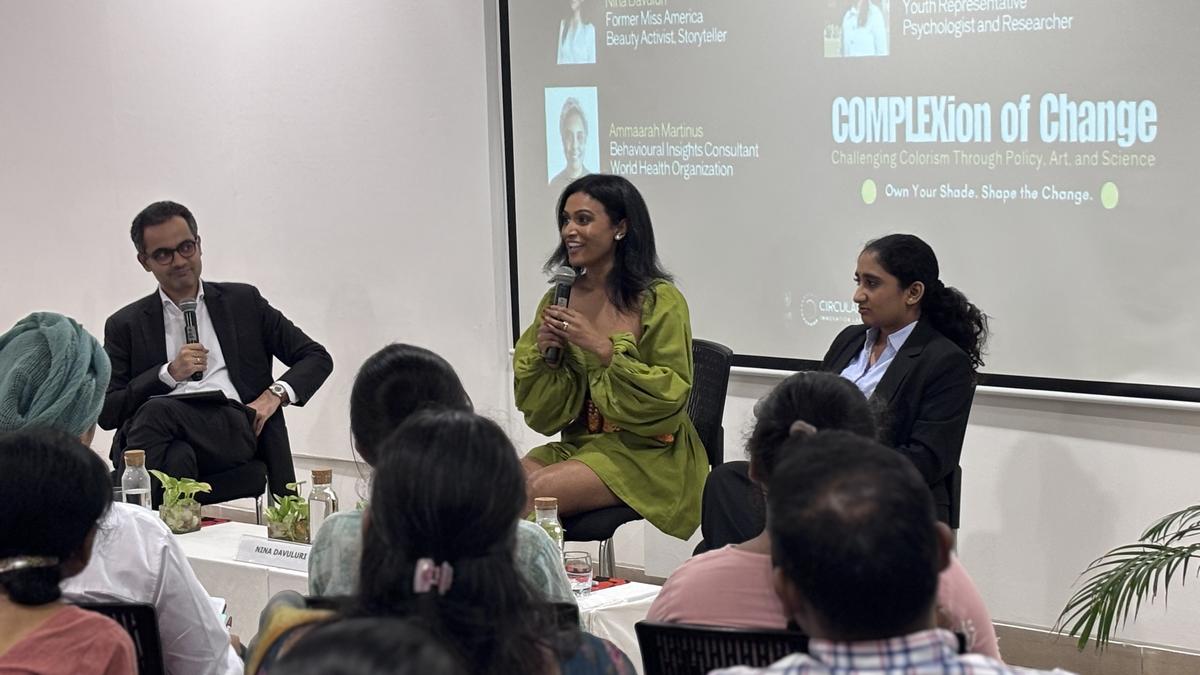


Speakers at the ‘Complexion of Change: Challenging Colorism Through Policy, Art, and Science’ discussion held at Goethe-Zentrum Hyderabad on Wednesday (October 7, 2026)
| Photo Credit: By Arrangement
‘If a sibling uses a skin-lightening product, you may be more likely to use one too’. This was among the findings from behavioural research cited by the World Health Organisation (WHO) during a discussion on colourism in Hyderabad on Wednesday (October 7, 2026).
The discussion was part of ‘Complexion of Change: Challenging Colorism Through Policy, Art, and Science’, held at Goethe-Zentrum in Hyderabad. A documentary exploring global skin colour bias and the deep-rooted societal association of fair skin with higher status, beauty and success was also screened as part of the programme.
“Skin-lightening product use was not a single behaviour but was influenced by psychological, cultural and environmental factors,” said Ammaarah Martinus, Behavioural Insights consultant at the WHO.
The psychological dimension includes motivations such as wanting to appear fairer, younger or to fit into society. The cultural dimension includes the influence of families, communities and social networks. Mr. Martinus said research had found that people were more likely to use a skin-lightening product if a sibling used one. She also spoke about access to such products . In India, skin-lightening products could be easily purchased in local markets and supermarkets. “Interventions to address skin-lightening therefore need to work across all three levels rather than focus on only one aspect of the behaviour,” she added.
Psychologist and researcher Bharti Upparu said children begin receiving messages about skin colour at a very young age, often without anyone explicitly telling them that one skin tone is preferable to another. They observe who is complimented, who is bullied and who is teased, and gradually learn which physical characteristics society values. “A person perceived as fair and attractive may unconsciously be associated with other positive characteristics such as competence, goodness and trustworthiness. Such biases can compound into an overall perception of a person’s character and affect how others interact with them,” she said.
The discussion also highlighted that colourism is not restricted to women. Arpit Bhutani, co-founder of Circular Innovation Lab and moderator of the session, pointed to products marketed specifically towards men and noted that the pressure to conform to lighter-skin beauty standards also affects men.
Former Miss America Nina Davuluri recalled an incident involving a friend’s baby, when an older family member cautioned against taking the child into the sun because the child could become darker. “Such comments are not necessarily made with malicious intent but can come from a desire to see children succeed in a society where lighter skin is perceived to offer advantages,” she added.
Mercury in skin-lightening products
In remarks before the documentary screening, Monika Stankiewicz, executive secretary of the Minamata Convention on Mercury, said mercury was among the chemicals of highest public concern according to the WHO and that cosmetics were one pathway through which people could be exposed. “Mercury-containing skin-lightening products can damage the skin and may also contaminate households, potentially exposing other family members,” she added.
Ms. Stankiewicz stressed that the issue was not solely a chemical problem but also a social one linked to beauty standards and the pressure to conform to them. She said meaningful change could not come through regulations alone and that activism, art, culture and storytelling also had important roles to play.

Published – October 08, 2026 01:49 pm IST