



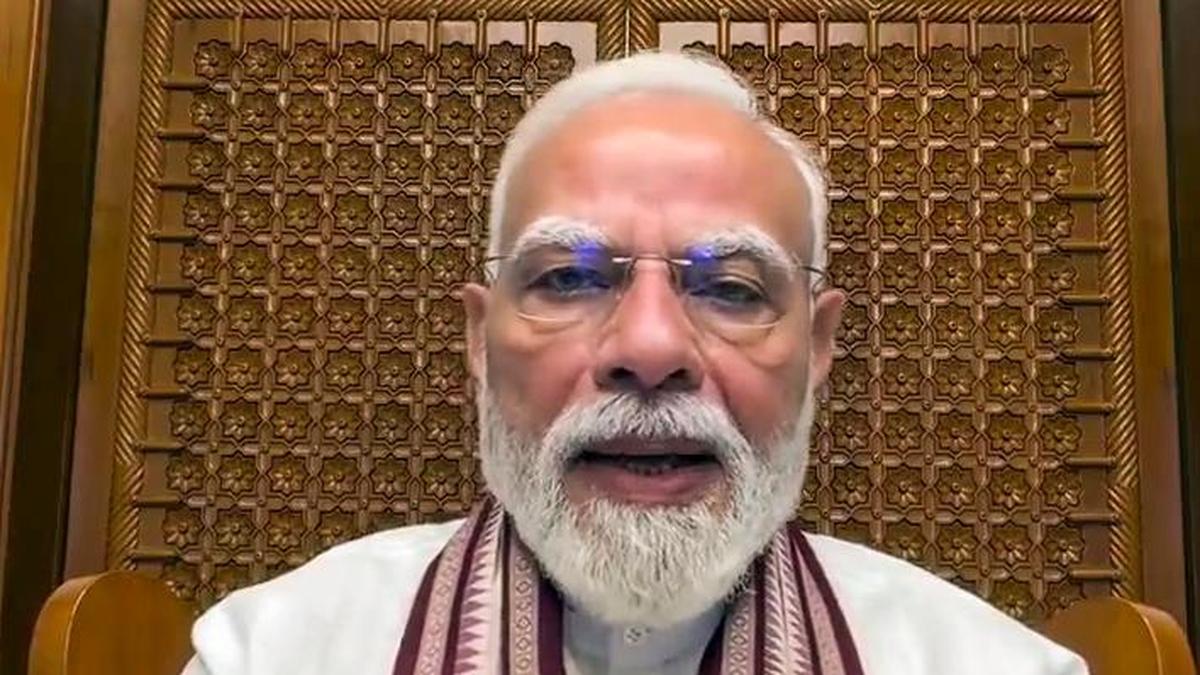


Prime Minister Narendra Modi shares a video on his Instagram after his recent video message (Jul 23) on exam paper leaks, thanking young people who watched it and sent their suggestions (Jul 24), in New Delhi. Photo:@narendramodi Instagram/ANI Video Grab
Prime Minister Narendra Modi has posted a series of Instagram reels since July 23 in response to the student protests against his government in Delhi and many other parts of the country. This was widely seen as a bold effort to reach out to the Instagram generation, also referred to as Gen -Z, aged between 14 and 29. The oldest among them had just started voting in 2014 when Mr. Modi came to power; the youngest were barely two years old. Rashtriya Swayamsevak Sangh chief Mohan Bhagwat is also reaching out to the young generation and exploring ways to engage with them.
One particular video, in which Mr. Modi offers forgiveness to young protesters who made vulgar remarks against him and his mother, has attracted widespread public attention. He described them as “misguided children” and said it was society’s responsibility to guide them. Some see it as an act of magnanimity, while others see it as an act of duplicity, considering the high level of tolerance for bad language within the Sangh ecosystem
This raises a larger question: who exactly is he addressing through his new reel politics? Is he addressing Gen Z, or is he addressing their parents — the WhatsApp generation? Given the continuing police action against the protesters, and the sustained social media campaigns portraying them as irresponsible or politically motivated, it is increasingly clear that Mr. Modi, or Mr. Bhagwat for that matter, is not trying to win over the Instagram generation, but to consolidate the WhatsApp generation that has become somewhat shaky in its support for the BJP. He appears to be guided by the wisdom of the patriarch that a bird in the hand is worth two in the bush. Mr. Modi is talking to fellow patriarchs, not the protesters.
Mr. Modi’s popularity was built on a network of WhatsApp communities in the run-up to the 2014 election. One of his key strategists at the time, Prashant Kishor — now the founder of the Jan Suraaj Party which recently upstaged the BJP in the Bankipur Assembly byelection in Patna — said in a recent interview that around six crore people were on WhatsApp in India at that point. It was through messages circulating on that network that the Congress-led United Progressive Alliance (UPA) began to unravel in the public imagination and Mr. Modi’s political persona was built. The worldview of the then aspirational youth — many of whom are today the parents of Gen-Z — is a matter of detail, but suffice it to say that it broadly reflects the worldview of the BJP’s present support base.

There is little reason to think that they are revolting against Mr. Modi or his government, but there are at least two issues that appear to have raised doubts in their minds about his performance. First, the controversy surrounding devotees’ donations at the Ram Temple in Ayodhya; and second, the snowballing concerns related to the mandatory blending of ethanol in petrol. Both these issues cut close to the bone. They are donors at Ayodhya, and many among them associated their ability to own a vehicle with the rise of Hindutva under Mr. Modi. This binds them in a complicated relationship with him. Their loyalty has been shaken, but they are not yet willing to choose anyone over Mr. Modi.
Mr. Modi’s reels are speaking to them. Their message is, in effect: See, your daughters — not your sons — are using abusive language in public. This is a cultural shock. It is our responsibility to guide and protect them. They are nudged to consider what is of greater urgency: the controversy over donations at Ayodhya, the impact of ethanol blending on their automobiles, or the cultural shock of defiant daughters. This is an age-old message repurposed for the digital era — the notion of Kaliyuga, imagined across the ages, always in the present, as a breach of social and gender hierarchy and order. Mr. Modi’s message appears to be landing well among the constituency to which it is addressed. The WhatsApp generation is, going by the anecdotal evidence I have gathered, finding common cause with Mr. Modi in trying to ensure that their daughters are disciplined and cultured. They appear willing, at least for now, to suspend their concerns regarding the controversy over Ayodhya donations and ethanol blending.

That, perhaps, is the purpose of the midnight reels and the RSS chief’s outreach. They speak the language of Instagram, but they are addressed to the moral universe of WhatsApp. Mr. Modi is talking to fellow patriarchs, not the protesters.
Published – August 07, 2026 12:33 pm IST