



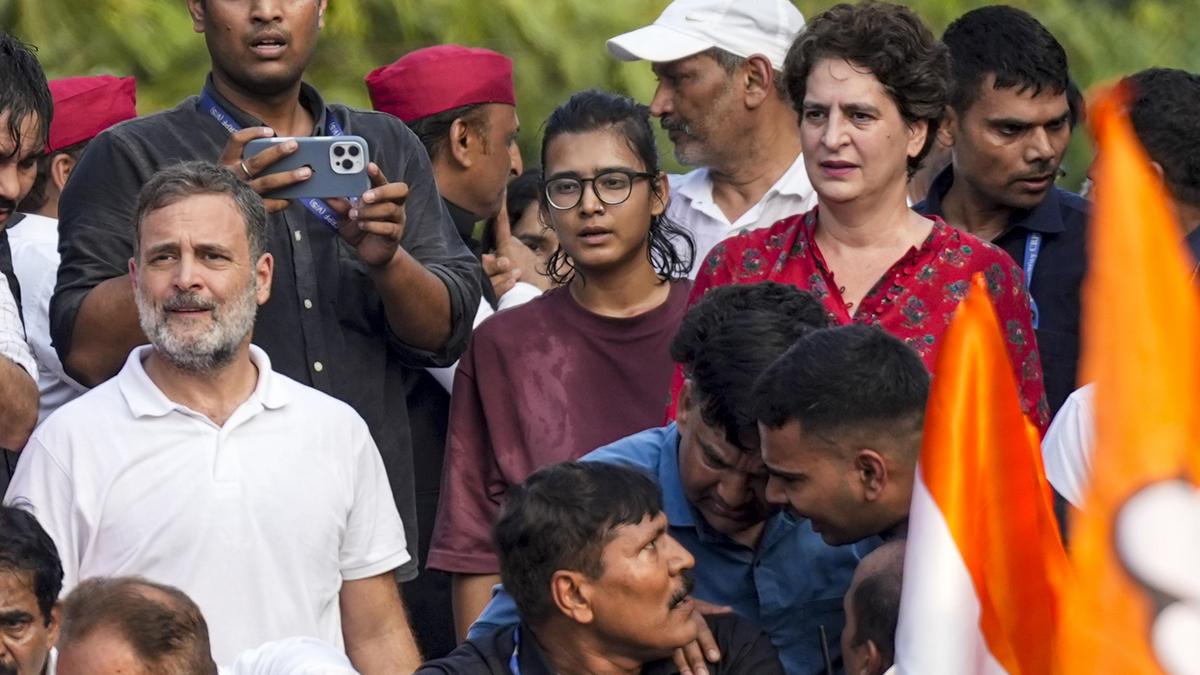

On Saturday (October 10, 2026), as viral images of protests across Delhi flooded social media, with Jantar Mantar out of bounds and the Delhi Police carrying out mass detentions, Congress workers across the country received an appeal from top leaders, including Rahul Gandhi, to travel to the capital on Monday (October 12, 2026) and to show up for the Indian National Developmental Inclusive Alliance’s (INDIA bloc’s) “March for Democracy”.
By Monday (October 12, 2026) afternoon, even before the buses carrying INDIA bloc leaders rolled out of the Constitution Club, Congress flags and their bearers were waiting at intersections along the route expected to be taken by the procession.

Many of them, like former Haryana Youth Congress working president Mayank Chaudhary, arrived just in time for the march, dodging police barricades. Driving down from Badkal in Haryana in a cavalcade of private cars, he said he encountered five barricades. “Each of the cars was packed with our workers. To ensure that the police did not detain us, many of them would get out before each barricade and walk the distance before getting back into the car,” he said.
Swift mobilisation
The Congress claimed that 2.5 lakh people participated in the march. It took “meticulous planning” and a refreshed party machinery to pull off the feat, party general secretary (organisation) K.C. Venugopal said.

“We had instructed everyone to arrive in Delhi in their private vehicles and not display flags or banners. Despite all precautions, many workers were detained at the Rajasthan and Haryana borders, while others were picked up by the police from lodges in Delhi at night. We kept the doors of the party offices open for workers to stay and asked every parliamentarian to do the same,” Mr. Venugopal said.
All Congress MPs were instructed to help workers find accommodation. Many parliamentarians, including Pramod Tiwari, Phulo Devi Netam, Jai Prakash, Karti Chidambaram, Jebi Mather and Dr. Kirsan Namdeo, threw open the doors of their Delhi residences for workers to spend the night.

Over the last year, under the party’s Sangathan Srijan programme, 1,000 new district Congress committee (DCC) presidents have been appointed. Around 130 DCCs within driving distance of Delhi, across Haryana, Rajasthan, Uttar Pradesh, Punjab, Uttarakhand, and Himachal Pradesh, mobilised people from their areas for the protest. This is in contrast to the old Congress system of relying solely on individual leaders’ capacities to pull crowds.
The Congress organisation, Mr. Venugopal said, has changed drastically. “Within 48 hours, we can mobilise our workers. You saw that on Monday in Delhi, and you can see it in the States where we are carrying on with this campaign,” he added.
‘Turning point’
Haryana and Rajasthan contributed the majority of the crowd. Sachin Pilot, the Congress general secretary in charge of Punjab, sees Monday’s march as a “turning point” in the narrative of “how India’s politics will move forward”.
“It is no longer just about SIR (special intensive revision of electoral rolls) or seeking Chief Election Commissioner Gyanesh Kumar’s resignation. It is about the future of the country,” Mr. Pilot said.
The march, he said, will act as a springboard for the next round of grassroots outreach. “We are going to every gram sabha and reaching out to every panchayat to meet those who have been excluded from the electoral rolls,” he added.

The crowd that turned up on Monday, Lok Sabha MP Deepender Hooda said, was highly charged. Many remained at the venue long after the march had wound up.
“The anger is real. For example, the statewide difference in votes between the Congress and the BJP is just 14,000. People are enraged at being denied a choice through the abuse of the electoral process. So, it was not only our workers who turned up. Several ordinary citizens angered by the issue joined Congress workers on the streets,” Mr. Hooda said.
Published – October 13, 2026 10:27 pm IST