







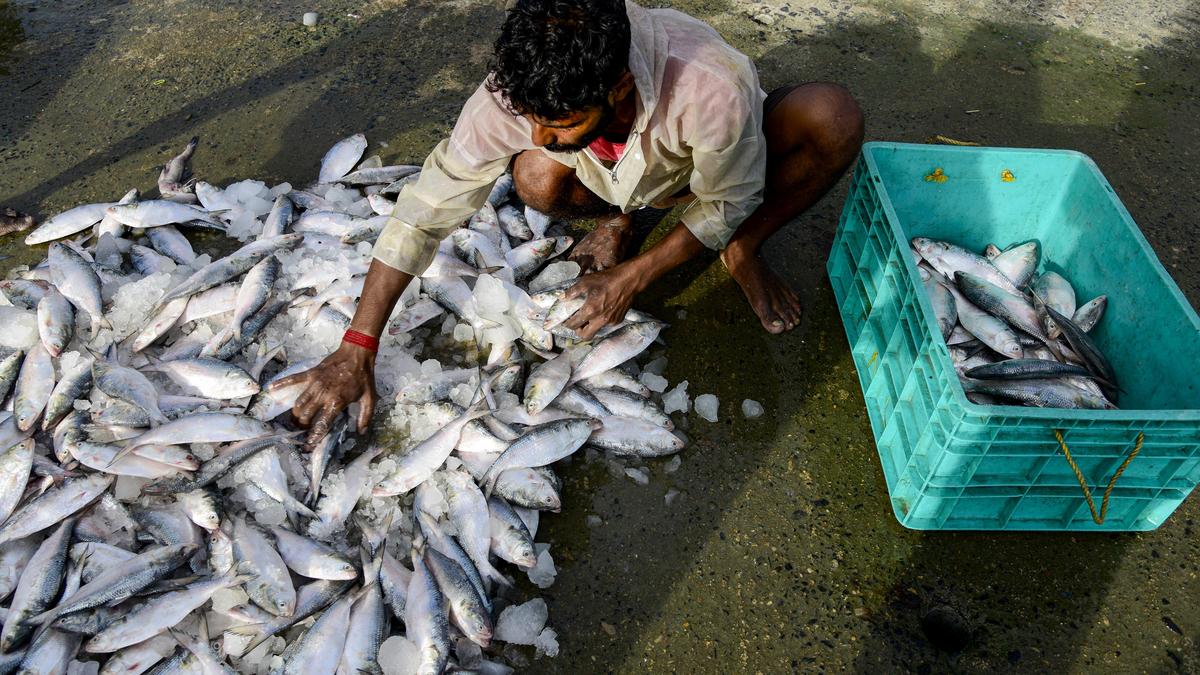


Hilsa with high roe content have so far fetched considerable market in Chattogram and Sylhet in Bangladesh, said the officials. File
| Photo Credit: PTI
According to officials, the increased demand is reportedly linked to lower domestic Hilsa catches in Bangladesh
In a boost to India’s fish-based economy, particularly in West Bengal, India has exported around 500 tonnes of Hilsa fish to Bangladesh in the last two months, with traders anticipating an additional 150 to 200 tonnes in the coming weeks.
According to officials, the increased demand is reportedly linked to lower domestic Hilsa catches in Bangladesh. A substantial proportion of the consignments originated from Gujarat, particularly the Bharuch region, while some supplies moved through the Howrah wholesale fish market in West Bengal.
Hilsa with high roe content have so far fetched considerable market in Chattogram and Sylhet in Bangladesh, said the officials.
This marks a notable reverse trade flow in a fish traditionally associated with movement from Bangladesh into Indian markets.

Conservation steps
Considering a growing market opportunity, experts also emphasised on the effective conservation measures to prevent additional pressure on wild Hilsa stock. They advised the West Bengal government to build an ecosystem by implementing necessary regulations to prevent juvenile fishing and protect mature and gravid brooders.
“Hilsa conservation is an investment in the future of the fishery. Maintaining suitable freshwater–salinity gradients, protecting deep-water migration corridors and establishing strategic fishing-free zones at estuarine entry points are essential for the safe upstream migration of large Hilsa,” said Ranjan Kumar Manna, Head of the Department, ICAR-CIFRI.
He said stringent regulation of fishing in the Hooghly river during March to May could help reduce juvenile fishing. He suggested making a provision to maintain mesh size of gill nets above 90 mm to minimise capturing juvenile fishes.
Mr. Manna also urged the government to improve the hydrological connectivity and restore the condition of Saptamukhi, Matla, Thakuran, and Herobhanga rivers in the Sundarbans region that support relatively low Hilsa abundance, partly due to reduced freshwater discharge and altered salinity regimes.
“Protecting critical deep-water stretches of the Hooghly and establishing strategic fishing-free zones near estuarine entry points may also facilitate safe migration,” he added.
With the new reverse trade flow, the government is now focusing more on the improving the production of Hilsa by building a sustainable ecosystem.
“The reverse trade flow should therefore be viewed as an opportunity to build a stronger, more organised and sustainable fisheries value chain in India. With science-based management, habitat restoration, responsible fishing and technological innovation, West Bengal can pursue greater Hilsa production and trade while safeguarding the ecological integrity of the Ganga–Hooghly–Sundarban system,” the Ministry of Fisheries said in a statement.
Published – September 17, 2026 01:52 am IST