






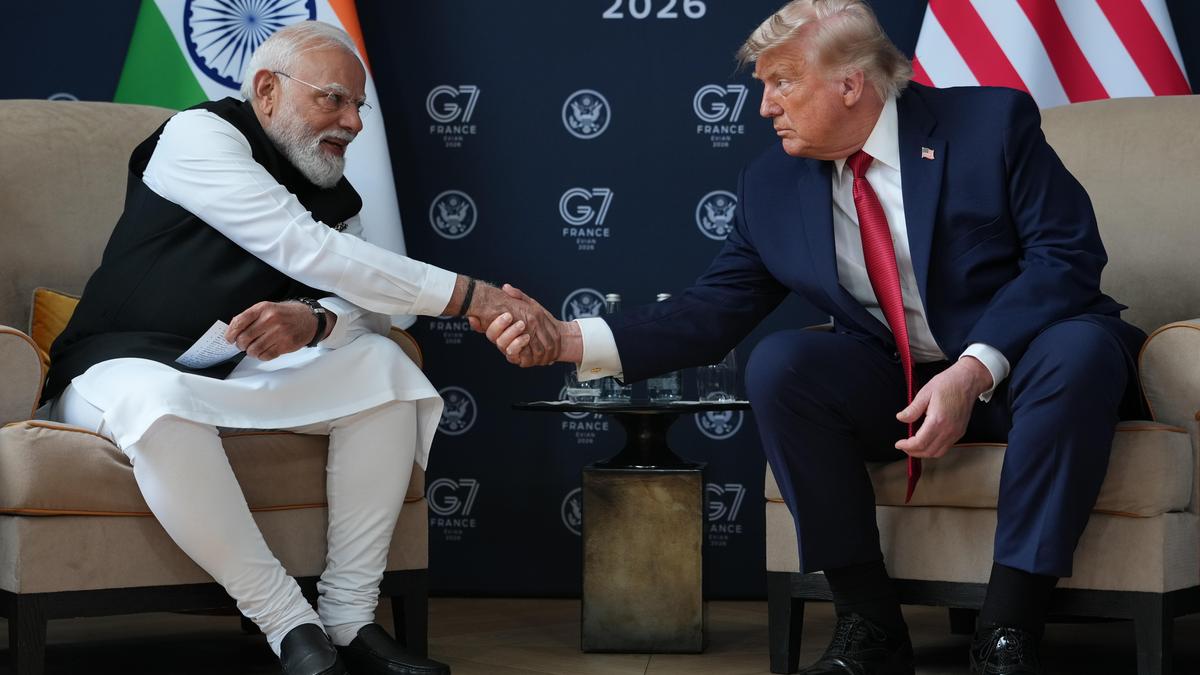


U.S. President Donald Trump with India’s Prime Minister Narendra Modi. File
| Photo Credit: AP
India and the U.S. are unlikely to sign a trade deal until the U.S. launches a series of fresh ‘Section 301 investigations’, concludes them, and places tariffs on India’s competitors such as Pakistan, Sri Lanka and the Philippines, a person familiar with the process has said. It was a “strategic mistake”, according to the person, that Pakistan was not included in the list of countries probed in the excess capacity 301 investigations opened in March 2026.
100% U.S. tariff threat: Can India’s new trade deals reduce its dependence on America?
An announcement of fresh 301 investigations against some of India’s competitor countries is likely in the near future, The Hindu has learned, although the timelines and the subject matters for these 301s have not yet been decided. For this reason, it is highly unlikely that a trade deal will be concluded around Commerce and Industry Minister Piyush Goyal’s upcoming visit to the U.S. for the G20 trade ministerial that starts on September 30.
These developments appear to be consistent with Commerce Secretary Rajesh Agrawal’s remarks at the Global Fintech Fest 2026 earlier this month. Mr. Agrawal had said that India operates largely on an MFN (Most Favoured Nation) tariff basis, while the U.S. operates on an executive tariff basis, and that a trade agreement would require an architecture with differentials and preferential market access structure for India.
The ‘301s’ are part of how the U.S. government is working around the February 2026 U.S. Supreme Court ruling that President Donald Trump’s ‘reciprocal’ tariffs were an unlawful application of the International Emergency Economic Powers Act (IEEPA). Prior to this ruling, India and the U.S. had arrived at an Interim Agreement on trade that was announced via an India-U.S. joint statement issued on February 6.
Explained | Why has India-U.S. trade deal been delayed?
The general tariff rate for Indian goods entering the U.S. under the interim deal was going to be 18%, giving India an advantage over its main competitors. These include not just Pakistan (19%), which is the most politically sensitive country in New Delhi’s calculus, but also Vietnam (20%), Sri Lanka (20%), Bangladesh (19%) and the Philippines (19%). Nepal and the Maldives did not fall under the reciprocal tariff schedule and were tariffed at 10%. Following the scrapping of these tariffs, they trade with the U.S. on an MFN basis.
A central challenge to concluding the India-U.S. deal is that Pakistan, Sri Lanka and the Philippines were subject to 301 probes for forced labour, but are not on the 301 probe list for excess capacity, which India was subject to. Both probes were launched in March 2026. Pakistan, for instance, is tariffed at 10% as a result of the forced labour 301 investigation. So, at the moment, there are no similar legal instruments through which tariff rates on these countries could be raised further to their previous levels, while India is likely to be tariffed at 8% in the excess capacity investigation, bringing the overall tariff rate it faces back up to 18%.
To complicate matters, last Friday, Mr. Trump signed the Lindsey O. Graham Sanctioning Russia and Iran Act into law, enabling the executive branch of the U.S. government to impose up to 100% tariffs on the top five importers of Russian oil. This includes India and China.
Also Read | Trade deal with India not far-off, but there are still gaps: U.S. official
The relationship between the existence of this new law and the likelihood that a bilateral trade deal will be signed is not straightforward. Sanctions can be suspended in the American national interest, as per the wording of the law. Additionally, the Trump administration is mindful of global oil prices and their link to the price of U.S. gas (petrol) at the pump, with the midterm elections scheduled for November 3. Global oil prices are impacted by India’s energy consumption and sourcing; New Delhi is the third-largest importer of crude oil globally and is the second-biggest market for Russian crude oil.
There is reporting to suggest that the bill, which was originally scheduled for consideration after the midterm elections, was rushed through in time for the September 24 meeting between Chinese President Xi Jinping and Mr. Trump in Washington, DC. China has reportedly been delaying the shipment of rare earths to U.S. and Japanese companies. U.S. officials had asked China to stick to recent commitments around export licences for rare earths, as per reporting from Reuters. This is one of the areas where the sanctioning authority could be used as leverage by the U.S. side in talks this week.
Another consideration is whether this new law increases the risk of Mr. Trump cancelling or substantially changing any draft U.S.-India deal (because his leverage has increased), as he has done in the context of other trading relationships.
Published – September 22, 2026 10:31 pm IST