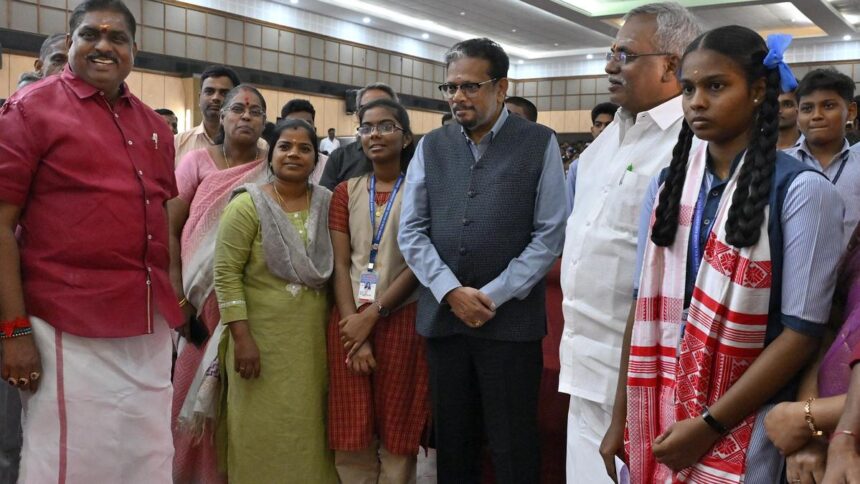




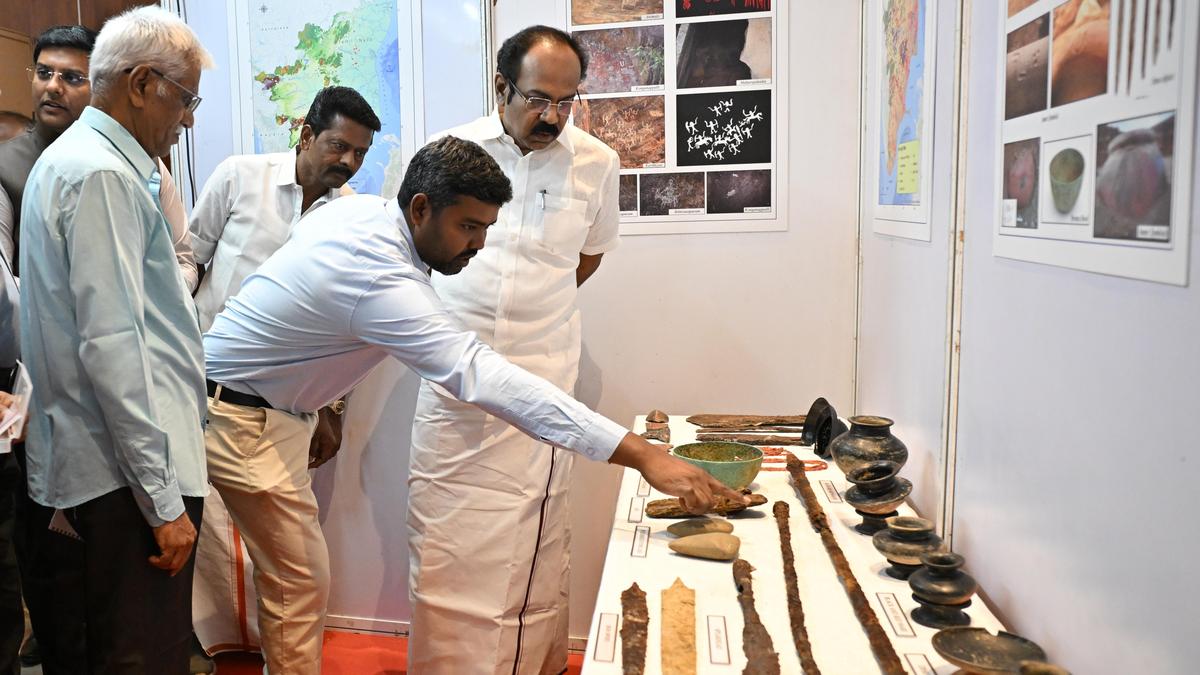

Highlighting the tasks undertaken by Archaeology Department, Tamil Nadu Finance Minister Thangam Thennarasu said the focus was mainly on reconstructing human past through scientific methods, establishing site museums, and collaborating with domestic and international laboratories for scientific interpretation of cultural materials.
These analyses had led to several significant breakthroughs, he said at the inauguration of the three-day international symposium on ‘Recent scientific studies in archaeology of Tamil Nadu’, here on Thursday. He also inaugurated an archaeological exhibition and released books on archaeology.
Mr. Thennarasu said, “While selecting a site for excavation, we carefully see that it covers a wider geographical space, such as North, South, East, West and Central Tamil Nadu, and also chronological space from prehistoric times to the historical period.”
He said several long-term projects such as documentation of rock art in T.N., preparation of archaeological and historical atlas of T.N., documentation of cultural heritage of T.N. and underwater archaeological expeditions were in progress.
“We have established museums at Keeladi and Porunai, and proposed to establish Naavai museum at Alagankulam, Chola museums at Thanjavur and Gangaikondacholapuram, Memorial Stone museum at Dharmapuri, Noyyal museum at Perundurai and Cultural museum at Mamallapuram,” he said, adding they would showcase the history of science and technology, transoceanic and navigational maritime trade techniques, and cultural transformation taken place in the State.
He said AMS dating from Sivagalai had established a date of 3345 BCE for iron, demonstrating that T.N. possessed iron technology approximately 5,300 years ago. The discovery of paddy and millets in excavations at Adichanallur and Sivagalai confirmed that early communities practised both dry and wet cultivation around 3,500 years ago, he said.
Over 15,000 graffiti-inscribed potsherds, along with AMS dates, indicated that the Iron Age in South India was contemporaneous with the Indus Valley Civilisation. Approximately 90% of the graffiti signs found in T.N. had parallels with Indus graffiti, and about 60% correspond with Indus seal signs. More than 100 scientific dates had been obtained over the past five years, spanning from the Microlithic to the Early Historical period, he added.
He said around 25 AMS dates had been recorded for the Iron Age, with nearly 10 dates falling between 2500 BCE and 3345 BCE. As many as 89 AMS dates from 79 Early Historic sites had been received from layers containing Tamil-Brahmi inscribed potsherds. Of them, 50% belong to pre-Asokan times.
More than 1,600 Tamil-Brahmi inscribed potsherds had been documented across T.N., with the earliest dating back to 685 BCE at Sivagalai. DNA studies were under way on samples collected in Sivagalai, Kondagai, Kodumanal, Mayiladumparai, and Kilnamandi, in collaboration with Madurai Kamaraj University and Harvard University, he said.
Experimental archaeology was being conducted on Palaeolithic and Neolithic tools in partnership with Sharma Heritage Centre. Plans were in place for isotopic analysis in collaboration with Deccan College and the University of Georgia. Other scientific analyses include OSL dating with BSIP, Lucknow, and PRL, Ahmedabad, he said.
He said Diatom studies with Agharkar Research Institute, Pune, suggested the brick channel found at Keeladi was meant for industrial activities. The findings of Indigo by the MKU finally narrowed down to the textile industry. Palaeobotanical studies with Deccan College from several excavated sites and Phytolith analysis with the French Institute of Pondicherry were in progress to understand the palaeoenvironment. Metallurgical and glass analysis were in progress with IIT Gandhinagar, he said.
Additionally, residue analysis, XRD, XRF, and many other scientific techniques were being employed to deepen understanding of the cultural heritage, he said. Retired IAS officer and scholar R. Balakrishnan, eminent archaeologists Kishore Kumar Basa, K. Rajan, R. Sivanantham, Madurai Collector K.J. Praveen Kumar, and Deputy Mayor T. Nagarajan were present.
Published – January 22, 2026 09:47 pm IST