







It’s not every day that you get to speak with one of your childhood idols, especially when their work has been so instrumental in shaping your own enthusiasms. Having dedicated a sizeable chunk of my childhood scampering across the terracotta rooftops of Renaissance-era Italy in Ubisoft’s seminal Assassin’s Creed II, Jesper Kyd’s infatuating original score was transforming the fun I had parkouring across the Il Doumo in Florence into a formative emotional experience. It is one of the biggest reasons I fell so irrevocably in love with videogames as a medium.
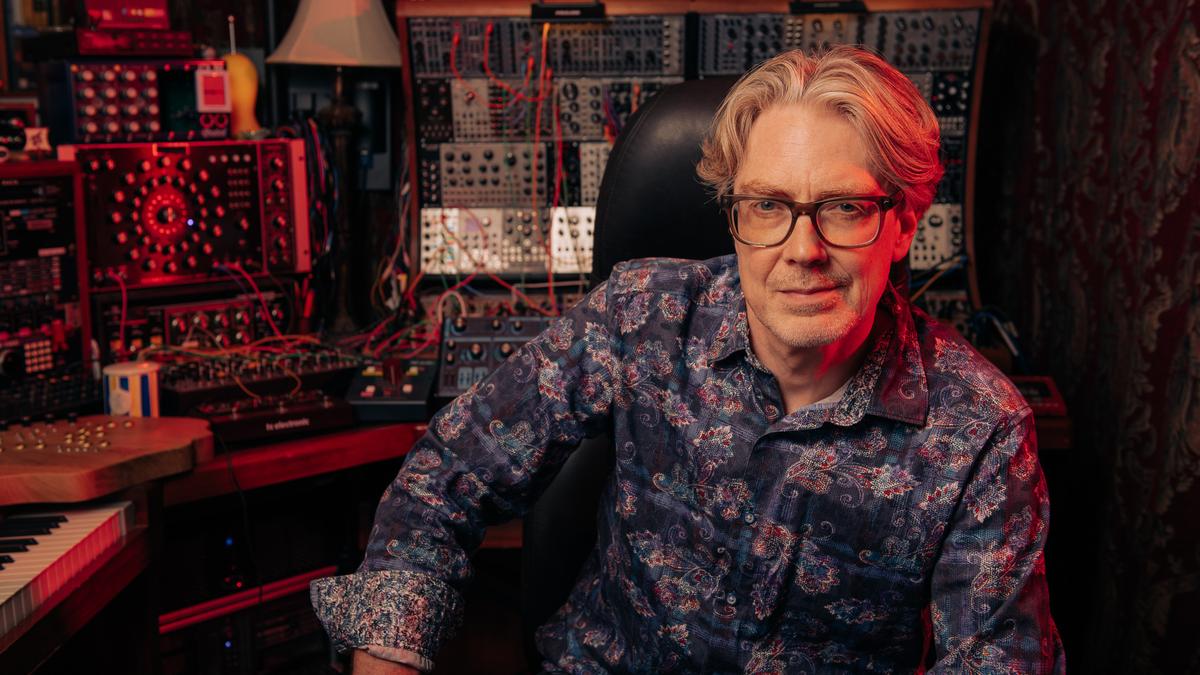
That the 54-year-old Danish composer behind my Renaissance reveries had also gone on to score the mythological nightmare of Tumbbad in 2018, was reason enough to seek him out. With the Indian horror landmark approaching its anniversary this year, I finally had the perfect excuse to pick his brain about both these utterly mesmerising sonic landscapes.

Jesper Kyd
| Photo Credit:
Ben Bentley
Jesper’s collaboration with Sohum Shah on Rahi Anil Barve’s folk-horror fever dream, is among the more unexpected entries in his eclectic catalogue of compositions. Written by Mitesh Shah, Adesh Prasad, Barve and Anand Gandhi, with Barve and Prasad directing, the film stars Shah as Vinayak Rao, whose lifelong pursuit of a hidden treasure in a rain-soaked village in Maharashtra becomes a grotesque tale of greed and generational rot. The film premiered in the Critics’ Week section of the 75th Venice International Film Festival, becoming the first Indian film to screen in the section, before opening in cinemas on October 12, 2018, to widespread critical acclaim for its storytelling, cinematography and painstaking production design. It has since then gained a cult following and is widely considered one of the greatest Indian horror films of the 21st century.

Jesper’s unlikely union with the production came about when Tumbbad co-director Adesh Prasad, found himself drawn to ‘Apocalypse’, a track Jesper had composed for Hitman: Blood Money. Asked what he believed Tumbbad had got right to endure in the years since, Jesper says, “As soon as I saw the footage, I could feel that there was something honest and real about the film. It brought together two of my favourite genres: fantasy and horror. There was an earthy realism to the film that I can’t quite explain. Everything felt so tangible, even as supernatural elements entered the story.”

A still from ‘Tumbbad’
| Photo Credit:
Sohum Shah Films
Having never worked on an Indian production before, he found himself entering unfamiliar territory. “I’d never worked on an Indian production before, so I was thrown straight into something new. I worked closely with Adesh, and our conversations focused on what the score should be and how far we could push it. We wanted a score that felt original. The goal was to make something that just kind of oozed that world. This score only works for Tumbbad.”
The music of Tumbbad was built from an array of dissonant strings, pounding percussion, manipulated acoustic instruments and electronic textures. A majority of its disconcerting motif’s were at once tactile and unearthly, with whispers, finger snaps and the occasional musical saw making everything sound all the more elemental and primordial. Asked whether he and Prasad consciously sought to make the film sound Indian without resorting to familiar cinematic signifiers, Jesper says, “Adesh did send me videos about Indian culture and festivals, which inspired me, and I interpreted those influences in my own way. We were more interested in finding something in between a sound that felt otherworldly and wasn’t tied too firmly to anything familiar. It needed to seem as though it came from an alternate place, from this particular universe”.
The search led him towards unusual instruments and unconventional playing techniques, with the cymbalom becoming one of the score’s principal sonic signatures: “The cymbalom is a type of dulcimer, a hammered-string instrument. The dulcimer is associated with Hungary, where it’s the national instrument. So it gave us a sound that felt as though it belonged in India, but also didn’t. We also played it in an unusual way. Instead of hammering the strings as you normally would, we scraped across them, which immediately created an interesting sound. I then processed it with music effects to give it a rich texture.”
In the film, when Shah’s character Vinayak finally reaches the treasure he has spent his life pursuing, the music swells into an almost ecstatic celebration, allowing us to share in his exhilaration before the full implications of his discovery become apparent. Jesper wrote this track ‘Descending’ as the first for the film, building it around a live-recorded 14-piece Bulgarian choir.

A still from ‘Tumbbad’
| Photo Credit:
Sohum Shah Films
“We knew the moment needed something special,” Jesper says. “Vinayak has spent much of his life searching for this treasure, so how could the music convey the importance of finally finding it? The title ‘Descending’ gives away what’s happening — he’s descending into greed. But I didn’t want to approach it like ‘Greed Manifests,’ another cue that accompanies greed taking hold of his body. That track is dark and stressful. In ‘Descending,’ he finally finds what he’s been looking for, so it becomes a celebration, almost a party. I wanted us to experience his absolute triumph, even though he’s triumphing for all the wrong reasons. The film isn’t there to judge him. It presents the world and tells the story without declaring what’s good or bad.”
There is of course, a difference between making an audience jump out of its seat and making it feel that something has gone profoundly, perhaps irreversibly, wrong with the universe, and Tumbbad feels more attuned with the latter than in cheap auditory ambushes. Asked whether composing for horror demands a fundamentally different approach, Jesper says, “Yes and no. Tumbbad isn’t typical horror”. He adds how in a conventional horror film, “you might be trapped in a haunted house or pursued by something and trying to escape, but Tumbbad doesn’t feel like that”, and argues that “with fantasy horror, you can shape the world around whatever you want the film to feel like, and I embraced the atmosphere because the filmmakers did, too. The moon, the sun, the rain and the imagery all contribute to that feeling, and I wanted the music to match it.”

A still from ‘Tumbbad’
| Photo Credit:
Sohum Shah Films
As compelling as Kyd’s work on Tumbbad may be, I must confess that the ostensible motive for speaking with Jesper was inevitably, Assassin’s Creed. Set in Renaissance Italy between 1476 and 1499, the second game and my introduction to the franchise follows Ezio Auditore da Firenze, a young Florentine nobleman driven towards the Assassins after the execution of his father and brothers, drawing him into their centuries-old struggle against the Templars, who seek peace through control. Ezio’s evolution from an impetuous young man into someone tempered by grief, vengeance and experience, is a transformation Jesper’s music renders with a poignancy that has proved remarkably resistant to the passage of time. I asked Jesper what he remembers most fondly about making the music, and whether he anticipated how deeply it would resonate:
“One of my favourite periods was working on the first two Assassin’s Creed games. With the first, I remember wondering what kind of monster we were unleashing. But I knew we had something unique that hadn’t been done before. By the second game, the team was excited. We knew we were addressing some of the first game’s flaws and making something special. I see a parallel with Tumbbad: we follow Vinayak from childhood through his life, much as Assassin’s Creed II takes Ezio from the beginning of his story through his journey. When you have a strong story and tell it that way, it stays with people. It gives them something they can return to.”
The music Jesper created for the Ezio trilogy has meant a great deal to me, not least for the melancholy threaded through its leitmotifs, which seem to have accrued even more value with every passing year. Though the tracks “Ezio’s Family” and “Venice Rooftops” are some of the more popular among fans, my personal favourites, “Earth” and “Home in Florence”, are the album’s more contemplative pieces. Asked whether he drew on experiences from his own life to imbue these themes with such exceptional emotional depth, Jesper talks about recognising something of himself in Ezio’s transformation.
“Ezio’s story really resonated with me. At first, he’s young and boisterous, as though nothing can touch him. Then he’s thrown into an enormous tragedy and has to rebuild himself. I haven’t experienced anything like what happens to him, but I’ve had moments in my life when I felt on top of the world and then lost everything. I know what that feels like, so I try to draw on my own experiences where I can. It was so well written and felt truthful, rather than like a story created purely for entertainment. You can take that truth and bring it into the music, and I felt the same with Tumbbad — there’s a truth at the heart of the film that I connected with, and I wanted the music to have that same quality.”
Ezio, and by extension Jesper, have been indelible fixtures of my life for years, and I know I am far from the only person who feels the same. Which is why I was curious to know whether Jesper could ever experience his own music with the same unselfconscious abandon as the rest of us, stepping outside the mechanics of its creation to encounter it simply as a listener himself:
“It’s difficult, because hearing a piece immediately takes me back to the moment I made it. I remember struggling with various parts erstwhile but now, I might approach those things differently. My mind is always on the next project and on how I can challenge myself and move in new directions. That’s the only way to learn, and learning is everything. I can take what I’ve learned and bring it to a new score. By repeating that process, I hope I can keep creating something new. I’m afraid of getting stuck by working on projects in the same category or making too many sequels. If I keep choosing new things, I can continue to surprise myself. That’s what matters.”