





Delhi has become synonymous with a seemingly endless parade of increasingly questionable variations on the momo, as though Nepal’s vast culinary heritage begins and ends with a dumpling stuffed with whatever new abomination Delhiites currently find exciting.
Very few restaurants in the city have attempted to engage with the breadth of Nepali food beyond momos, and fewer still have managed to present it with an authenticity that feels rooted in Nepal rather than calibrated to Indian taste buds.
To address that gap, bringing the food of Nepal to India through a restaurant shaped by Nepali recipes, ingredients and culinary traditions, one of the country’s most popular restaurant chains has finally opened its doors in Delhi-NCR: Jimbu Thakali, a Kathmandu-born chain devoted to the cuisine of Nepal’s Thakali community.

Jimbu Thakali at M3M 65th Avenue, Sector 65, Gurugram
| Photo Credit:
Special Arrangement
Now open at M3M 65th Avenue in Gurgaon, Jimbu is heavily rooted in Nepal. Staff members can tell you where an object came from and why a particular dish exists on the menu. While lentils, vegetables, meats and other readily available produce are sourced locally, more key ingredients such as the eponymous aromatic Himalayan herb jimbu, and the wild-growing Nepali Sichuan pepper timur, remain difficult to replace because their particular flavours are so closely tied to the cuisine.
Vivek Man Sherchan is the hospitality entrepreneur behind Jimbu, which began in Kathmandu in 2016 and now has four outlets across Nepal. He spent years working in food and beverage in the United States after training as a commercial airline pilot, eventually returning to Nepal in 2010 and opening Capital Grill, a bar and diner that became a popular haunt for expatriates and diplomats. When the devastating 2015 earthquake forced him to reconsider the business, the restaurant that emerged from that disruption eventually became Jimbu Thakali.

“I decided, when in Rome, you know?” Sherchan tells me. “What’s the most popular palate in Nepal?” His answer was the food people were already eating at home, particularly rice-based meals served with vegetables, dal and an assortment of accompaniments. The trick was to turn that everyday familiarity into a restaurant experience.

Vivek Man Sherchan, owner of the Jimbu Thakali restaurant chain
| Photo Credit:
Special Arrangement
“The Thakali thali is basically a staple,” he says. “The thali itself, is something that the average Nepali household consumes almost every day.” Jimbu’s version developed around the idea that families could eat the food they knew while enjoying the convenience of eating out. “If you have someone actually already doing that and gives you a better service, why not?”
The origins of Thakali cuisine
Thakali cuisine itself comes from the Thak Khola region of Mustang, where the Thakali community historically lived along the Kali Gandaki trade corridor. Mustang’s altitude shaped what could be cultivated, while its position along trade routes brought outside ingredients and culinary influences into the region. Buckwheat became particularly important, while jimbu, timur and fermented foods acquired distinctive roles in the cuisine. Sherchan explains the evolution of the thali through the peculiar relationship between Mustang and rice.

“Mustang does not cultivate a single grain of rice,” he says. “It’s buckwheat, but they grow the best buckwheat. So, whenever they had any chance of having rice, they imported rice. Whenever they cooked rice, they made sure everything around it was extra special. And that’s how the Thakali thali evolved.”
That food bore testament to that philosophy. The Mustang-spiced potatoes are among the simplest things I ate, and perhaps the easiest to underestimate. The potatoes are simply tossed in salt and jimbu; their texture soft enough to collapse under the slightest pressure.

A serving of the Mustang Potatoes
| Photo Credit:
Special Arrangement
Kanchayamba, the restaurant’s Thakali buckwheat fries, replaces the familiarity of the potato fry with the nutty graininess of buckwheat becoming a crisp vehicle for seasoning.
The mushroom choila was another favourite, served cold and coated in Newari spices that give the mushrooms a sharp, acidic edge against their chilled texture. The combination is strange for a few seconds before becoming deeply compelling.
The mutton momos are more immediately familiar, although their appeal comes from the effort behind the filling and seasoning rather than novelty.

The mutton momos
| Photo Credit:
Special Arrangement
What is a son-in-law thali?
But the highlight for me was the cheli jwai Thali, named after the Nepali term for a son-in-law. The idea, as Vivek explains, is that “when the son-in-law comes home, you pamper him with an extravagant meal”. Sherchan says the thali is among the most popular formats in Nepal, and it is easy to understand why.
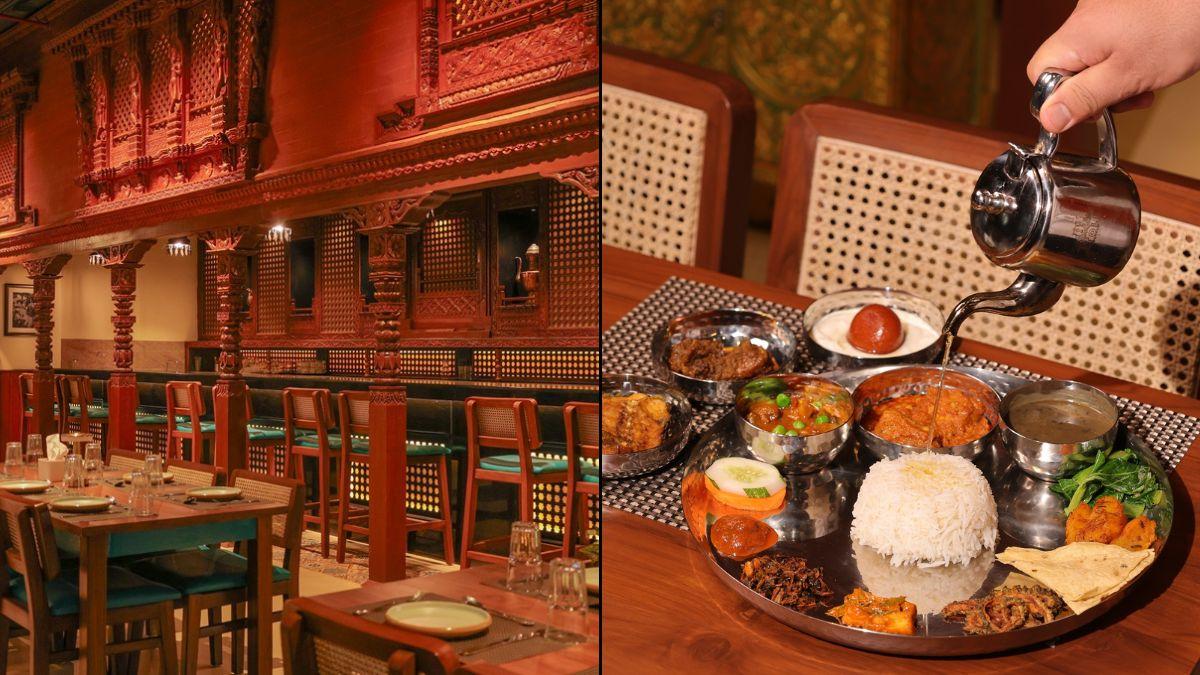
The trick to a great thali, in my opinion, is consistency across the offerings. It is easy to get a few things right, but maintaining that level of quality across every little offering spread across a large plate is what separates a great thali from a mediocre one. The cheli jwai was one of the better thalis I have had the privilege of feasting on. From the perfectly cooked mutton and flavoursome chicken to the homestyle dal, aloo, karela and fish fry, with papad and a helping of saag, everything holds its own before the entire plate is finished with generous dollops of poured liquid ghee. It’s hard to think of a fault in this wonderful meal.

The hearty Cheli Jwai Thali topped with liquid ghee
| Photo Credit:
Special Arrangement
Sherchan attributes much of Jimbu’s culinary identity to his mother, whose recipes form the foundation of the Thakali menu. “Our entire Thakali menu is based on my mom’s recipes,” he says. His mother inherited the cooking traditions of a family in which women were sought after for large communal meals and celebrations. The familial connection gives the food a useful sense of continuity, particularly because Jimbu is attempting to take a cuisine rooted in domestic cooking into a new market.
That market has also changed considerably. Sherchan describes the relationship between India and Nepal through an old Nepali expression, saying, “Nepal and India, we call ourselves ‘roti beti ke rishte’. It’s like the ‘betis’ travelled, but the roti never did.” He is surprised that authentic Nepali restaurants remained scarce in Delhi for so long, particularly given the enormous popularity of momos.

The cultural traffic between Delhi and Kathmandu has only intensified, with frequent flights making the distance increasingly easy to cross. Sherchan says that around 80 per cent of the guests who had visited Jimbu during its first few days in Gurgaon had already eaten at one of the Nepal outlets.
With terracotta surfaces, earthen textures, Newari-style wooden detailing and artwork from Mustang occupying Jimbu’s walls, the restaurant has no shortage of visual history. But the series of black-and-white photographs interspersed among them turned out to have one of the wildest backstories in the room.

Some of the many monochrome photographs that adorn Jimbu Thakali’s walls
| Photo Credit:
Ayaan Paul Chowdhury
Sherchan tells me that a European man arrived in his family’s village in Mustang during the 1950s and was taken in by his grandfather. The man, known locally as Ansari, spent several years there taking photographs. Only later did the family learn that he was a Third Reich fugitive from justice who had fled Nazi Germany and was hiding from his past. Decades later, after China’s takeover of Tibet and the arrival of Tibetan guerrillas in Mustang, Sherchan says the Nepalese authorities eventually mistook the mysterious foreign photographer for a CIA operative and deported him.

A photograph of Sugata, known as Ansari in Mustang, in a photograph displayed on the walls of Jimbu Thakali
| Photo Credit:
Ayaan Paul Chowdhury
Years later, the man returned to become a Buddhist monk in Nepal, taking the name Sugata, and his journey was eventually chronicled in Bird of Passage, written with Rachel Kellett. In the late 1990s, Sugata returned to Mustang as an elderly, blind figure and handed the original negatives to Sherchan’s cousin. Those photographs now exist throughout Jimbu Thakali’s kitchens.
With a history this curious baked into its walls, Jimbu Thakali definitely feels like a new culinary homestyle experience worth seeking out, especially if you’re ready to move beyond Delhi’s momo obsession and taste the Nepal that exists beyond the dumpling.
A meal for two costs approximately ₹2,000. Jimbu Thakali is located at M3M 65th Avenue, Sector 65, Gurugram, and is currently open for lunch and dinner.