






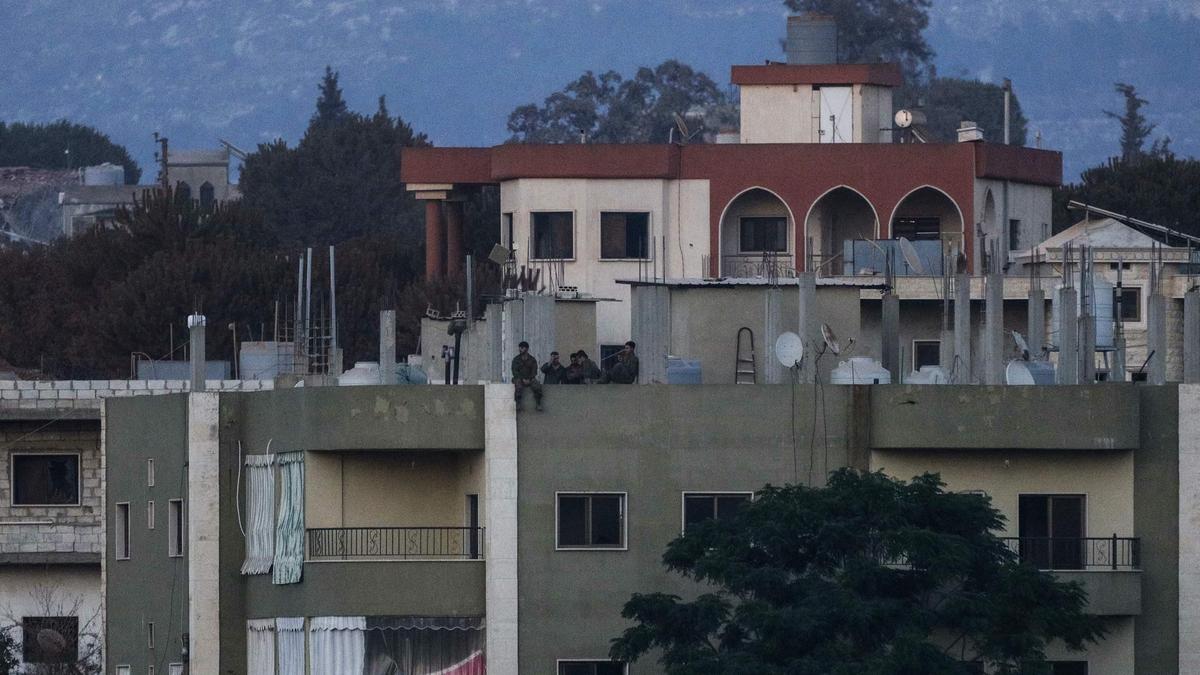


A photograph taken from the southern Lebanese village of Zawtar al-Gharbiyah, one of the first pilot zones, shows Israeli soldiers standing on the roof of a residential building in the nearby village of Zawtar al-Charkiyah, on August 4, 2026.
| Photo Credit: AFP
Lebanon and Israel held a fresh round of U.S.-sponsored talks in Rome on Tuesday (August 4, 2026), with Beirut seeking Israel’s phased withdrawal from the country’s south.
Convoys carrying delegations from the two countries arrived in the morning to the U.S. embassy in the Italian capital, where discussions are scheduled to run until Thursday (August 6).
“The United States remains fully committed to supporting both governments as they carry this process forward in a manner that delivers lasting security for both countries, eliminates security threats to Israel, and restores Lebanese state authority throughout the south,” State Department spokesman Tommy Pigott said on X.

At negotiations in Washington in June, Israel and Lebanon agreed to a framework deal that involves the disarmament of Hezbollah, a gradual withdrawal of Israeli forces from Lebanon’s south and the deployment of the Lebanese army to the region, starting in test areas known as “pilot zones”.
This week’s negotiations are the seventh round of Washington-mediated talks since Hezbollah drew Lebanon into the West Asian war in March with rocket fire at Israel in support of its backer Iran.
Israel responded with heavy airstrikes and a ground invasion that Lebanon says have killed more than 4,300 people.

Hezbollah leader Naim Qassem said on Tuesday (August 4) that the direct negotiations would bring “nothing but shame, humiliation, and successive compromises” for Lebanon.
In a televised address, he also criticised Lebanon’s President Joseph Aoun, saying he “has not acted as an arbiter, nor as a unifying figure, but has become biased and divisive, which is incompatible with his role and with Lebanon’s strength”.
On Monday (August 3), Italian Foreign Minister Antonio Tajani urged Lebanon and Israel to “continue in a constructive spirit, identifying shared solutions that will allow for the full implementation of the framework agreement”, his Ministry said.
After talks last month, Israel’s military withdrew from the outskirts of the village of Zawtar al-Gharbiya, one of the first pilot zones.

The Lebanese Army deployed to the area and has allowed residents to inspect their homes and businesses.
Pilot Zones
Lebanese Prime Minister Nawaf Salam told a cabinet meeting on Monday (August 3) that his country was pursuing “efforts towards successive Israeli withdrawals from Lebanese territory, leading to a full withdrawal”.
A U.S. State Department official had told AFP that this week’s discussions would “include expanding the pilot zone process, resolving all outstanding border issues, and working on a comprehensive peace and security agreement”.

On Monday (August 3), U.S. Ambassador to Lebanon Michel Issa warned that “moving too quickly risks jeopardising the very civilians this process is meant to protect”.
“It is better to take the time needed to get this right the first time. Doing so will allow subsequent pilot zones to move forward more efficiently,” Mr. Issa said.
“Both sides must agree on a clear, workable process before proceeding.”
The Lebanese Army’s deployment is a major test, with experts expressing doubt over the authorities’ ability to disarm Hezbollah — which opposes the Israel deal and refuses to surrender its weapons — and prevent further non-state military activity.

Observers say Israel’s commitment to withdraw will also be tested when pilot zones are selected in areas fully under its occupation.
Violence in Lebanon has decreased since the Lebanon-Israel deal and the signing in June of a preliminary U.S.-Iran agreement on the West Asian conflict.
But Lebanon continues to report intermittent Israeli strikes and shelling, as well as detonations and demolitions in southern villages.
Published – August 05, 2026 04:53 am IST