

Long before Chennai became synonymous with contemporary art, the city was forging a distinct visual language of its own. The Madras Movement of the 1960s, led by KCS Paniker at the Government College of Arts and Crafts, drew on indigenous scripts, folk forms, and abstraction rather than looking westward. Together with the Cholamandal Artists’ Village, it laid the foundations for a movement that would shape generations of artists and leave an enduring imprint on Indian modern and contemporary art.
That legacy comes into focus once again with Contemporary Now — Edition III, a 20-day citywide exhibition that brings together 66 artists, seven leading galleries, and a programme of exhibitions, conversations, artist walkthroughs, and open houses across Chennai. Against this backdrop, we speak to artists with roots in Madras to understand how the city has shaped their artistic language, practice and ways of seeing the world.

C Krishnaswamy
| Photo Credit:
Special Arrangement
C Krishnaswamy: Central station, Albert theatre and rava dosas
For artist C Krishnaswamy, studying at the Government College of Arts and Crafts from 1991 to 1996 (now Government College of Fine Arts), Madras, education began on the campus but extended beyond that. “That was a time when Madras itself became my art school.”
He recalls wandering through Central and Egmore stations, sketching around the Government Museum and St. Andrews Church, spending afternoons at the American Consulate Library, the British Library and Higginbothams in search of books on the world’s great artists. Armed with a student bus pass, he and his friends would board buses without a destination, exploring unfamiliar neighbourhoods before heading back on another route. “We bought old papers by the kilogram at Kothaval Chavadi and searched Moore Market for forgotten books and discarded objects,” says Krishnaswamy.

He would spend countless hours at Albert Theatre and Devi Theatre watching films and painting watercolour portraits around the Government Museum and St. Andrew’s Church. A plate of onion rava dosa at Kaveri Hotel often completed the day. Giri Trading and Perumal Chetty & Sons were their regular stops for art materials, and they would buy canvases near the old Rolex Hotel.
“Those years remain within me like breathing itself. They shaped the way I see, think, and create. Madras did not simply educate me; it became an inseparable part of my artistic practice,” says Krishnaswamy.
His ongoing work at Ashvita’s explores ecological memory and humanity’s enduring relationship with the land. Drawing inspiration from the Ayyanar tradition of southern India as an ancient expression of guardianship, the works revisit village shrines where clay guardian figures symbolised the bond between earth, memory, and community, reimagining these ideas for the present.

Benitha Perciyal K
| Photo Credit:
Special Arrangement
Benitha Perciyal K: British Council, Alliance Française and Max Mueller Bhavan
Benitha Perciyal K arrived in Madras from Tiruvannamalai as a student in 1995, a move she describes as both a cultural shock and a turning point in her artistic journey. During her years at college, from 1995 until she completed her Master’s degree in 2002, the city became a space of constant discovery.

“Moving from a small town to a metropolitan city was a cultural shock at first. But slowly, as I explored the city and the college, it changed my perspective,” she says. It was through institutions such as the British Council, Alliance Française and Max Mueller Bhavan that she discovered world cinema, contemporary theatre, literature and conversations with artists and writers. “Those years were not just about studying Art. They exposed me to literature, theatre, cinema and writers. It became a multidimensional learning experience, and in many ways, Madras transformed how I saw myself and my practice. That experience has stayed with me since,” she says.
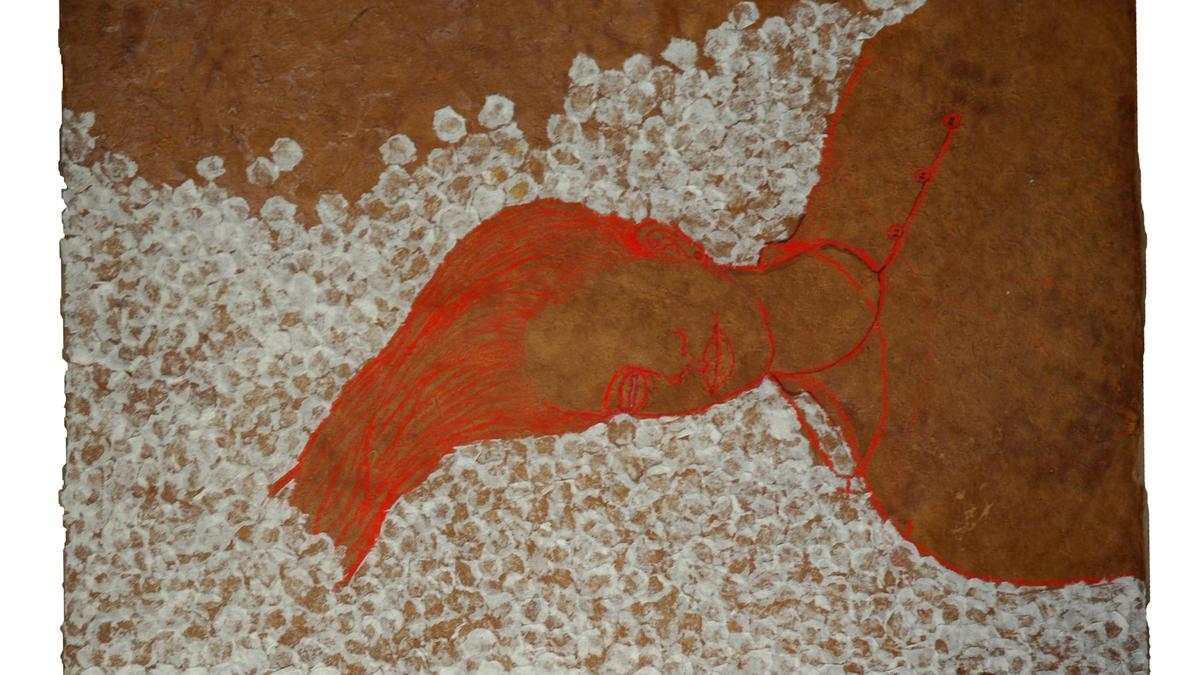
For Contemporary Now, Benitha will present a section from her long-running library series, an evolving body of work she has been developing for over a decade. Featuring hand-carved wooden books arranged as bookshelves, the installation draws on texts spanning ecology, medicine, history and archival knowledge, including titles dating back centuries. This deeply personal journey explores themes of memory, displacement, faith, and belonging.

Suresh Kumar
| Photo Credit:
Special Arrangement
Suresh Kumar P: Kasimedu fishing harbour, Anderson Church and the Government College of Fine Arts
Suresh Kumar P, a contemporary artist, sculptor and one of the founding members of the KINETICS collective, credits Chennai with shaping the way he sees the world. “Chennai has been the foundation of my artistic journey,” he says. Having studied at the Government College of Fine Arts, he remembers a city that was quieter and slower, where observation became second nature. “The college campus, with its lush greenery, gave me a peaceful environment where observing became a way of learning,” he recalls.
Sketching landscapes, colonial buildings and landmarks such as Anderson Church, along with painting the vibrant fishing neighbourhood of Kasimedu, became formative experiences. While the city has transformed over the last 25 years, Kumar says those memories continue to inform his practice. “Although my work has evolved into abstraction, the attention to colour, atmosphere and the poetry of everyday life that I discovered in Chennai continues to shape my work,” says Suresh.

Showcasing as part of Gallery Veda for Contemporary Now, his Untitled abstract paintings emerge from fleeting moments of beauty, discovered in everyday environments, from Nature to urban landscapes and overlooked spaces. Through an intuitive, meditative process, he transforms these impressions into colour and form, inviting viewers to linger, to reflect, and to find their own meanings within the work.

Maanas Udayakumar
| Photo Credit:
Special Arrangement
Maanas Udayakumar: TASMAC outlets, stray dogs and late-night card game
Unlike many of the artists whose memories of Madras are rooted in its art schools and cultural institutions, Maanas Udayakumar finds his inspiration in the city’s everyday rituals. His Chennai is one of TASMAC outlets, stray dogs, late-night card games and the unhurried camaraderie of bachelor life. Although he is now based in Bengaluru, it was only after leaving the city that these seemingly ordinary moments resurfaced in his practice. “I painted these works after I moved out of Chennai. That’s when the character of the city came back to me. There’s something about Chennai’s slowness. Slow living isn’t about going away to a farm; it’s about noticing what’s around you and appreciating ordinary existence,” he says.

An evening with the girls by Maanas Udayakumar
| Photo Credit:
Special Arrangement
The two works he is exhibiting at Contemporary Now grew out of memories from the pandemic, when he spent long evenings in an old bungalow with friends, observing the rhythms of everyday life. The first painting features groups of women playing cards and drinking in the familiar presence of Chennai’s liquor shops — less as a symbol of drinking than as a marker of Chennai’s social landscape.

The second painting shows a man cooking with liquor bottles on the side and fish bags from a fish export market in North Chennai’s Kolanthur. “People often label these men as drunkards, but I wanted to show their innocence,” he says. “I wasn’t trying to make a statement. I was simply journalling the little beauty in what already existed.” By documenting these unremarkable moments, Maanas invites viewers to look beyond stereotypes and recognise the tenderness embedded in the city’s everyday culture.

Jagath Ravi
| Photo Credit:
Special Arrangement
Jagath Ravi: A childhood rooted in everyday Chennai life
Jagath Ravi, who has spent his entire life in Chennai, says that the city has shaped both his life and his artistic practice. “From childhood until now, I have never lived anywhere else, which makes me deeply rooted in this city,” he says. Having watched Madras evolve over the years, he believes he has changed alongside it. “The city has shaped how I see, respond, and engage with the world, and this influence is quietly reflected in my work.” Rather than looking out to grand landmarks, Jagath draws from the emotional texture of everyday happenings around him.

Punishment 2025
| Photo Credit:
Special Arrangement
For the show, Jagath presents his work titled Punishment (2025), a painting inspired by a playful exchange between a teacher and a student that helps foster better understanding between them. The work reimagines punishment not as an act of authority but as a simple playful gesture.

Maanas Udayakumar
| Photo Credit:
Special Arrangement
For some, Chennai was an art school beyond the classroom; for others, it was the streets, libraries, theatres, fishing harbour and everyday rituals that became a source of inspiration. Together, these artists reveal that the city’s greatest legacy lies not only in the Madras Movement it once nurtured, but also in its continued ability to shape generations of practitioners through every change the city continues to witness.
Contemporary Now Edition-III starts from August 8. For the full schedule, follow @contemporarynow on Instagram.

Suresh Kumar
| Photo Credit:
Special Arrangement