


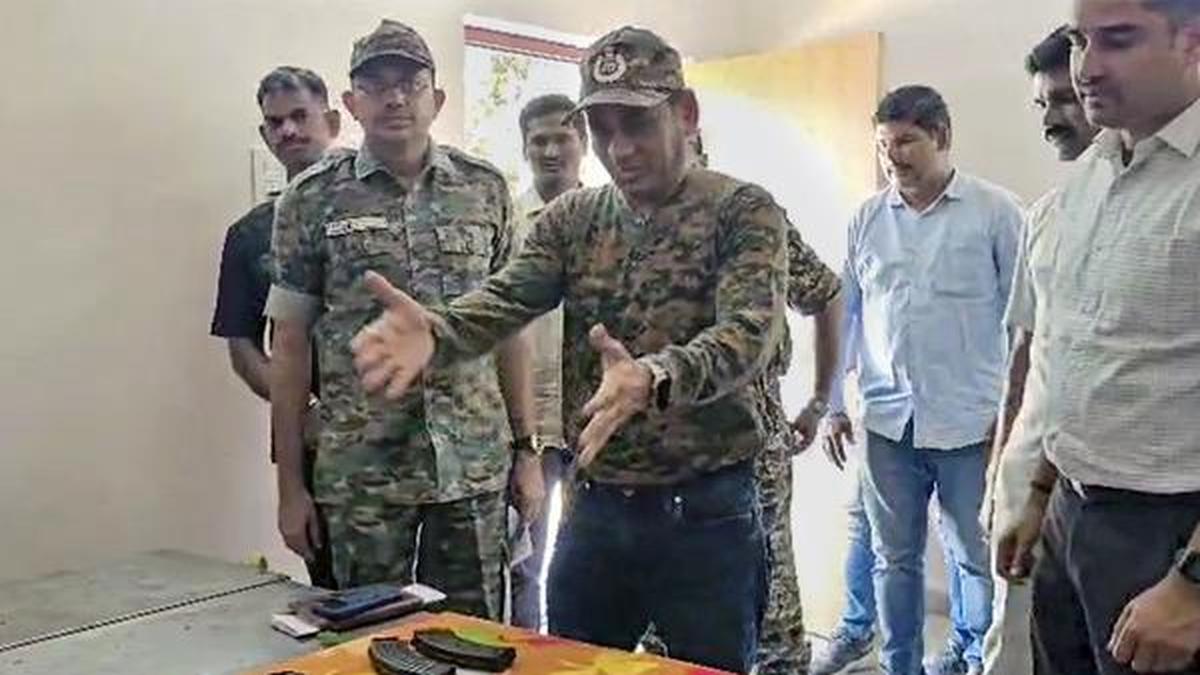

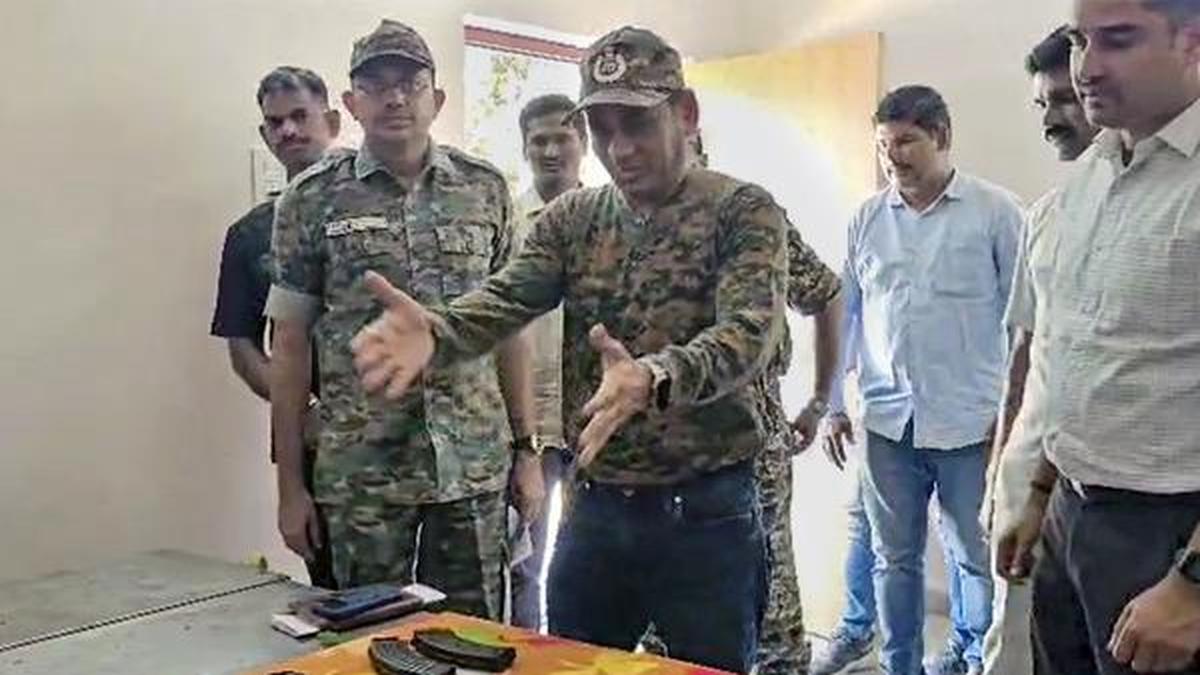
Additional DG (intelligence) Mahesh Chandra Laddha inspecting the weapons seized from the site of encounter in which Maoist Central Committee member Madvi Hidma was killed, in Maredumilli of Alluri Sitharama Raju district in November.
| Photo Credit: File Photo
As the year draws to a close, the four-decade-old Left Wing Extremist (LWE) insurgency—commonly known as Naxalism—appears to be at its lowest ebb.
The banned CPI (Maoist), the current manifestation of Naxalism, has suffered its worst reverses so far, and security analysts believe that the endgame has begun, with the movement heading towards extinction.
Historically, the movement began as a peasant uprising under the banner of the Communist Party of India (Marxist-Leninist)—a breakaway faction of the present CPI(M)—in 1967 at Naxalbari of West Bengal. Led by radical ideologues Charu Majumdar, Jangal Santhal and Kanu Sanyal, it withered away within a few years after spreading to parts of the then unified Andhra Pradesh, with Srikakulam district emerging as its epicentre.
However, the movement was revived in Andhra Pradesh in 1980 by Kondapalli Seetharamaiah under the banner of the Communist Party of India (Marxist-Leninist) People’s War. It later took a different form with the formation of CPI (Maoist) following the merger of People’s War and the Maoist Communist Centre in 2004.
Thereafter, the movement spread across Andhra Pradesh, Odisha, Chhattisgarh, Madhya Pradesh, Bihar, Jharkhand and parts of Maharashtra, with the aim of creating a ‘Red Corridor’—a goal it largely achieved.
Even after being driven out of Andhra Pradesh and Odisha, it managed to retain its stronghold in Chhattisgarh, a predominantly tribal State. The Maoists were even successful in establishing a ‘Janatana Sarkar’, a parallel governance system, ruling the roost until the Union government launched Operation Kagar, also known as ‘Black Forest’, in April 2025.
The endgame
Operation Kagar, led by multiple specialised forces including the CoBRA of the CRPF, the District Reserve Guards (DRG) of Chhattisgarh, the Special Operations Group (SOG) of Odisha, the Greyhounds of Andhra Pradesh, and the C-60 of Maharashtra, not only successfully besieged the Maoists in the forests of Chhattisgarh but also made deep inroads into their core strongholds such as Karregutta and Abujhmad.
The Maoists suffered heavy losses over the past six months. According to a Maoist document released by the party’s Central Committee, more than 320 cadres were killed in the last 11 months, including about eight Central Committee members and several senior and mid-level leaders and military commanders.
The biggest blow came in May this year, when the party’s general secretary, Nambala Keshava Rao alias Basavaraju, was killed along with 27 others in the Abujhmad area.
The residual movement in Andhra Pradesh was curtailed with the killing of Central Committee member Gajarla Ravi alias Uday and senior leaders such as Aruna and Tech Shankar in recent months.
This was followed by the surrender of Bhupati (Mallojula Venugopal Rao), one of the senior-most Central Committee members, along with 60 others.
The final hope of reviving the Maoists’ military wing suffered a decisive setback when their youngest Central Committee member and commander of the Central Military Commission (CMC)—the party’s main fighting body—Madvi Hidma, was killed on November 18 in the Chintoor of Alluri Sitharama Raju district.
The deaths of Hidma and Basavaraju were the biggest setbacks for the movement and signal its endgame, says Mahesh Laddha, Additional Director General (Intelligence) of Andhra Pradesh.
Hidma’s killing was followed by the arrest of over 50 Maoists from various cities in A.P. within 24 hours.
Union Home Minister Amit Shah has said that the Maoist movement must be eliminated by March 31, 2026. With events rapidly aligning towards that goal, it appears that the four-decade-old insurgency is nearing its end.
Published – December 18, 2025 09:48 am IST