


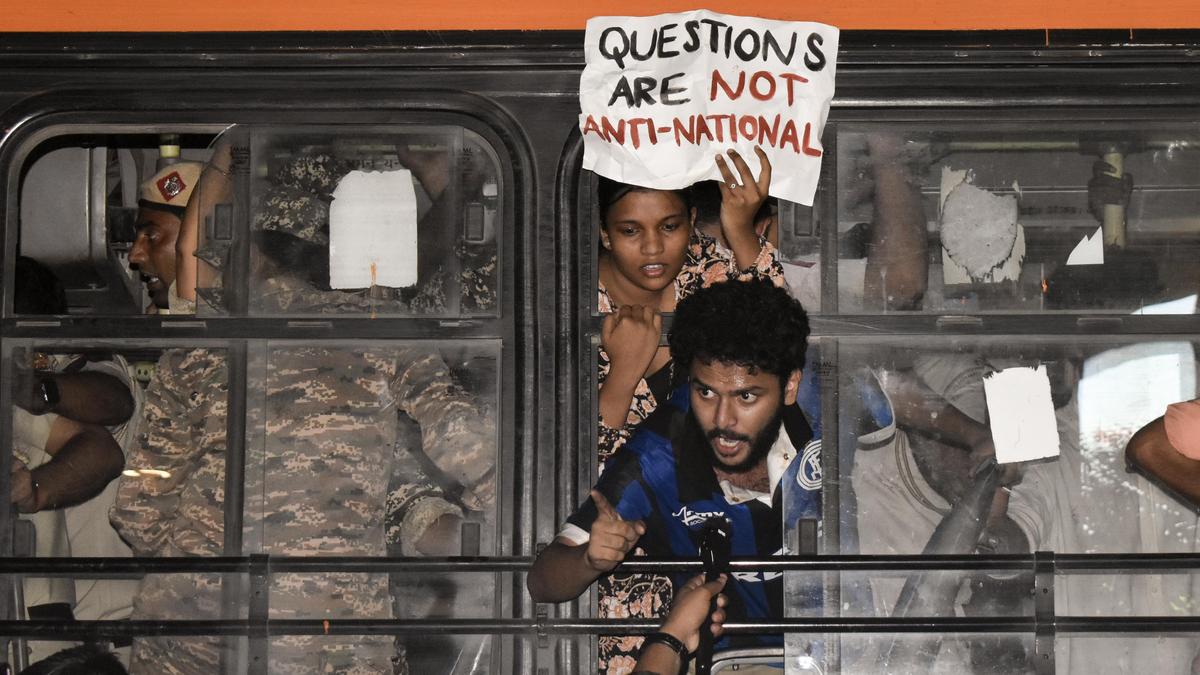


A demonstrator shouts slogans from inside a police bus after being detained during a protest organised by the Cockroach Janta Party (CJP), at Connaught Place, in New Delhi
| Photo Credit: PTI
Amid large-scale detentions across the national capital on Saturday (October 10, 2026), as police sought to thwart a youth protest demanding the resignation of Chief Election Commissioner (CEC) Gyanesh Kumar over deletions of names from electoral rolls, legal experts questioned the basis on which Delhi Police detained protesters beyond the New Delhi district, where prohibitory orders under Section 163 of the Bharatiya Nagarik Suraksha Sanhita (BNSS) are in force.
Among those detained on Saturday were Cockroach Janta Party (CJP) representatives Abhijeet Dipke, Saurav Das and Ashutosh Ranka, who were taken into custody after police boarded their Air India flight upon its arrival in Delhi. CJP legal wing head Ratna Singh alleged that police prevented her from leaving her residence in Jangpura, while YouTuber Dhruv Rathee was detained at a residential flat in Gurugram.

Several instances of protesters being picked up and taken away in buses were also reported through the day, with some alleging that they were not informed of the grounds for their detention, raising concerns over compliance with constitutional safeguards governing deprivation of personal liberty.
Section 163 of the BNSS, which replaced Section 144 of the Code of Criminal Procedure (CrPC), empowers an executive magistrate to issue prohibitory orders where “immediate prevention or speedy remedy is desirable”.
Delhi Police has maintained that detentions in the capital followed violations of prohibitory orders imposed under Section 163 of the BNSS in the New Delhi district, which bar unauthorised public assemblies, demonstrations and protests. Late on Saturday evening, police said women protesters and senior citizens were being released from detention centres, while “due legal process” would be followed in the case of the CJP leaders.

However, there was no clarity on the legal authority invoked to detain protesters from areas where such orders were not in force, or whether any other preventive powers, including those under special laws, had been invoked.
‘Tool to curb protests’
“The detention of CJP representatives from areas in Delhi-NCR where prohibitory orders are not in force is wholly illegal,” advocate Nipun Saxena said. He also pointed to what he described as the increasing use of prohibitory orders to quell even peaceful protests.
“Intended as an exceptional measure to deal with emergencies and maintain public peace, such orders are often reissued by the authorities in a cyclostyled manner, turning an exceptional power into a routine tool to curb protests,” Mr. Saxena said.
He also pointed to the practice of resorting to detention rather than formal arrest, which, he said, enabled the police to avoid some of the procedural safeguards that accompany an arrest.
“The police know that the power to arrest cannot be exercised casually when protesters are not committing a cognisable offence punishable with imprisonment of more than seven years. If they make arrests in such cases, they will have to justify them before the courts,” he said. “That is why they choose to detain people and release them within 24 hours, so that they do not have to be produced before a magistrate.”
The safeguards applicable to such brief detentions during protests, however, remain a grey area. The extent to which safeguards governing formal arrest apply to temporary restraints on personal liberty, and the consequences of their breach, have not been conclusively settled by the Supreme Court.
Grounds of detention
Referring to instances of protesters being picked up and taken to buses and stadiums across the capital, former Supreme Court judge Abhay S. Oka said authorities were obligated under Article 22 of the Constitution to communicate the grounds for depriving a person of their liberty “as soon as may be”. He said this protection could not be circumvented merely by describing the restraint as detention rather than a formal arrest.
Mr. Saxena agreed, saying that even where the police claim to be exercising preventive powers rather than arresting a person for an offence, the grounds for detention must be communicated at the earliest opportunity.
“There are a host of Supreme Court judgments which hold that even in cases of preventive detention under stringent laws such as the National Security Act, 1980 (NSA), communication of the grounds of detention is a sine qua non,” he said.
(With inputs from Jagriti Chandra and Saurabh Trivedi)
Published – October 11, 2026 04:24 am IST