





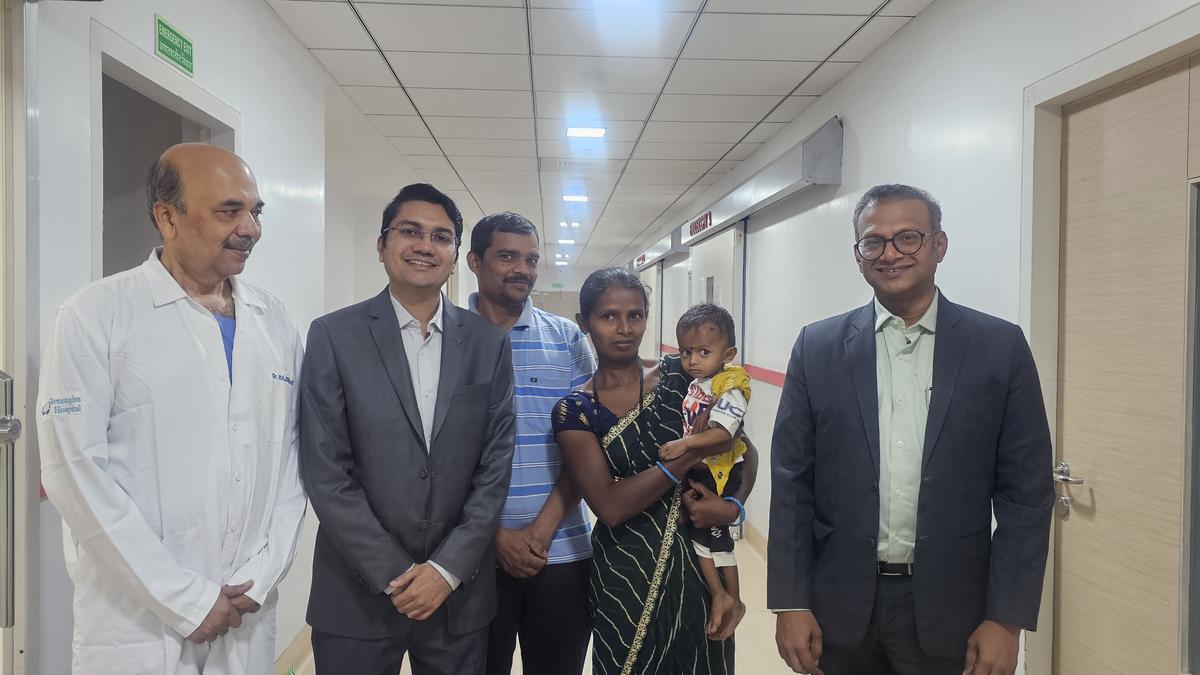

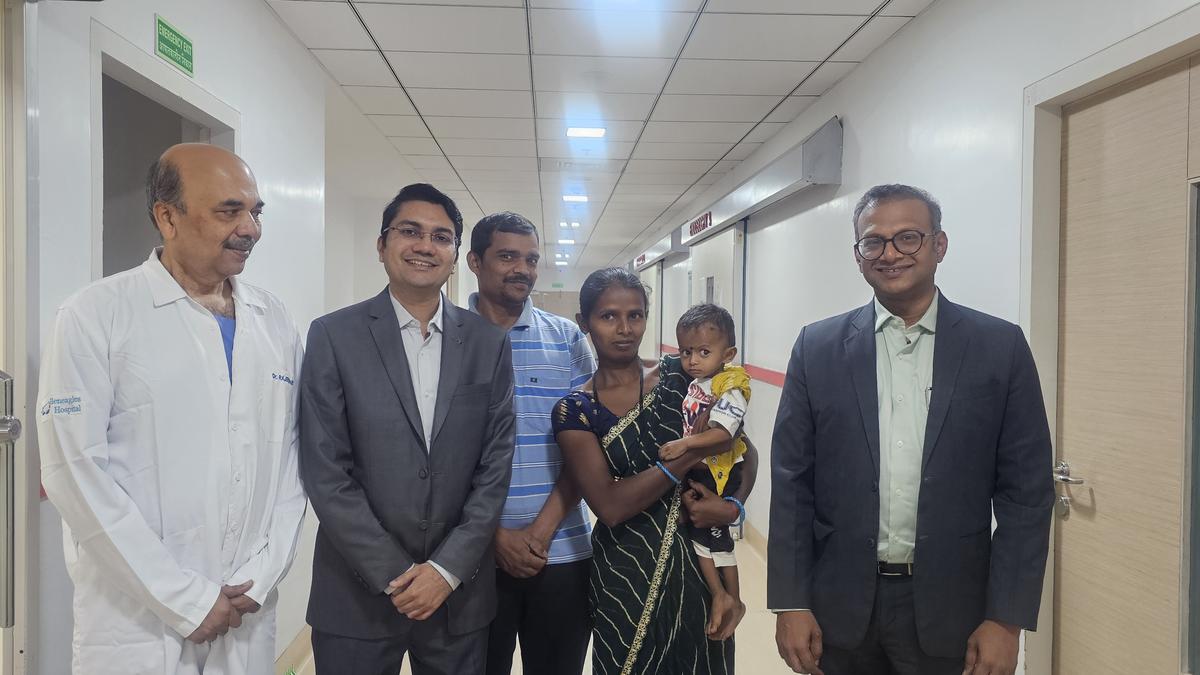
(L to R) Dr. Rajan Daftari, Dr. Shankar Zanwar, patient and family with Dr. Vibhor Borkar at Gleneagles Hospital, Parel, Mumbai.
| Photo Credit: Special Arrangement
A 14-month-old child from Nashik district, suffering from a rare condition that made swallowing nearly impossible, has recovered after undergoing a complex Per Oral Endoscopic Myotomy (POEM) procedure at Gleneagles Hospital, Parel, Mumbai.
The child, weighing just 5.9 kg, was diagnosed with Achalasia Cardia—a disorder where the valve between the food pipe and stomach fails to open—leading to persistent vomiting, repeated pneumonia, and severe malnutrition.
The child, Neeraj Balu Kavar from Chinchore village, appeared healthy in his early months and consumed milk normally. Trouble began around nine months when solids such as khichdi was introduced. What seemed like a feeding issue soon turned into daily vomiting, rapid weight loss, and repeated chest infections, including three episodes of pneumonia. Despite consulting several clinics, the cause remained unclear until the family was referred to Mumbai in late November.
“Neeraj had recurrent vomiting and pneumonia since early infancy. Endoscopy showed the valve was not opening at all,” said Dr. Vibhor Borkar, Director – Paediatric Gastroenterology and Hepatology. The tests revealed a massively dilated food pipe and a tightly shut valve at its junction with the stomach, confirming Achalasia Cardia — a condition affecting about one in five lakh infants.
Given his severe malnutrition, dehydration, and electrolyte imbalance, conventional options such as balloon dilation or open surgery were ruled out. “Balloon dilation has a 40% recurrence rate and balloons of suitable size aren’t available for such small infants. Surgery is invasive and leaves scars,” said Dr. Shankar Zanvar, Senior Consultant Gastroenterologist.
The team, including Dr. Rajan Daftari, adapted a bronchoscope normally used for lung procedures because adult endoscopes were too large. “We created layers within the food pipe and performed the myotomy internally without external cuts. POEM is well-established in adults, but this is the youngest child in India to undergo it and possibly the smallest by weight globally. Based on literature, only an 11-month-old in China has been reported earlier,” Dr. Zanvar added.
The procedure was performed on December 9, the same day the toddler was admitted, and lasted 3.5 hours. Unlike adults who are discharged the next day, Neeraj was kept under observation for one week to prevent re-feeding syndrome, a dangerous complication if feeding resumes too quickly. . He has now started eating without regurgitation and is gaining strength.
Why POEM scores over other treatment options
Doctors explained that POEM offers several advantages over traditional treatments. It is minimally invasive and performed entirely through an endoscope, leaving no external scars or stitches. Nearly 95% of patients remain symptom-free after POEM, compared to balloon dilation where symptoms return in up to 60% of cases.
POEM also avoids the trauma of major surgery, reduces hospital stay, and allows faster recovery, with most patients able to eat within two days. For fragile, underweight children like Neeraj, where conventional surgery carries higher risks, POEM is considered the safest and most effective option.
The procedure, which typically costs between ₹2.1 lakh and ₹3.8 lakh in India, was followed by a cautious recovery plan in Neeraj’s case. “Achalasia Cardia often goes undiagnosed for months because symptoms mimic reflux or heart issues. Early intervention is crucial to prevent failure to thrive,” Dr. Borkar said.
Neeraj’s mother, Pramila Kavar, expressed relief, “For months, we watched our child suffer. No one could tell us what was wrong. Today, seeing him eat properly and slowly gain strength feels like a miracle.”
Published – December 29, 2025 01:03 pm IST