







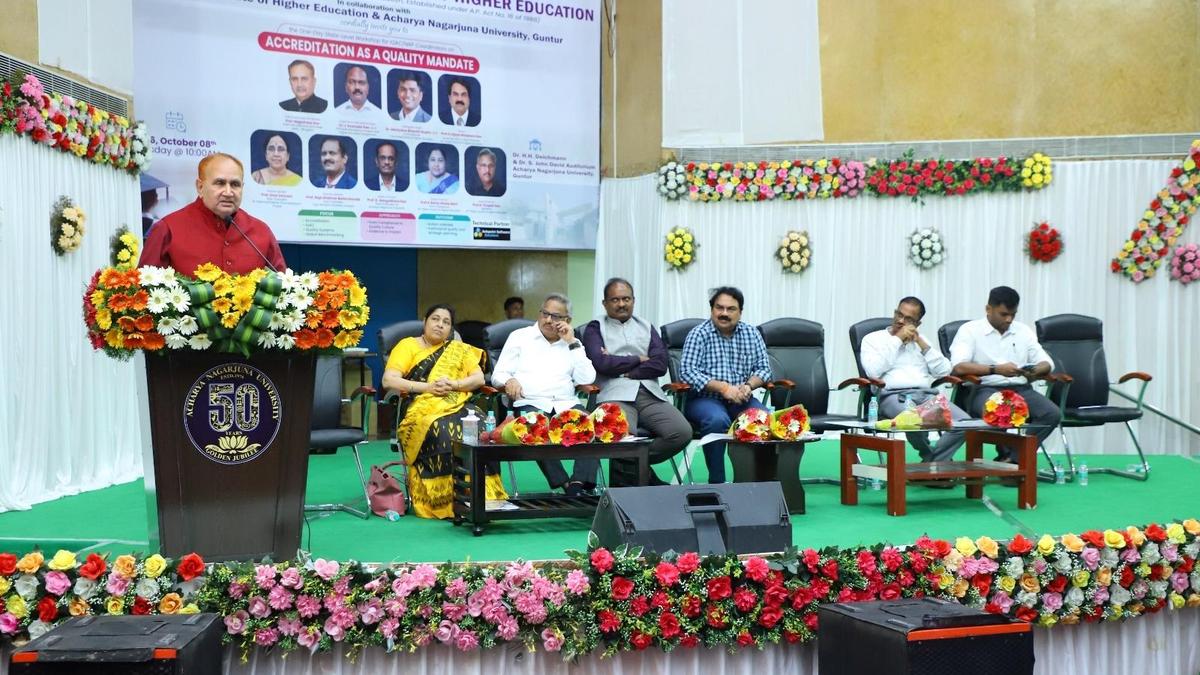


NAAC Executive Committee Chairman Nageshwar Rao speaking at a workshop organised by Andhra Pradesh State Council of Higher Education in Vijayawada on Thursday.
| Photo Credit: G.N. RAO
The new accreditation framework of the National Assessment and Accreditation Council (NAAC) will focus on institutional outputs and outcomes rather than inputs and documentation, said NAAC Executive Committee Chairman Nageshwar Rao.
Addressing a workshop on “Accreditation as a Quality Mandate” organised by the Andhra Pradesh State Council of Higher Education (APSCHE), in association with Acharya Nagarjuna University (ANU) on Thursday, Prof. Rao said the new framework was being shaped by the recommendations of the 2024 Radhakrishnan Committee.
Under the proposed system, institutions would have to demonstrate tangible outcomes, such as commercially relevant patents and the number of skilled students produced, rather than merely furnishing documents.
Differentiated assessment formats and metrics would be introduced through Maturity-Based Graded Levels (MBGLs), replacing the common Self-Study Report, he said.
The new system would also place greater trust in institutions and reduce assessment timelines, he added.
Prof. Rao cautioned higher education institutions against relying on unverified information available online, pointing out that the metrics under the new NAAC framework were still being finalised. He also encouraged institutions to institutionalise the use of SWAYAM and SWAYAMPRABHA platforms.
APSCHE Secretary B. Tirupati Rao said Internal Quality Assurance Cells (IQACs) should move beyond their role as documentation units and become effective mechanisms for institutional quality improvement. “Accreditation is not a destination, but a foundation for institutional progress,” he said.
APSCHE Vice-Chairperson K. Ratna Shiela Mani called upon institutions to align themselves with NEP 2020 and prepare for the emerging Binary NAAC framework. “Quality has to be a habit in each institution,” she said.
APSCHE Chairman (I/c) S. Vijaya Bhaskara Rao said the central challenge before higher education institutions was to make students employable or self-employable. Institutions should identify emerging employment sectors and train students in relevant skills, even with limited resources, he said.
ANU Vice-Chancellor Prof. K. Gangadhara Rao pointed to discrepancies between All India Survey of Higher Education (AISHE) and NAAC data. He stressed the need for integrated data systems and a single point of coordination under the One Nation–One Data (ONOD) approach.
Yogi Vemana University Vice-Chancellor B. Rajasekhar identified data integrity, particularly placement data, as a major challenge. He urged institutions to maintain consistency in information submitted to AISHE, the Commissionerate, institutional websites and other public platforms, especially with AI-enabled validation gaining importance.
Commissioner of Higher Education Narayana Bharat Gupta said only 293 of around 2,800 colleges in the State were accredited, while about 800 colleges had not declared their accreditation status. The State had set a target of achieving 60% institutional accreditation in the coming year, he said.
Published – October 08, 2026 07:52 pm IST