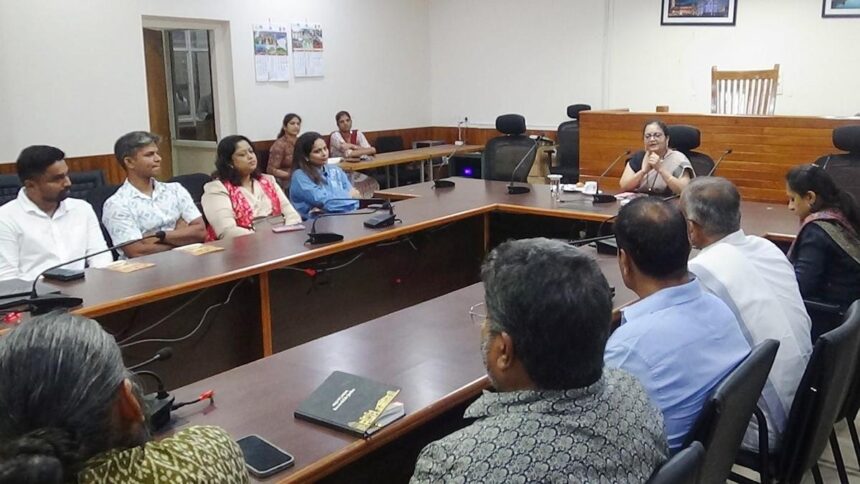






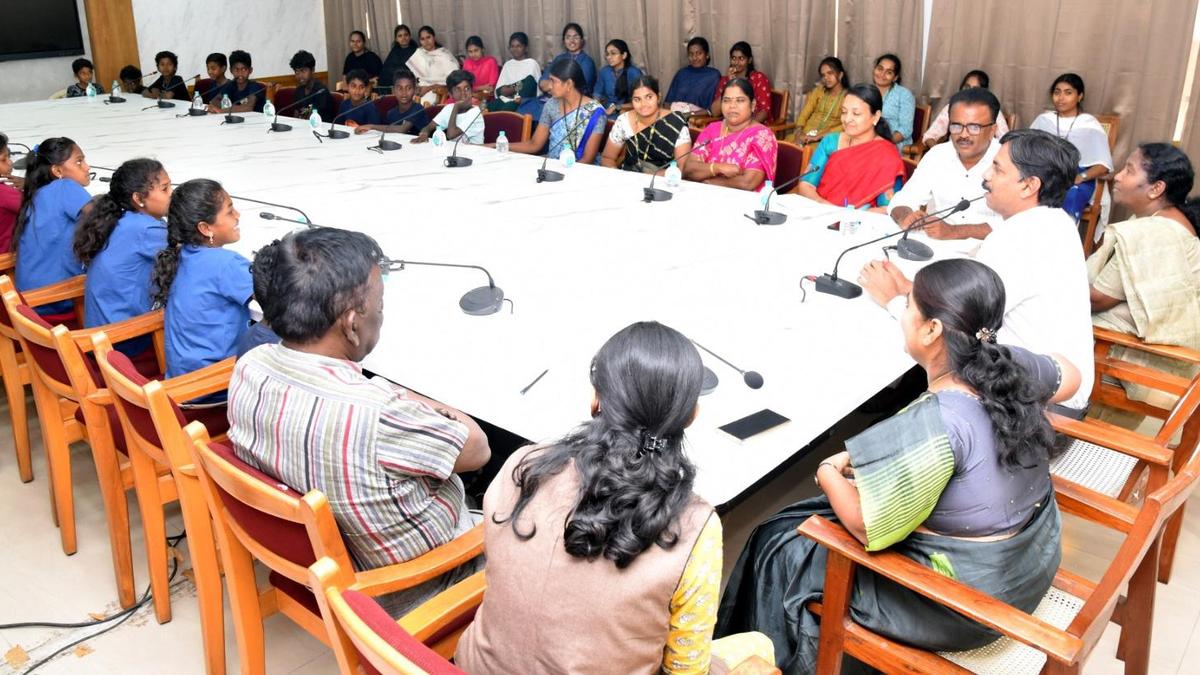


Collector S. Kandasamy interacting with children from Bargur Hills at the Erode Collectorate on Wednesday.
| Photo Credit: HANDOUT_E_MAIL
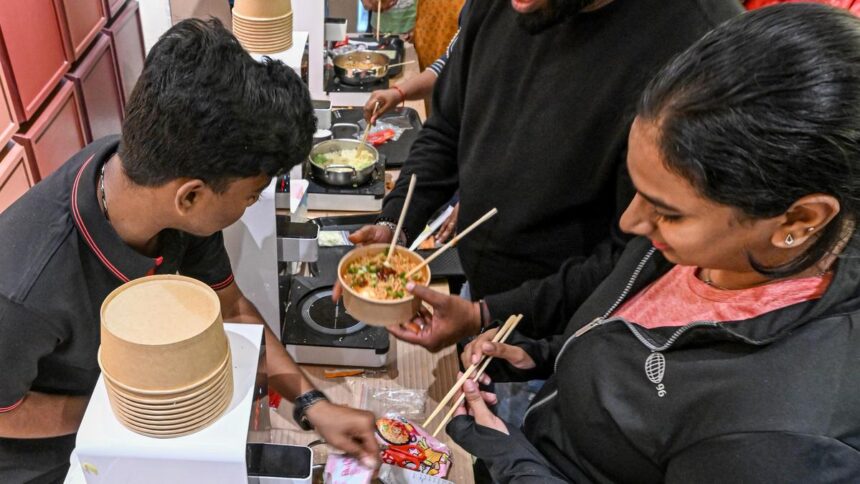
Nine students from the Bargur Hills, who had remained out of school for several months, resumed their studies on Thursday following a two-day residential catch-up camp held on February 10 and 11.
Two students rejoined the Government Tribal Residential High School at Kongadai, while seven returned to the Government Higher Secondary School at Oosur, both located in the West Bargur Hills. A total of 22 students participated in the camp, titled “My Dream, My Education”, organised by the Tribal Welfare Centre (TWC) of Vellalar College for Women and the NGO Management Club of VET Institute of Arts and Science, in association with the Service Unit for Development Activities in Rural (SUDAR), a non-governmental organisation.
More than 60 students had earlier been identified as dropouts in these hill schools. The camp aimed to sensitise children to the importance of education, rebuild their confidence, and facilitate their reintegration into mainstream schooling.
On Wednesday, the students met Collector S. Kandasamy at the Collectorate. Sharing his personal journey, the Collector told them that education had enabled him to reach his present position and urged them to continue their studies. He emphasised that education alone could bring lasting change to their lives and uplift their families.
S.C. Nataraj, Director of SUDAR, told The Hindu that efforts were under way to counsel parents and persuade them to send their children back to school. He expressed confidence that more students would resume their studies in the coming days.
Addressing the root causes of dropouts, Mr. Nataraj said long-term solutions lay in preventing seasonal migration by creating sustainable livelihood opportunities. The largely rain-fed land in the hills supports only millet cultivation, which meets families’ subsistence needs. In the absence of steady income, many families migrate to the plains for work, and children either accompany their parents to agricultural fields or take up work in bakeries.
Many families also collect minor forest produce (MFP), such as broom grass, but sell it to middlemen for less than ₹20 a kg. When processed into broomsticks, however, the same produce can fetch around ₹50 a piece, potentially enabling a family to earn up to ₹1 lakh annually and secure employment for nearly eight months a year.
V.P. Gunasekaran, State committee member of the Tamil Nadu Tribal People Association, said their understanding of the importance of education is still low. Additionally, their food habits, which were earlier largely dependent on millets, have shifted towards a more rice-based diet. As consumers, they now require money to purchase essential commodities., he said. The activist pointed out that addressing migration and strengthening sustainable livelihoods were key to curbing dropouts. He said value addition to MFP, improvement in livestock-based income, creating awareness among parents about the importance of education, and improving basic amenities and communication networks would help prevent migration.
He also called for strengthening residential schools in the hill areas and ensuring that forest-dwelling communities are able to exercise their rights to collect and market MFP under the Forest Rights Act, 2006, to improve their economic prospects and keep children in school.
Published – February 12, 2026 08:10 pm IST